
Horyuji — The World's Oldest Surviving Wooden Buildings and the Temple of Prince Shotoku
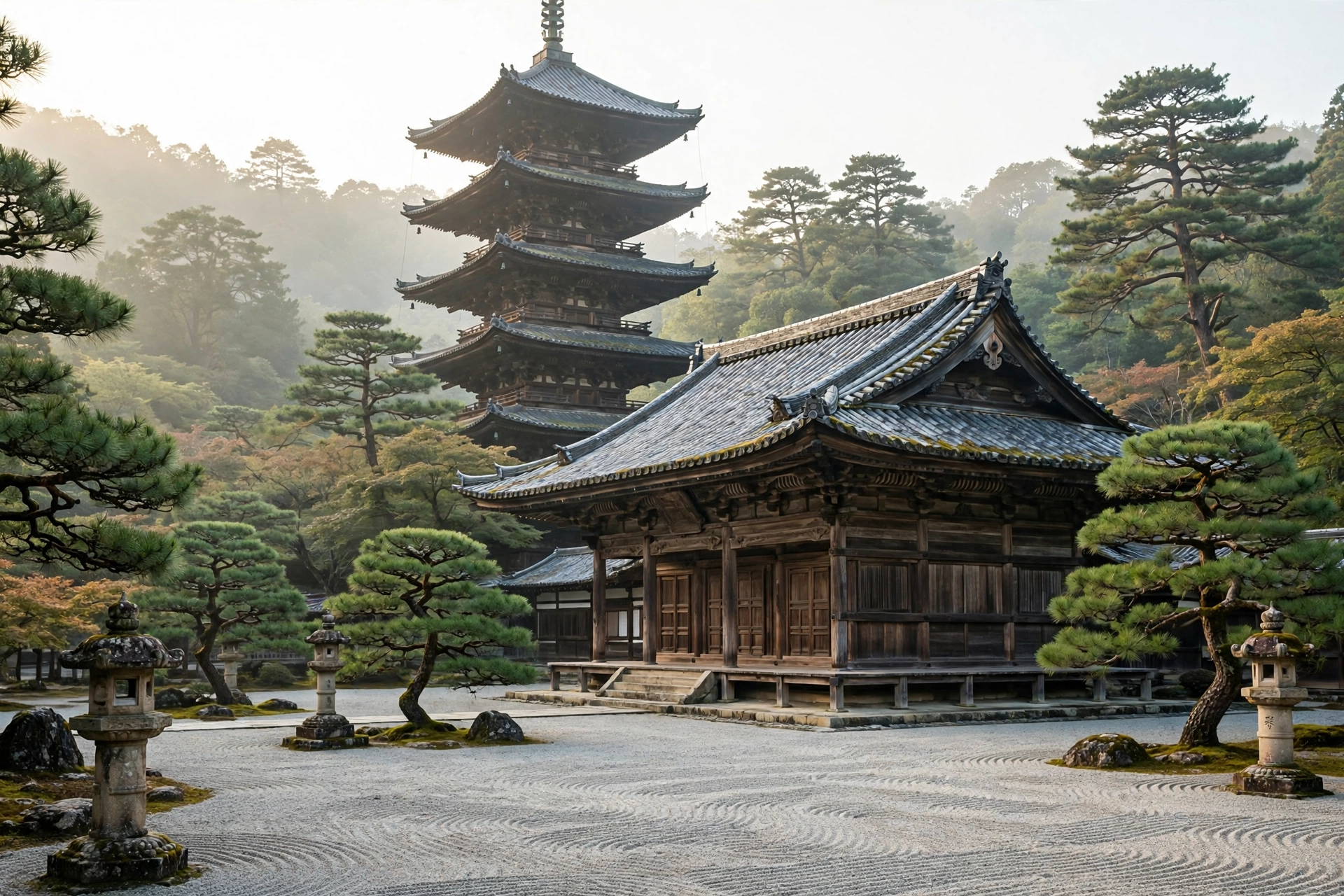
The point first: Horyuji in Ikaruga, Nara, preserves the world’s oldest surviving wooden buildings — the Kondo, Five-Story Pagoda, Chumon gate and corridors of its Western Precinct (Sai-in), all National Treasures. Founded in 607 by Empress Suiko and Prince Shotoku in fulfillment of Emperor Yomei’s vow, it was registered in 1993, together with Hokiji, as Japan’s first UNESCO World Cultural Heritage site under “Buddhist Monuments in the Horyu-ji Area.” About 190 items across the temple are designated National Treasures or Important Cultural Properties. No general guide to funerals, memorial services, perpetual memorials, interment or tree burials was found on its official site, and this article says so plainly.
I am Kurashiki Bouzu (kurashiki-bouzu), born in 1971, a former funeral professional now living in an old house in Kurashiki, Okayama, working with Moka, my AI butler.
This is one article in a series introducing temples across Japan, one temple at a time. This time it is Horyuji in Ikaruga Town, Nara Prefecture. This is not a record of a visit I made myself; it is an article organizing only confirmed facts from Horyuji’s official site and published sources of Nara Prefecture and the Agency for Cultural Affairs. Please read it as preparation before a visit.
Basic information
- Temple name: Horyuji. At its founding it is said to have also been called Ikaruga-dera. The official site’s title is “Head Temple of the Shotoku School, Horyuji”
- School: head temple of the Shotoku School
- Address: 1-1 Horyuji Sannai, Ikaruga Town, Ikoma District, Nara Prefecture
- Principal image: Shaka Nyorai (Shakyamuni). The Kondo enshrines the Shaka Triad. Nara Prefecture’s materials explain that, according to the inscription on its halo, this statue was made in 623 by Kuratsukuri no Tori for the repose of Prince Shotoku, and is said to reflect the Prince’s own figure
In 1993, Horyuji was registered, together with Hokiji, as Japan’s first World Cultural Heritage site, as “Buddhist Monuments in the Horyu-ji Area.”
History
Emperor Yomei vowed to build a temple praying for recovery from illness, but passed away; inheriting his wish, Empress Suiko and Prince Shotoku are said to have completed the temple in 607.
According to the Nihon Shoki, the temple burned down in 670, and it is thought to have been rebuilt afterward on the present site. The Agency for Cultural Affairs’ Cultural Heritage Online explains that the Kondo of the Western Precinct was completed by around 680 at the latest, followed by the Five-Story Pagoda, Chumon and corridors, with the whole temple complex complete by around 710.
The Eastern Precinct (To-in) is said to have been built around 739 by the monk Gyoshin on the site of the Ikaruga Palace. That two complete precincts, west and east, survive together after so many years is a great feature of this temple.
Highlights
The Kondo, Five-Story Pagoda, Chumon and corridors of the Western Precinct are regarded as the world’s oldest surviving group of wooden buildings, and are National Treasures. According to Agency for Cultural Affairs materials, 15 buildings in the Western Precinct are National Treasures and 6 are Important Cultural Properties.
The Eastern Precinct is centered on the Yumedono (Hall of Dreams, National Treasure). Agency materials list 3 National Treasures and 6 Important Cultural Properties in the Eastern Precinct. The Daihozoin (Great Treasure Hall) houses works such as the Mumei Kannon (Dream-Changing Kannon), and Nara Prefecture’s materials note that about 190 items across the whole temple are designated National Treasures or Important Cultural Properties.
The numbers of statues and treasures are overwhelming, not just the buildings. Within the world’s oldest wooden architecture, prayer from the Asuka period survives in physical form — that is where this temple’s particular weight lies.
The Western and Eastern Precincts each have their own central buildings and separate visiting routes. In the west, the Kondo and Five-Story Pagoda; in the east, the Yumedono — each lets you feel the air of its own era. Two precincts surviving within one temple ground is rare, and walking while checking the layers of time is one of the pleasures of visiting. For a first visit, the route from the Kondo and Five-Story Pagoda of the Western Precinct on to the Eastern Precinct is easy to follow, but please confirm the route in the official guide.
The figure of about 190 National Treasures and Important Cultural Properties also shows that this is not merely a temple where old buildings happen to survive. Because buildings, statues and treasures have survived together, the temple was chosen as a World Heritage site conveying Asuka-period culture to the present. The sheer size of the number can overwhelm, but when you think that each item has been protected across long years, the feeling of a visit changes too.
Events
- Oeshiki: March 22 to 24, at the Shoin (Hall of the Sacred Spirit). A service on the memorial days of Prince Shotoku’s death month. The dates were confirmed in other materials, but the full text of the official site’s events page could not be directly verified, so please reconfirm with that year’s official guide before going
- Special opening of the Yumedono and the standing statue of Kuse Kannon (Savior Kannon): in spring from April 11 to May 18, and in autumn from October 22 to November 22. The dates may change by year
- Ominugui (wiping of the sacred images): December 8. Confirmed in the event information of Nara Prefecture’s official tourism site
Event schedules may change by year. Please check the latest information on the official site.
Funerals and memorial services
As a former funeral professional, what draws my attention is guidance on funerals and memorials. In the range of Horyuji’s official site checked this time, no general guide to funerals, memorial services, perpetual memorials, interment or tree burials was found. To be honest, no such guide appeared on the official site.
There is guidance on prayers and wooden prayer tablets (shakugata ofuda), but that is separate from funeral services. The tradition that the Shaka Triad was made for the repose of Prince Shotoku stays with me as an old example of feelings for the departed taking physical form. But this article does not connect that to modern funeral guidance. Not writing what is not known is the rule of this series.
Practical information for a visit
From official and Nara Prefecture official tourism guides, the confirmed contents:
- Visiting hours: from February 22 to November 3, 8:00–17:00; from November 4 to February 21, 8:00–16:30. Reception closes 30 minutes before closing
- Admission (common to the Western Precinct, Daihozoin and Eastern Precinct): adults, university and high school students ¥2,000; junior high school students ¥1,700; elementary school students ¥1,000. Some materials state cash only
- Older pages of Nara Prefecture may still show former fees, so this article uses the current ¥2,000
Fees and hours may change. Please check the latest guide on the official site before going.
Finally, I will honestly leave what this article could not cover. The naming of the principal image differs by source, as “Shaka Nyorai” or “Shaka Triad.” This article centered on the Shaka Triad of the Kondo, but the difference in naming should be noted. The dates of the Oeshiki also require final confirmation in the official guide for that year. Separating what could be confirmed from what could not is, I believe, the promise that lets this series continue for a long time. Horyuji is known as the place where the world’s oldest wooden buildings survive, but its value lies not only in age — it lies in how prayer for Prince Shotoku took form and has continued to survive. With that feeling, I close this article.
Sources
- Horyuji official site
- Horyuji official, news
- Nara Prefecture, “Horyuji, built by Prince Shotoku inheriting his father’s wish”
- Agency for Cultural Affairs, Cultural Heritage Online, “Horyuji”
- Nara Prefecture official tourism site, Horyuji
- November 22, 2026 ― Published in English (translation of the Japanese article, ledger No. 2816)(6,734 characters)