
Koyasan Kongobuji — A Sacred Site of Japanese Buddhism Where the Whole Mountain Is the Temple
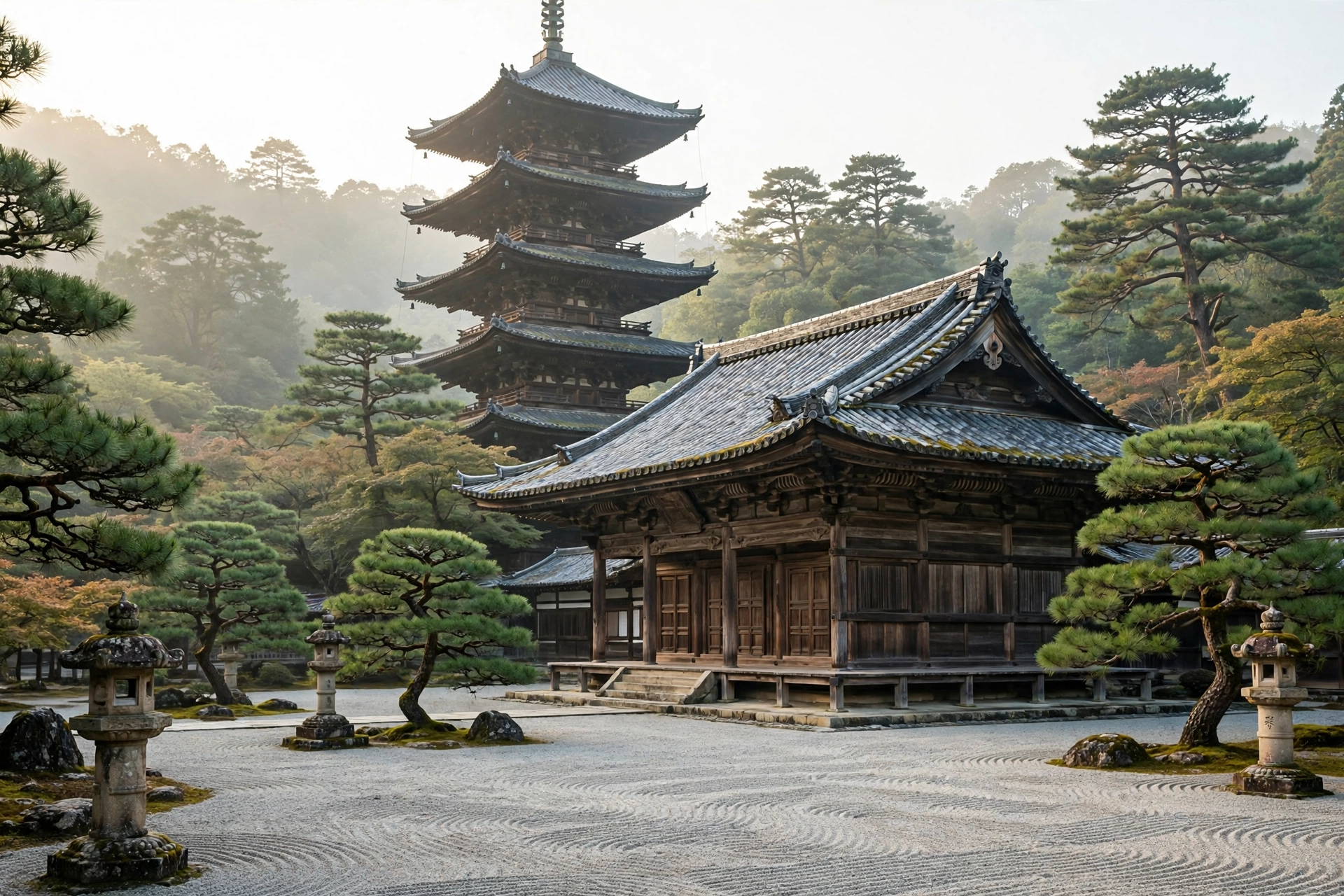
The point first — and the point most often misunderstood: at the head temple Kongobuji, sutra memorials and lamp memorials are accepted for up to one year, but perpetual memorials (eidai kuyo) are not accepted. The official guide directs people who wish for a perpetual memorial to consult a nearby temple or a temple within Mount Koya. Ash interment and memorials at Mount Koya are handled at Okunoin, regardless of sect. And “Kongobuji” itself, in official usage, refers to the whole of Mount Koya — the whole mountain is the temple — so this article does not name a single principal image for it.
I am Kurashiki Bouzu (kurashiki-bouzu), born in 1971, a former funeral professional now living in an old house in Kurashiki, Okayama, working with Moka, my AI butler.
This is one article in a series introducing temples across Japan, one temple at a time. This time it is Koyasan Kongobuji in Wakayama Prefecture. This article was organized from official published sources such as the temple’s official site; it is not an account of a visit I made myself.
Basic information
- Name: Koyasan Shingon School, Head Temple Kongobuji
- School: Koyasan Shingon School (head temple; officially introduced as encompassing more than 3,700 branch temples nationwide)
- Address: 132 Koyasan, Koya-cho, Ito District, Wakayama Prefecture 648-0294
- Telephone: 0736-56-2011 (main)
On the principal image, an important note applies. In official usage, “Kongobuji” refers to the whole of Mount Koya (the entire mountain precinct). This article therefore does not write “the principal image is this one statue.” As what could be confirmed hall by hall: Kobo Daishi is enshrined in the Jibutsuma (the room for the founder’s image), the principal image of the Kondo is Yakushi Nyorai (a hidden Buddha), and the principal image of the Konpon Daito is Taizo Dainichi Nyorai.
History
The official overview explains that “Mount Koya is a sacred site of Japanese Buddhism opened by Kobo Daishi at the beginning of the Heian period.” The name “Kongobuji” is said to have been taken by Kobo Daishi from a sutra, the “Kongoburokaku Issai Yuga Yugi Kyo.”
The founding story the official account transmits is this: when Kobo Daishi returned from Tang China, he threw a sanko (a three-pronged ritual implement), praying that it would show him the place to build his monastery, and the sanko was later found at the site of the present Danjo Garan. Led by a hunter with two dogs, one black and one white, he entered the mountains, met the local deity, and found the sanko caught in a pine tree; judging this place fitting for Shingon esoteric Buddhism, he resolved to open the mountain.
When we say Head Temple Kongobuji, it refers not to a single temple but to the whole of Mount Koya. Everywhere on Mount Koya is precinct land, and the whole mountain is the temple — that is the official explanation. What serves as its main hall is the Kondo of the Danjo Garan, where most important ceremonies are conducted. The sub-temples within the mountain are called tatchu temples; there are currently 117, of which 51 provide lodging as shukubo.
The present Kongobuji head temple building (the main hall building) originates in Seigan-ji, built in Bunroku 2 (1593) by Toyotomi Hideyoshi as the family temple for his late mother, which later merged with the neighboring Kozan-ji and was renamed Kongobuji.
Highlights
The Kongobuji head temple building was designated a national Important Cultural Property in January of Reiwa 6 (2024). Its Great Hall is a place for important rituals and services, with Kobo Daishi enshrined in the Jibutsuma at the back of the front. The stone garden Banryu-tei covers 2,340 square meters, described as among the largest in Japan, expressing a pair of dragons in a sea of clouds guarding the inner hall.
The Danjo Garan is the place Kobo Daishi set about preparing first when founding Mount Koya, and is said to represent the world of the Taizo Mandala. The Kondo is the head main hall of the whole mountain; the present building, completed in Showa 7 (1932), is its seventh rebuilding. The Konpon Daito is said to have taken two generations — Kobo Daishi and Shinnen Daitoku — and to have been completed around 816 to 887, and is regarded as the first building in the tahoto pagoda style in Japan.
Okunoin is the center of faith on Mount Koya, the sacred place where Kobo Daishi entered eternal meditation. Along the roughly 2 km path from Ichi-no-hashi bridge to the mausoleum, more than about 200,000 gravestones, memorial monuments and cenotaphs stand among cedar trees up to a thousand years old. In the Toro-do (Lantern Hall), the “inextinguishable fire” keeps burning, and dedications of merit and prayers are performed there.
Events
The main events from the official annual calendar: the Shushie from January 1 to 3 prays for the removal of disasters and invitation of good fortune, abundant harvests, and peace for the nation. The Sho-mieku on March 21 is the service on the anniversary of Kobo Daishi’s entering eternal meditation, held at Okunoin. Kechien Kanjo (the bonding consecration) is held in the Kondo — the Taizokai from May 3 to 5 and the Kongokai from October 1 to 3 — and can be received by clergy and laity alike. The Sosho Gotan-e on June 15 celebrates Kobo Daishi’s birth. At the Mando Kuyo-e (Candle Festival) on August 13, the approach from Ichi-no-hashi to Okunoin is adorned with the light of about 100,000 candles, memorializing all the spirits resting at Okunoin. The official site also cautions that events of the old calendar are carried out converted to new-calendar dates, so advance confirmation is necessary.
Funerals and memorial services
From the viewpoint of a former funeral professional, I will organize the memorial guidance. Memorials and ash interment on Mount Koya are handled at Okunoin. There are two methods of memorial, “sutra memorial” and “lamp memorial,” and both can be applied to all kinds, including ancestral memorials and mizuko memorials.
For interment of ashes, a sutra memorial of about one hour is held with the sponsor present, the party then moves together to the ossuary, and a monk places the ashes inside the hall. The ashes entrusted are basically the smaller portion (the throat Buddha bone); the full set of ashes cannot be accepted. And what matters is that interment is officially guided as open regardless of sect or school. A call to respect the wishes of the deceased and to decide after consulting well as a family is also attached. Reception requires no advance reservation, from 8:30 to 14:40.
Here, let me convey accurately a point that is easily misunderstood. At Head Temple Kongobuji, sutra memorials and lamp memorials are accepted for up to a maximum of one year, but perpetual memorials are not accepted. The official guide directs people who wish for a perpetual memorial to consult a nearby temple or a temple within Mount Koya. If you hear “perpetual memorial at Mount Koya” and assume Kongobuji itself accepts it directly, there will be a mismatch, so please take care. Memorial events include the cemetery general memorial and the Okunoin Great Segaki-e on May 21.
Practical information for a visit
Viewing of Kongobuji is 8:30–17:00 (reception until 16:30), and admission is ¥1,000 for junior high school students and above, ¥300 for elementary school students, and free for preschool children. A common inner-worship ticket covering five places — Kongobuji, the Kondo, the Konpon Daito, the Tokugawa Mausoleum and Jukai — is ¥2,500 for junior high school students and above. The Reihokan museum is ¥1,300 for general admission, 9:00–17:00, and the Toro-do at Okunoin is open 6:00–17:00. Around the New Year there are viewing restrictions and closures at the halls, so please check the official guide before you go.
Access is basically: from Nankai Namba Station, take the Nankai Koya Line to Gokurakubashi Station, then the Nankai Koyasan Cable to Koyasan Station, then a Nankai Rinkan bus into the mountain. Wheelchairs can be borrowed at places such as Kongobuji, but a guide also notes that not all visitable places are fully equipped with slopes and similar facilities.
Before your visit, please check the latest guidance on the official site.
Sources
- What is Head Temple Kongobuji (Kongobuji official)
- Guide inside the temple (Kongobuji official)
- Highlights of Mount Koya (Kongobuji official)
- Annual events (Kongobuji official)
- Fee table for Kongobuji-related places (Kongobuji official)
- Inquiries / FAQ (Kongobuji official)
- Kongobuji official site (top)
- See and meet Mount Koya (Koya Town Tourism Association)
- Transport access (Koya Town)
- Kongobuji (Wakayama Prefecture official tourism site)
- November 22, 2026 ― Published in English (translation of the Japanese article, ledger No. 2708)(7,230 characters)