
Saidaiji Kannon-in — A Koyasan Shingon Temple Known for Eyo, the Naked Festival (Okayama City)
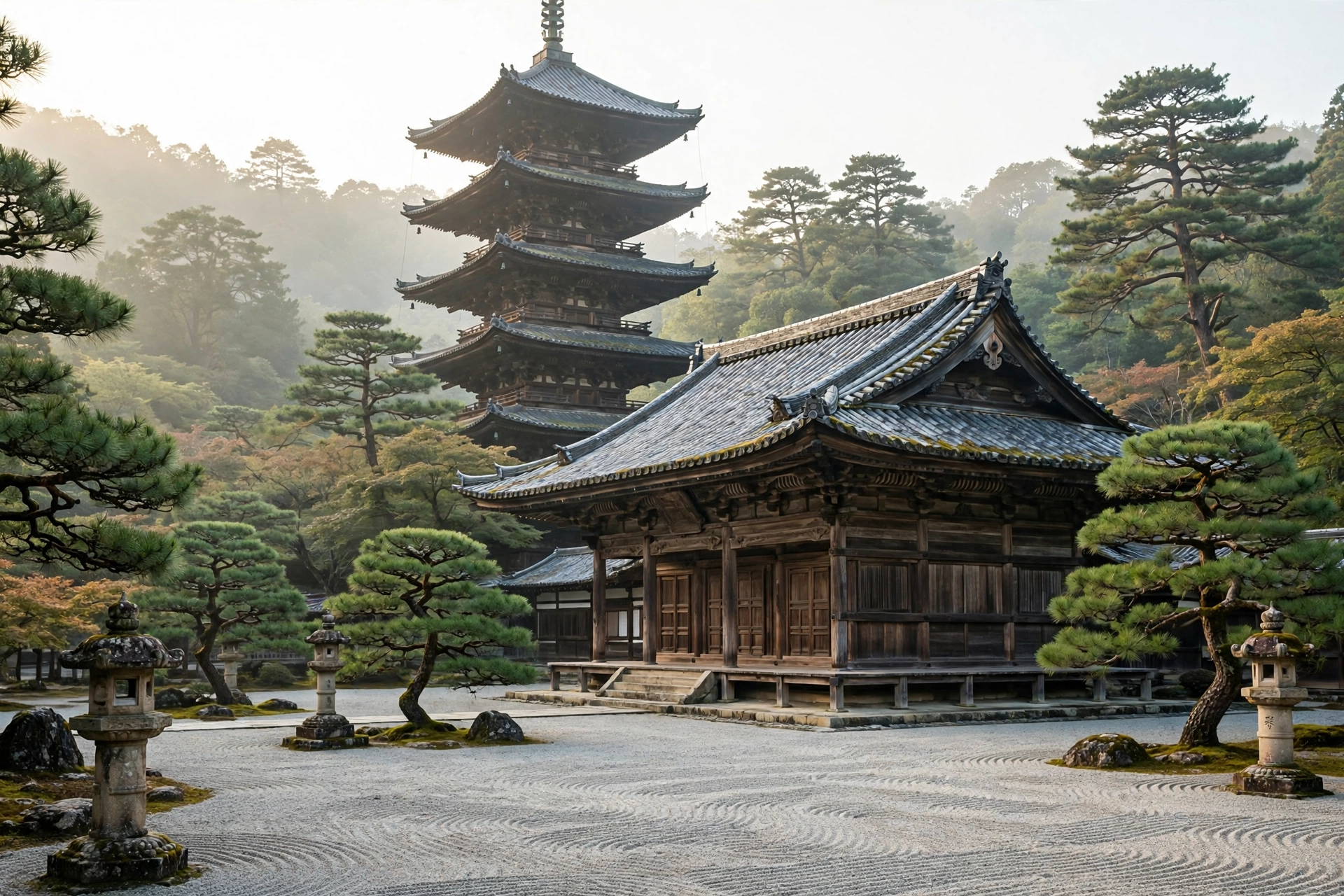
The point first: Saidaiji Kannon-in is best known for the Saidaiji Eyo, the “Naked Festival,” held on the third Saturday of February each year and designated a national Important Intangible Folk Cultural Property. Its principal image, a Thousand-Armed Kannon, is a hidden Buddha scheduled for a special unveiling in Reiwa 10 (2028), for the first time in 33 years. For memorials, this article covers only what is officially announced — notably the Renkado ossuary for perpetual memorials.
I am Kurashiki Bouzu (kurashiki-bouzu), born in 1971, a former funeral professional now living in an old house in Kurashiki, Okayama, working with Moka, my AI butler.
This is one article in a series introducing temples across Japan, one temple at a time. This time it is Saidaiji Kannon-in in Higashi Ward, Okayama City. This article was organized from official published sources; it is not a record of a visit I made myself, and I state that honestly at the outset.
Basic information
- Formal name: Kinryo-san Saidaiji. The main temple (honbo) is Kannon-in
- School: Special head temple of the Koyasan Shingon School
- Address: 3-8-8 Saidaiji-naka, Higashi Ward, Okayama City 704-8116
- Principal image: Senju Kannon (Thousand-Armed Kanzeon Bosatsu), a hidden Buddha
Saidaiji is also the first temple on the Chugoku Kannon pilgrimage. Its hidden principal image is scheduled, according to the guide, to be unveiled in Reiwa 10 (2028) for the first time in 33 years.
History
According to the official origin story, in Tenpyo Shoho 3 (751), Princess Fujiwara no Minataru opened a hermitage in the village of Kanaoka and enshrined a Thousand-Armed Kannon. While the statue was being carried by boat, the boat stopped moving at Matsunaka Island in Kanaoka-sho (present-day Kanaoka, Saidaiji); when the image was taken ashore the boat floated up, so it was taken as Kannon’s wish to remain in this place, and a hall was built to enshrine it. In Hoki 8 (777), Anryu Shonin built the temple halls, founded the temple, and named it Saida-ji, later changed to Saidaiji. The Kannon-bo became the main temple and, the origin story says, the present Kannon-in. The above is what the official site presents as its origin story.
Highlights
The main hall, built in Bunkyu 3 (1863), is an Important Cultural Property designated by Okayama City. It has one of the largest roofs in the prefecture, and because the Eyo is held there, its outer sanctuary is board-floored and fitted with the Gofuku-mado window. The Niomon gate, built in Genbun 5 (1740, by temple tradition), is a national Registered Tangible Cultural Property. The three-story pagoda, built in Enpo 6 (1678), is an Important Cultural Property designated by Okayama Prefecture. The Korean bell is a national Important Cultural Property, described as the largest Korean bell surviving in Japan.
Events
The best known is the Saidaiji Eyo, the so-called Naked Festival. It is a national Important Intangible Folk Cultural Property held on the third Saturday of February each year; the official site announced the 517th Eyo for Saturday, February 21, 2026. That is an example for 2026. Its origin goes back to Anryu Shonin transmitting the Shushie rite of Todai-ji, and in Eisho 7 (1510), when a guardian talisman was thrown down from above, people scrambled for it and ended up naked — that, tradition says, was the beginning. On the day, at the 22:00 conclusion, the sacred wooden stick (shingi) is thrown from the Gofuku-mado window.
In summer, the Yomachi Matsuri is held on the night of the third Saturday of July, and the Mizu Matsuri on the night of the third Saturday of August; the Mizu Matsuri includes floating lanterns to send off the spirits of the dead. There are also a Setsubun festival, ancestral memorials, a flower festival, and New Year’s Eve bell ringing.
Funerals and memorial services
The general form of a Koyasan Shingon funeral could not be confirmed this time from the school’s official sources, and whether this temple accepts general funerals is also unconfirmed. This article is therefore limited to perpetual memorials and memorial reception.
The Renkado ossuary stands in the precinct and can store ashes in their urns in units for individuals, couples and others. The official guide explains that many people choose it when there is no successor to a grave, or when care and management have become impossible. One official document also says tours are accepted every day from 10:00 to 16:00 by telephone or email reservation. Senju-in (Senju-do) was formerly used as a funeral hall and is now, the precinct guide says, familiar as a “dojo for memorial services.” At the Mizuko Jizo, mizuko memorials and prayers for safe childbirth are accepted at any time (reservation required), and reception for prayers and memorials is from 9:00 to 16:00, every day of the year.
Practical information for a visit
The halls in the precinct can be worshipped from outside 24 hours a day (restrictions apply during events such as the Eyo). The office is open every day of the year: sutra stamps (noei) from 8:30 to 17:00, and reception for hall viewing and for prayers and memorials from 9:00 to 16:00. Inner worship of the main hall and Gofuku-shoden is ¥500 for adults and ¥200 for children.
Access is a 10-minute walk from Saidaiji Station on the JR Ako Line, about 18 minutes from JR Okayama Station according to Okayama City. By bus it is about 30 minutes from the Okayama Tenmaya Bus Center. By car, there is parking in the precinct (the number of spaces differs by source, so this article does not state a figure).
Sources
- Saidaiji Kannon-in official site (top page) https://www.saidaiji.jp/
- Saidaiji Kannon-in official site, “Origin of Saidaiji” https://www.saidaiji.jp/about/engi/
- Saidaiji Kannon-in official site, “About the Thousand-Armed Kannon” https://www.saidaiji.jp/about/contents/senjyukannon/
- Saidaiji Kannon-in official site, “Precinct halls and surroundings” https://www.saidaiji.jp/about/precinct-guide/
- Saidaiji Kannon-in official site, “Cultural properties of Saidaiji” https://www.saidaiji.jp/about/cultural-assets/
- Saidaiji Kannon-in official site, “Eyo” https://www.saidaiji.jp/eyou/
- Saidaiji Kannon-in official site, “Greeting for the Eyo” https://www.saidaiji.jp/eyou/greeting/
- Saidaiji Kannon-in official site, “Annual events” https://www.saidaiji.jp/about/activity/
- Saidaiji Kannon-in official site, “Access” https://www.saidaiji.jp/access/
- Saidaiji Kannon-in official site, “Perpetual memorials / ossuary” https://www.saidaiji.jp/perpetual-memorial/
- Saidaiji Kannon-in official site PDF (ossuary tour guide) https://www.saidaiji.jp/cms/wp-content/uploads/2020/10/72ab242758d853c52423692a76757c6f.pdf
- Saidaiji Kannon-in official site, “Eyo live streaming” https://www.saidaiji.jp/live/
- Saidaiji Kannon-in official site, “About the Kannon pilgrimage” https://www.saidaiji.jp/about/contents/kannon-spirit/
- Okayama City official site, “Saidaiji Kannon-in” https://www.city.okayama.jp/higashiku/0000011671.html
- Okayama Prefecture official tourism site, “Saidaiji Kannon-in” https://www.okayama-kanko.jp/spot/detail_10183.html
- Agency for Cultural Affairs, “Designation of the Saidaiji Eyo as an Important Intangible Folk Cultural Property” https://www.bunka.go.jp/koho_hodo_oshirase/hodohappyo/pdf/2016011502.pdf
- November 22, 2026 ― Published in English (translation of the Japanese article, ledger No. 2645)(6,170 characters)