
Saijo Inari Myokyoji — A Nichiren Temple with a Torii Gate (Okayama City)
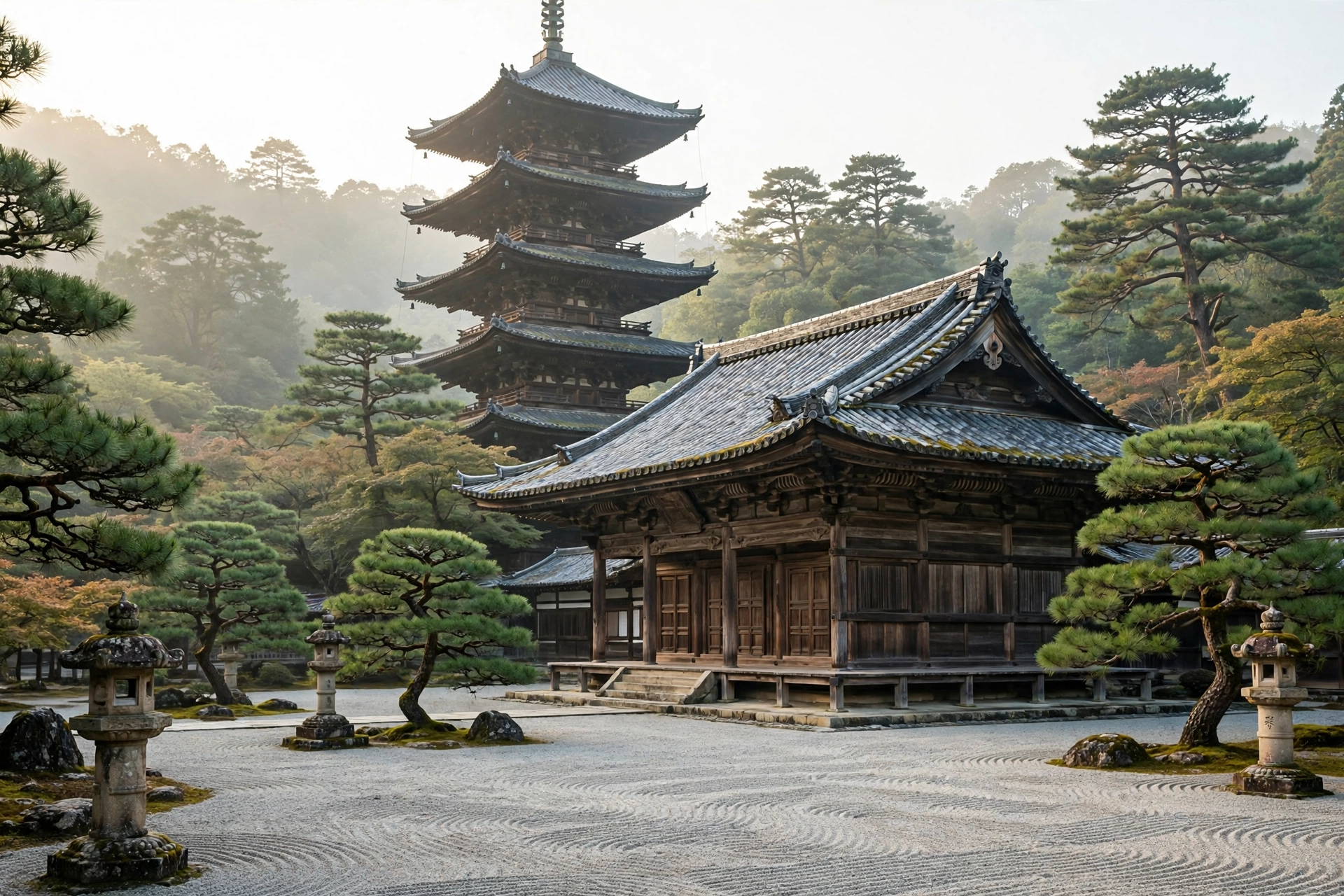
The point first: despite its name, Saijo Inari is not a shrine but a Nichiren temple — one that was specially allowed to keep a syncretic form after the Meiji separation of Shinto and Buddhism, so it has a torii gate and a shrine-style main hall. It is counted, in its official guide, among Japan’s three great Inari sites alongside Fushimi and Toyokawa, and it offers prayers, memorial services and perpetual memorial plans that are open regardless of sect.
I am Kurashiki Bouzu (kurashiki-bouzu), born in 1971, a former funeral professional now living in an old house in Kurashiki, Okayama, working with Moka, my AI butler.
This is one article in a series introducing temples across Japan, one temple at a time. This time it is Saijo Inari in Kita Ward, Okayama City. This article was organized from official published sources; it is not a record of a visit I made myself, and I state that honestly at the outset.
Basic information
- Formal name: Saijo Inari-san Myokyoji
- School: Nichiren School
- Address: 712 Takamatsu Inari, Kita Ward, Okayama City, Okayama Prefecture 701-1331
- Principal deity / prayer deity: Saijo Ikyo-o Daibosatsu, affectionately called “Saijo-sama”
Saijo Inari is also called the head temple of Saijo Inari, and its official guide counts it among Japan’s three great Inari sites alongside Fushimi and Toyokawa. The name makes people assume it is a shrine, but it is a Nichiren temple. When the Meiji government ordered the separation of Shinto and Buddhism, this temple was specially allowed to keep its syncretic form, so it has a torii gate and a main hall (Reikoden) that also has a shrine form. The three deities of the main hall are Saijo Ikyo-o Daibosatsu in the center, with Hachidai Ryuo-son and Sanmen Daikoku Sonten as attendants.
History
According to the official origin story, the temple began more than 1,200 years ago. In Tenpyo Shoho 4 (752), the monk Ho-on Daishi prayed on the eight-mat rock halfway up Mount Ryuo for the recovery of Empress Koken, and Saijo Ikyo-o Daibosatsu is said to have descended riding a white fox; the prayer was answered and the Empress recovered. In Enryaku 4 (785), by order of Emperor Kanmu, Ryuo-san Jingu-ji was built on the present site. The halls were later lost in the fires of the Bitchu Takamatsu Castle flood attack, but the statue of the principal deity alone is said to have escaped harm. In Keicho 6 (1601), Hanabusa-ko invited Nichien Shonin to restore the temple and renamed it Inari-san Myokyoji. The basis of its teaching is “anjin” — peace of mind — through faith in the Lotus Sutra. The above is what the official site presents as its origin story.
Highlights
The center is the main hall (Reikoden). The former main hall (Reio-den), rebuilt in Kanpo 1 (1741), is an Important Cultural Property designated by Okayama City. The precinct has 77 branch shrines; at the En no Massha, for good matches and for cutting bad ties, formal instruction in worship is given on the 7th of each month (except January). The stone Niomon gate was designated a Registered Tangible Cultural Property in Heisei 21 (2009). Other highlights are the Kansho-tei garden and the great torii, 27.5 m high and 2,800 t in total weight, built in Showa 47 (1972).
Events
The temple is known for Hatsumode, the first shrine-temple visit of the New Year, when the New Year Great Prayer Festival for Good Fortune is held. The Setsubun bean-throwing ceremony is one of its three great festivals; Okayama Prefecture’s official tourism guide for 2026 listed it on February 3 from 10:00 to 12:00, but that is an example for that year only.
Funerals and memorial services
For Nichiren funerals, the school’s official guide explains that a funeral is held so that the deceased can leave this world peacefully, and that holding it for the deceased is its first purpose. The flow proceeds through invocation, sutra chanting (the Lotus Sutra), guidance (indo), bestowal of a posthumous name, incense offering, chanting of the title (Namu Myoho Renge Kyo), and dedication of merit, with Reizan Jodo shown as the destination.
Whether this temple accepts general funerals could not be confirmed on its official site, so this article covers only the memorial services and perpetual memorials it officially announces. At this temple, prayer and memorial services are described as the two wheels of its faith. Memorial services are accepted at the prayer reception from 9:00 to 15:00 and performed in the Konpon Daido. Fees are from ¥10,000 per spirit for ancestral and pet memorials, and from ¥5,000 per spirit for mizuko (miscarried or stillborn children) memorials, with advance reservation required (amounts may change). The monthly ancestral memorial (Segaki-e) is held on the fourth Saturday of each month (except December and January) from 14:30 to 15:30 in the Konpon Daido, is open to worshippers regardless of sect, and costs from ¥5,000 (including tower memorial offerings).
For perpetual memorials, all plans allow pre-need contracts regardless of sect. Options include the Saijo Reibyo ossuary, the “Yasuragi” individual graves, the “Koshodo” communal grave, and the “Eidai Saijo Kuyo” tablet memorial.
Practical information for a visit
The official English page says entry to the precinct is possible 24 hours a day, every day of the year, and admission is free (except for some facilities such as the Kansho-tei garden). Prayer reception is from 5:30 to 16:30, and prayers are held at 6:00 and every hour from 9:00 to 16:00. Hours may change for events, so checking the official site before you go is recommended. The Kansho-tei garden is open from 9:30 to 15:00; admission is from ¥300 for adults and free for elementary school children and younger. Goshuin stamps are received at the prayer reception, for a donation of ¥500 or more each.
Access is about 5 km, or 10 minutes by car, from Okayama Soja Interchange. By train, get off at Bitchu-Takamatsu Station on the JR Momotaro Line (Kibi Line), about 2 km, or about 5 minutes by taxi. For parking, Okayama Prefecture’s official tourism site notes private parking around the temple (5,000 standard cars, large vehicles allowed, paid).
Sources
- Saijo Inari official site, “About Saijo Inari” https://inari.ne.jp/about/
- Saijo Inari official site, “First-time visitors” https://inari.ne.jp/first-time/
- Saijo Inari official site (top page) https://inari.ne.jp/
- Saijo Inari official site, “FAQ” https://inari.ne.jp/qa/
- Saijo Inari official site, “Guiding principles” https://inari.ne.jp/shishin/
- Saijo Inari official site, “Precinct guide” https://inari.ne.jp/guide/
- Saijo Inari official site, “Prayer guide and notes” https://inari.ne.jp/prayer/attention/
- Saijo Inari official site, “Memorial services” https://inari.ne.jp/memorial/kuyoattention/
- Saijo Inari official site, “Monthly ancestral memorial” https://inari.ne.jp/monthly/
- Saijo Inari official site, “Perpetual memorials and cemetery” https://inari.ne.jp/eidaikuyou/
- Saijo Inari official site, “Eidai Saijo Kuyo” https://inari.ne.jp/eidaikuyou/eidaisaijoukuyo/
- Saijo Inari official site, “Saijo Cemetery” https://inari.ne.jp/cemetery/
- Saijo Inari official site, “Tsuitachi-mairi” https://inari.ne.jp/tsuitachi/
- Saijo Inari official site, English page https://inari.ne.jp/en/
- Nichiren School portal, “About funerals” https://www.nichiren.or.jp/qa/funeral/
- Okayama Prefecture official tourism site, “Saijo Inari” https://www.okayama-kanko.jp/spot/detail_10003.html
- Okayama Prefecture official tourism site, “Setsubun bean-throwing ceremony” https://www.okayama-kanko.jp/event/detail_12822.html
- November 22, 2026 ― Published in English (translation of the Japanese article, ledger No. 2636)(6,374 characters)