
Do Not Put Your Face in the Coffin — Fatal Accidents from Carbon Dioxide from Dry Ice Are Happening
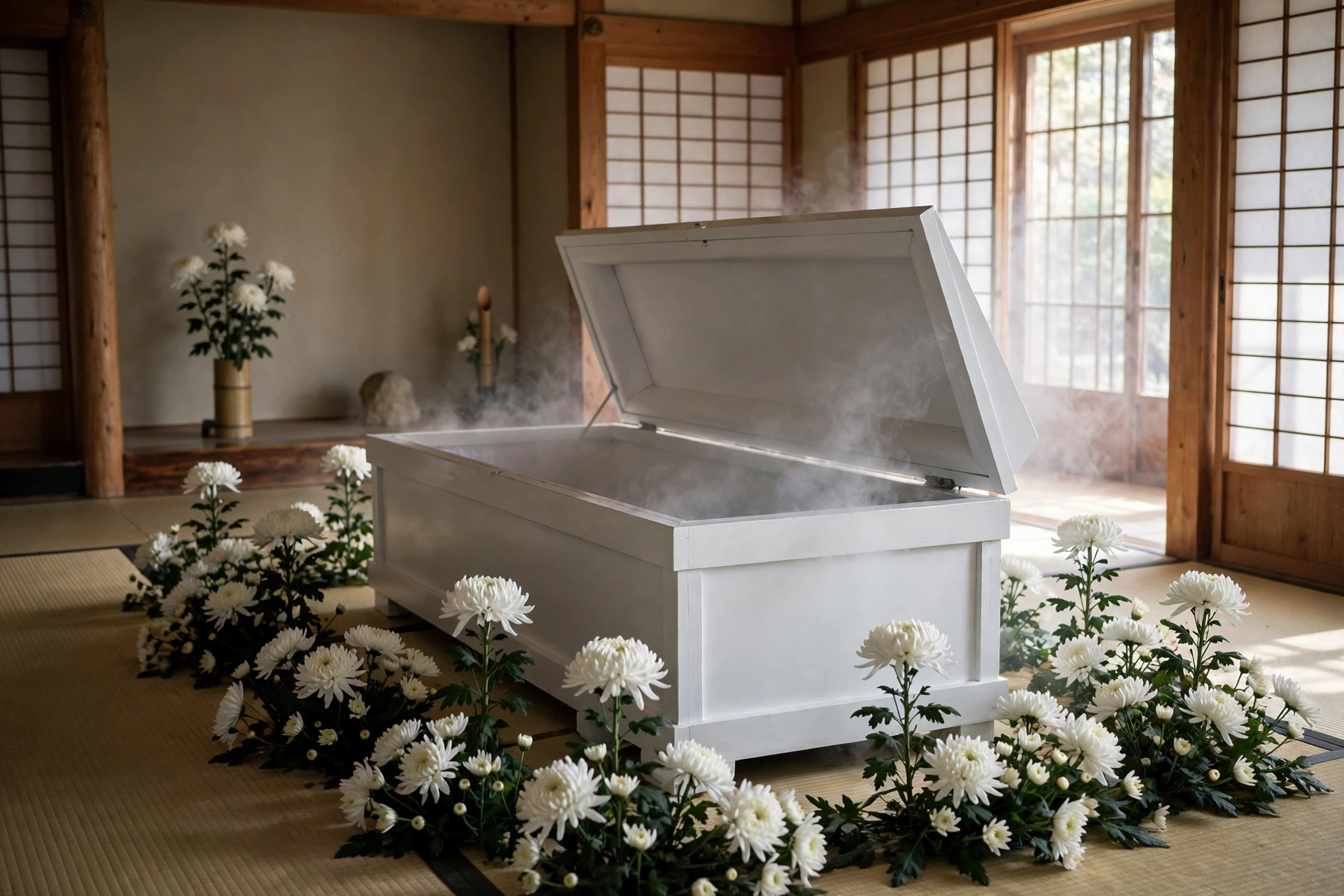
The result first: do not put your face inside a coffin. Dry ice placed in a coffin gives off colorless, odorless carbon dioxide, heavier than air, which pools inside. In an experiment, the concentration passed 30% — a level said to cause almost immediate loss of consciousness — 20 minutes after the lid was closed, and even after the lid was fully opened it stayed above 30% for about 50 minutes. Three fatal accidents suspected to be carbon dioxide poisoning were reported in 2020 and 2021, including a person who was only beside the coffin’s small window. At a farewell: keep your face outside the coffin, ventilate the room well, never keep the overnight vigil alone, and move away at once if you feel unwell.
I am Kurashiki Bouzu (kurashiki-bouzu), a former funeral home owner.
“Please do not put your face inside the coffin.”
This is an actual appeal issued by the Consumer Affairs Agency and the National Consumer Affairs Center of Japan. At a farewell, you want to see the deceased’s face up close, and to speak to them. As someone who was on the floor, I understand that feeling painfully well.
However, inside a coffin, invisible carbon dioxide is pooling. People have actually died.
Today I will organize those accidents and the experiment results. This is a rewrite, in today’s form, of an article I wrote in 2023 on my former site “Yuyu Jiteki.”
Three Fatal Accidents Have Happened
On September 21, 2023, the Consumer Affairs Agency and the National Consumer Affairs Center of Japan published a warning about carbon dioxide poisoning from dry ice inside coffins. Behind the publication was information on fatal accidents suspected to be carbon dioxide poisoning. According to reports, in 2020 and 2021, a total of three cases occurred in Miyagi, Miyazaki, and Okinawa prefectures.
The published circumstances of the accidents were as follows.
- At a funeral hall, a person was found unconscious beside a coffin filled with dry ice after opening its small window, and died at the hospital they were taken to
- At a funeral hall, a person was found with their face inside a coffin filled with dry ice, and death was confirmed at the hospital
- At home, a person was found with their face inside a coffin filled with dry ice, and death was confirmed
It was not only people who put their face inside. A person who was beside the small window also died.
In the Experiment, the “Immediate Loss of Consciousness” Concentration Was Reached in 20 Minutes
The National Consumer Affairs Center of Japan actually measured the concentration when dry ice is placed in a coffin. The experiment used four 2.5-kilogram blocks, about 10 kilograms in total.
- With the lid closed, 20 minutes after placement, the carbon dioxide concentration exceeded 30%, which is said to cause “almost immediate loss of consciousness”
- After 4 hours, it became almost constant at about 90%. The oxygen concentration fell, after 1 hour, to about 10%, which is said to cause loss of consciousness
- Even when the lid was fully opened from a state of about 90% concentration, after falling to about 60% immediately, the fall became gradual, and it stayed above 30% even after about 50 minutes
In other words, “the lid is open, so it is all right now” is not true.
The reason lies in the properties of carbon dioxide. Dry ice is solidified carbon dioxide, and 1 kilogram becomes about 500 liters of gas. That gas is colorless and odorless, and about 1.5 times heavier than air. So it flows into and pools in a low, closed place like a coffin. Because it has no smell and no color, you cannot notice you are breathing it in. And at high concentrations, the time from noticing you feel unwell to losing consciousness is very short.
Kurashiki Bouzu Demonstrated It Before Putting the Dry Ice In
On Kurashiki Bouzu’s floor, there was never a scene of hurriedly stopping a family after they had leaned their face toward a coffin. That is because we told them beforehand, before anything dangerous happened.
At encoffining, before putting in the dry ice, while demonstrating the posture of leaning one’s face toward the coffin, we said, “Please never do this.” Showing the posture conveys it better than words alone.
After the dry ice is put in, carbon dioxide pools inside the coffin. Once an accident happens, it cannot be undone. So the warning is not “stop them afterward,” but “tell them before putting it in.” That was the way on the floor.
What to Keep in Mind at a Farewell
Here is the appeal of the Consumer Affairs Agency and the National Consumer Affairs Center of Japan, lined up in the words of the floor.
- Do not put your face inside the coffin — Even when you want to speak to them, keep your face outside the coffin. The small window for seeing the deceased’s face, too: open it, but do not put your face inside
- Ventilate the room well — A coffin is not sealed, and carbon dioxide is also leaking into the room. Open windows and doors and make a flow of air
- Do not keep the overnight vigil alone — In case of emergency, watch together with several people where possible. Also avoid approaching the coffin after drinking alcohol
- If you feel unwell, move away from the coffin at once — Move to a well-ventilated place, and if there is any abnormality, call 119 immediately
- Ask the funeral home about anything you do not understand — Do not hesitate to check with the staff member in charge about how to open the coffin’s window or lid, and how to handle dry ice
Take particular care with children. They are short, and when they look into a coffin, their face easily goes straight inside. Carbon dioxide pools toward the bottom of the coffin — that is, at the height of a small person’s face.
Dry Ice Is Placed to Protect the Deceased
To avoid misunderstanding: dry ice is something necessary, placed to keep the deceased cool. What is dangerous is not placing it itself, but the amount, the handling, and how close you get at the farewell.
On the floor, most operators used the 10-kilogram package delivered by the supplier as it was. The amount of 10 kilograms used in the National Consumer Affairs Center of Japan’s experiment is close to that reality.
At Kurashiki Bouzu’s company, the standard was half of that: two 2.5-kilogram blocks, 5 kilograms in total. The place to put it was also decided: we placed it only on the abdomen, or around the esophagus. That is because dry ice works on the surface it touches. It was a way of placing it directly on the place we wanted to cool.
However, that does not mean half the amount is safe. Even with 5 kilograms, carbon dioxide pools inside the coffin. Regardless of the amount, not putting your face in is what matters.
If you are keeping your loved one at home and the family handles dry ice, all the more so. Ventilation, and not bringing your face close. Please be sure to keep these two (I also wrote the whole flow of keeping a loved one at home in the article “Can You Do a DIY Funeral Without a Funeral Home?”).
A final farewell with the deceased is a quiet, precious time. So that that time does not lead to another sorrow, please remember the appeal: “Do not put your face in the coffin.”
Sources and References
- Source article for transplant: “Do Not Put Your Face in the Coffin — There Is Also a Risk of Dying from CO2 Poisoning from Dry Ice” Yuyu Jiteki (September 22, 2023) https://nextlife358.com/monologue/20230921-kiken-doraiice-cyudokusi/
- National Consumer Affairs Center of Japan / Consumer Affairs Agency, “Beware of Carbon Dioxide Poisoning from Dry Ice Inside Coffins” (published September 21, 2023) https://www.kokusen.go.jp/news/data/n-20230921_1.html
- Consumer Affairs Agency, “Beware of Carbon Dioxide Poisoning from Dry Ice Inside Coffins” https://www.caa.go.jp/policies/policy/consumer_safety/caution/caution_071
- Related published article: “Can You Do a ‘DIY Funeral’ Without a Funeral Home?”
- November 18, 2026 ― English draft created (results-first rewrite of the Japanese article, ledger No. 60). Not published; publication is a separate step.(6,496 characters)