
A Hearse with a White License Plate Is Unlicensed — How to Tell a Licensed Vehicle
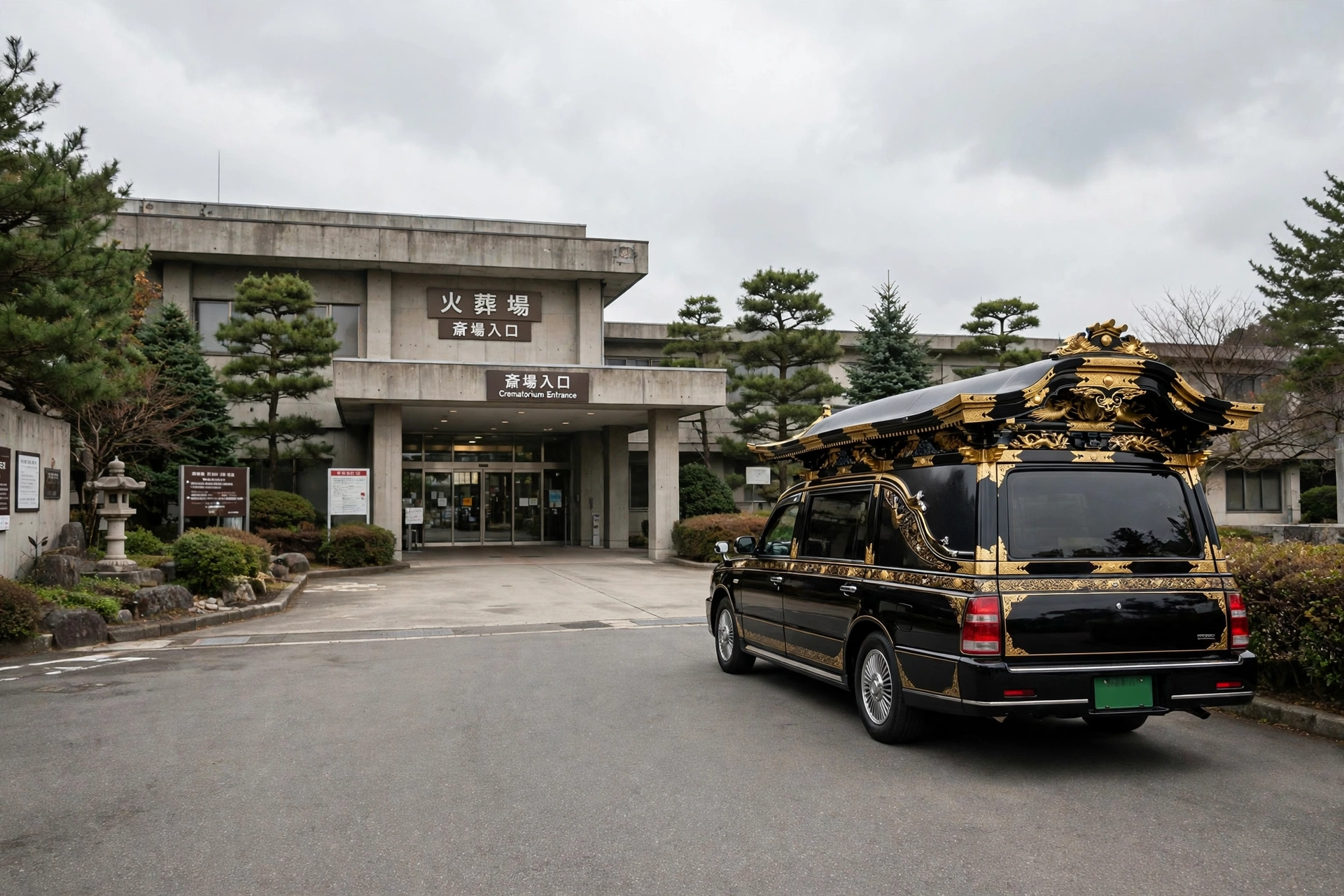
The result first: a hearse or stretcher vehicle that carries a deceased person for payment must have permission from the Minister of Land, Infrastructure, Transport and Tourism, and must carry a green commercial plate (a black plate for a light vehicle). Carrying a deceased person for payment with a white plate is an unlicensed operation. In 2017, five funeral companies were referred to prosecutors over exactly this. A family or friends carrying a loved one free of charge in their own car is not itself against the law — but in practice, most hospitals will not hand a body over to a private car, and most crematoriums will not accept one, so transport and departure are realistically work to leave to a licensed business.
I am Kurashiki Bouzu (kurashiki-bouzu), a former funeral home owner.
The car that comes to pick up your loved one at a hospital or at home, and the car that departs for the crematorium — have you ever noticed the color of its license plate?
For hearses and stretcher vehicles, the proper form is a commercial green plate (a black plate for light vehicles). Carrying a deceased person for payment while keeping a white plate amounts to unlicensed operation.
In 2017, there was a case in which operators were caught for exactly this “white plate” practice. Today I will organize that case, how the permission system works, and whether a family may carry their loved one themselves. This is a rewrite, in today’s form, of an article I wrote in 2017 on my former site “Yuyu Jiteki.” The original article contained an error in legal interpretation, and that part has been corrected in this transplant.
The 2017 “White-Plate Hearse Case”
In May 2017, five funeral companies in Tokyo and Kanagawa, and their owners, were referred to prosecutors. The suspected offense was violation of the Motor Truck Transportation Business Act (unlicensed operation).
The content was that they had used private cars without permission from the Ministry of Land, Infrastructure, Transport and Tourism as hearses and carried deceased persons. The starting point was information given to police by Kawasaki City in 2014 — “white-plate hearses are coming and going at the municipal crematorium” — and the Kanagawa Prefectural Police investigated for about two years.
What was the problem with being unlicensed? The National Hearse Association told interviews at the time that they had received consultations about operators charging more than double the going rate, and troubles such as a coffin being broken. An unlicensed operator is also hard for a transport branch office to crack down on. That is why it took a police action.
Why Is Permission Needed?
In law, a deceased person is treated as a “thing.” Therefore, the work of carrying another person’s body for payment is transport of “cargo,” and as a general motor truck transportation business (including permission limited to hearses), it requires permission from the Minister of Land, Infrastructure, Transport and Tourism. If operated with a light vehicle, a notification for a light motor truck transportation business is required.
Permission has requirements such as an office and garage, rest facilities for drivers, and vehicle structure, and it takes several months from application to start. Because it takes that effort, a licensed operator has safety, transparency of fees, and where responsibility lies in an accident guaranteed as a system.
Obtaining Permission Also Costs Money
The cost structure differs greatly between an ordinary passenger car and a light vehicle. First, the case of using an ordinary passenger car.
Behind operators who settle for a white plate, there is also this cost.
The registration and license tax paid to the state is 120,000 yen, and even combined with actual expenses such as the license plate fee, it is about 120,000 to 130,000 yen. Looking only at actual expenses, it is not a very large amount.
However, to actually start, that alone is not enough. If you ask an administrative scrivener, their fee applies. Furthermore, you must prepare enough funds to start the business, including vehicle purchase or lease fees, office and garage costs, insurance premiums, and labor costs. It varies greatly by conditions, but as a total initial cost for starting with an ordinary passenger car, about 3.5 million to 6 million yen is one guideline.
On the other hand, when obtaining a black plate with a light vehicle, the notification itself to the transport branch office has no fee. If you do the procedure yourself, actual expenses such as the license plate fee are about 2,500 to 10,000 yen. If you ask an administrative scrivener or similar, some offices charge tens of thousands of yen for the notification alone, but depending on the scope of the request, such as including the procedures for opening a hearse transport business, it can be 200,000 to 380,000 yen or more. In all cases, the vehicle cost is separate.
Not only money: permission for an ordinary passenger car takes several months from application to acquisition. Then operators appear who drift toward the judgment, “If we can carry with a white plate, let us keep it as it is.” That it costs money is no reason to be unlicensed. Still, one reason white plates do not disappear is the weight of this entrance.
By the way, how the cars are distinguished is also decided. A hearse is a car that carries the deceased placed in a coffin (the car at departure). A stretcher vehicle is a car that carries the body itself before it is placed in a coffin, and pickup from a hospital is done with this one. Both are subject to permission if they carry for payment.
The association also said there were cases among funeral companies that took on a funeral saying “body transport is free” and carried with a white plate. Even if it sounds “free,” if it is effectively included in the funeral price, it is no different from paid transport.
At Kurashiki Bouzu’s Company, We Moved from Outsourcing to a Black Plate, Then a Green Plate
Kurashiki Bouzu’s company (Dil) did not have its own cars from its founding either. At first, we outsourced transport to a specialist operator. After that, we came to have our own vehicles, and first obtained a black plate for a light vehicle. Next, we also obtained a green plate for an ordinary passenger car, and I did the permission and registration procedures myself, without asking an administrative scrivener.
Outsourcing itself is not a problem. What matters is whether the car and operator that actually carry are licensed. Even without your own cars, the form of leaving it to a licensed specialist operator is a proper form.
Also, on the floor, it was ordinary to see white-plate cars. It was not a rare sight. Of course, from the outside alone, you cannot tell whether that car was carrying for payment. Even so, there is meaning in checking the plate of the car that came, and it is here.
Is It Wrong for a Family to Carry Their Loved One Themselves?
This is the part the original article got wrong. I will write it correctly.
For family or friends to carry a loved one free of charge in their own car is not itself a violation of the law. Permission is needed in the case of “a business of carrying for payment in response to another person’s demand.” The view of the National Hearse Association is also that family are not “another person.”
However, the talk of law and the talk of the floor are different. From here is the reality of the floor.
- Hospitals ordinarily refuse to hand a body over to a private car. Even if they can hand over to a licensed stretcher vehicle, they cannot hand over to a private car — that is the hospital’s arrangement
- Most crematoriums do not accept delivery by private car. In Kurashiki Bouzu’s sense of the floor, 99% of crematoriums nationwide do not accept it. Today’s crematorium facilities are built in the form of receiving a coffin from a hearse
In other words, even if the law allows carrying, you are stopped at both the starting point (the hospital) and the destination (the crematorium). That is the reality. I wrote the details in the article “Can You Do a DIY Funeral Without a Funeral Home?”, but the conclusion is that transport and departure are realistically left to a business.
How to Tell a Licensed Vehicle
There are points you can check casually at pickup and departure.
- The color of the license plate — For an ordinary car, white characters on a green background (commercial); for a light vehicle, yellow characters on a black background. A white plate (a yellow plate for light vehicles) is a private car
- Markings on the vehicle body — A proper hearse or stretcher vehicle has markings showing it is commercial. Even if the appearance looks like a hearse, if the plate is white, it is a privately registered car
- The transport fee on the estimate — If a transport fee or vehicle fee appears on the estimate, but the car that came has a white plate, there is a possibility it is unlicensed
Recently, illustrated license plates have increased, and the colors have become harder to tell apart. If you are unsure, “Is transport done with a licensed car? Is it your own company, or outsourced?” is a fine question to ask at the meeting. Whether it is a funeral home that can answer clearly also becomes one way to judge them (I also wrote how to judge the staff member in charge in “5 Points to Judge Funeral Home Staff Skills”).
I understand well the wish to keep costs down. However, placing your precious person in an unlicensed car means placing them in a car with no guarantee of safety and responsibility. Kurashiki Bouzu thinks transport is the part of a funeral where “the meaning of leaving it to a business” shows most clearly.
Sources and References
- Source article for transplant: “‘White Plates’ Are Unlicensed Hearses!! Operators Referred to Prosecutors… Is It Also Wrong for Bereaved Family and Friends to Carry in a Private Car?” Yuyu Jiteki (May 17, 2017) https://nextlife358.com/life/funeral-related/funeral/20170517-white-number-plate-hearse-intrusion-prohibited/ (part of the legal interpretation was corrected in this transplant)
- Bengoshi.com News, “‘White Plate’ Unlicensed Hearse Operators Referred to Prosecutors… Is It Also Wrong for Bereaved Family and Friends to Carry in a Private Car?” (May 24, 2017, interview with the National Hearse Association)
- NHK News, “Funeral Operators Referred to Prosecutors for Using Unlicensed Cars as Hearses” (May 23, 2017)
- Reference for permission costs and funding requirements: Torasapo, “How to Obtain a Green Plate for Stretcher Vehicles (‘Hearse Only’)” https://tora-sapo.jp/journal/reikyu-ippankamotu/ / “Hearse Permission and Opening” https://kensetu-kyoka.com/unsou/hearse-permit-opening/ (the initial-cost guideline is for using an ordinary passenger car, and changes with how the vehicle is obtained and the conditions of the office and garage)
- Reference for light vehicle notification: Ministry of Land, Infrastructure, Transport and Tourism, Kinki Transport Bureau, “About Notification for Light Motor Truck Transportation Business (Black Plates)” https://wwwtb.mlit.go.jp/kinki/kyoto-honchosya/keikamotu.html (the notification itself is free; separate costs apply for items such as the vehicle inspection certificate and license plates)
- Related published article: “Can You Do a ‘DIY Funeral’ Without a Funeral Home?”
- November 18, 2026 ― English draft created (results-first rewrite of the Japanese article, ledger No. 59). Not published; publication is a separate step.(9,462 characters)