
Basics of Buddhist Statues — The Four Ranks of Nyorai, Bosatsu, Myoo and Tenbu, How to Tell Them Apart, and the Faces of the Nyorai
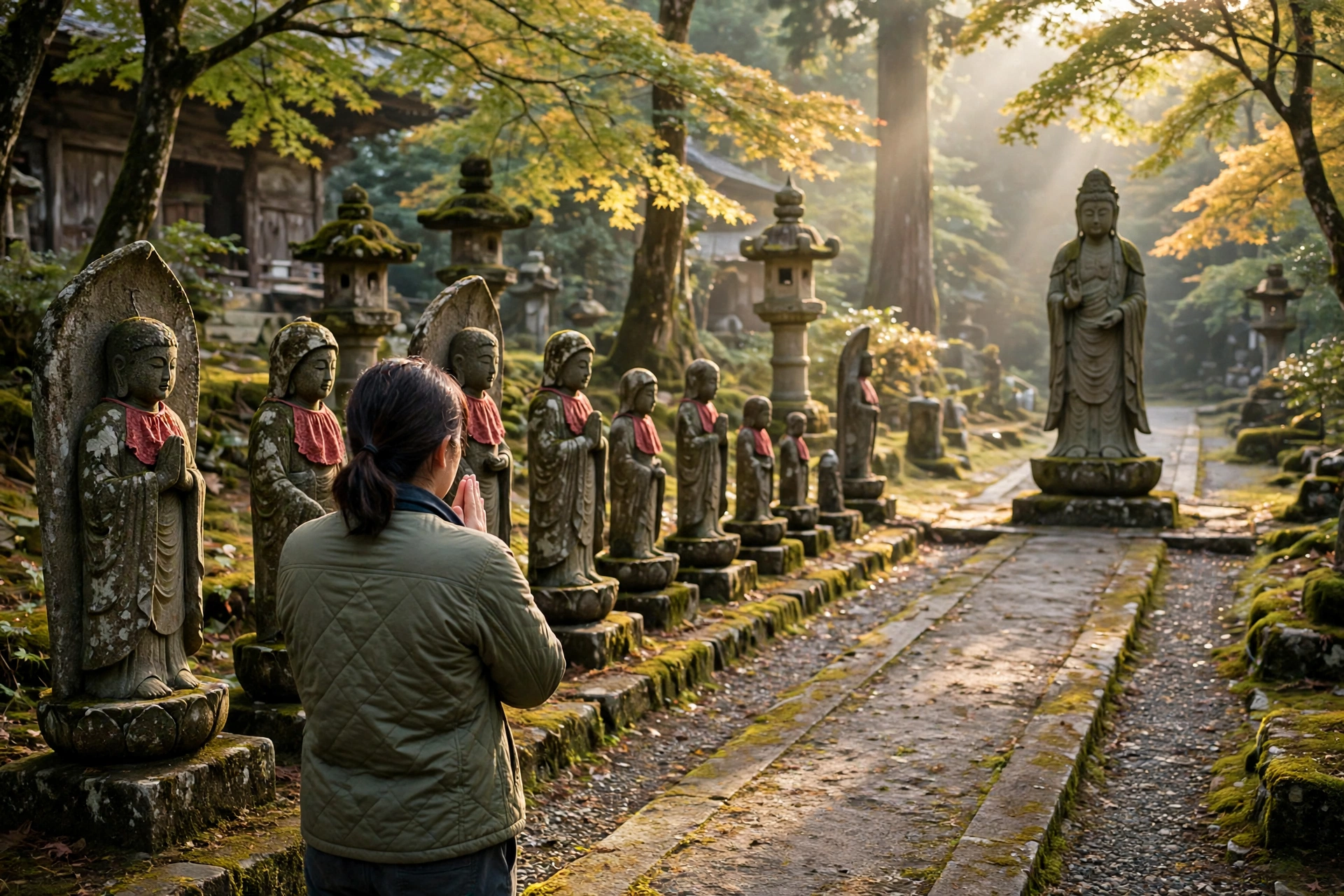
The result first: if you look at Buddhist statues by rank, they suddenly become easy to read.
- There are four ranks, from the top: Nyorai, Bosatsu, Myoo and Tenbu. The lower the rank, the closer the figure is to our daily life
- You tell them apart by four points: clothing and ornaments, expression, what they hold, and the shape of their hands (mudra). Plain dress points to a Nyorai, splendid ornaments to a Bosatsu, flames and an angry face to a Myoo, and armour to a Tenbu
- There are only two exceptions to remember. Dainichi Nyorai wears ornaments like a Bosatsu, and Jizo Bosatsu wears the plain dress of a monk
- The main Nyorai are Shaka, Amida, Dainichi (with Rushana) and Yakushi. Each carries a different answer to the question “what happens after we die?” — the cycle of rebirth and liberation, birth in the Pure Land, becoming a Buddha in this very body, and an answer to suffering in this life
I am Kurashiki Bouzu (kurashiki-bouzu), born in 1971, a former funeral director. I now live in an old folk house in Kurashiki, Okayama, and work together with Moka, my AI butler.
When you go to a temple, you meet many Buddhist statues. A large figure seated in the centre of the main hall, figures glaring from both sides of a gate, small Jizo statues lined up in a corner of a graveyard. You hear a name and think, “Ah, that statue,” yet when you stand in front of one, you can no longer tell who is who. I think everyone has had that experience.
This article is the fourth in a series organising knowledge about religions. It continues from the first article, on Christianity (Basics of Christianity — Catholic and Protestant, and Their Different Answers to “What Happens After We Die?”), and the second, on Buddhism (Basics of Buddhism and the Traditional Eight Schools), and after the previous article on Shinto, this time I organise “the eye for looking at the statues themselves.” If the articles on the schools were about “differences in teaching,” this one is about “differences in appearance.” The material is the record of “Knowledge of Religions” that I had Moka (my AI butler) assemble from published sources and organise. I explain difficult words briefly, where they appear.
Because there are so many faces among Buddhist statues, I will present them in three articles. In this first article, I look at the system of “ranks” and how to tell statues apart, and at the faces of the Nyorai, who stand at the top of the ranks. The second article is Bosatsu, Myoo and Tenbu — Those Who Reach Out a Hand, Those Who Stop You Even by Scolding, and Those Who Guard the Gate, and the third is Buddhist Statues We Meet in Daily Life — From Roadside Jizo to Amida in the Main Hall, and the Answers to “What Happens After We Die?”.
I will use the same measure as in the earlier articles. What shows the differences most clearly is the difference in the answer to “what happens to a person after death?” In fact, Buddhist statues each carry a different answer. A Buddha who comes to welcome you, a Bosatsu who goes around saving people, a Bosatsu of a promise to come in the future. In the introduction to each statue, I have added that statue’s answer briefly. A summary that gathers the answer of each statue in one place is in the third article. To look at a statue is also to look at the view of life and death of that temple and that family.
First, the whole picture — Buddhist statues are divided into four ranks
The basic arrangement is that Buddhist statues are divided, in order from the highest rank, into Nyorai, Bosatsu, Myoo and Tenbu.
To put it in a comparison:
- Nyorai: “the one who has arrived” — a person who has completed enlightenment
- Bosatsu: “the one who reaches out a hand” — a person who seeks enlightenment while reaching out to people
- Myoo: “the one who stops you even by scolding” — a person who stops even someone who will not listen, even if it means scolding them
- Tenbu: “the one who guards the gate” — originally gods of India who came over to the side of protecting the Buddha’s teaching
The lower the rank, the closer both the appearance and the role come to our daily life. The statues you meet as the principal image at a funeral or a memorial service are mainly Nyorai and Bosatsu. You meet Myoo and Tenbu more often in positions guarding a temple gate or a hall.
How to tell each rank apart — a quick-reference table
| Rank | Clothing and ornaments | Expression | Guide to what they hold and the shape of their hands | Representatives |
|---|---|---|---|---|
| Nyorai | Plain clothing only. No ornaments | Calm | The shape of the hands (mudra) is decisive. Yakushi holds a medicine pot | Shaka, Amida, Dainichi, Yakushi |
| Bosatsu | Ornaments like a prince. Wears a crown and necklaces | Gentle | A lotus flower, a wish-granting jewel, a water jar, and so on | Kannon, Jizo, Miroku, Monju, Fugen, Seishi |
| Myoo | Carries flames on the back and holds weapons | Angry expression | A sword and a rope (Fudo Myoo), and so on | Fudo Myoo, the Five Great Myoo |
| Tenbu | Armour of a warrior, or the form of a nobleman or a goddess | Various | A small pagoda, a biwa lute, weapons, and so on, by role | The Four Heavenly Kings, Bishamonten, Benzaiten, Ashura |
The order in which to look when you tell them apart is roughly these four points.
- Clothing and ornaments: If it is plain with no decoration, you can guess a Nyorai; if the ornaments are splendid, a Bosatsu; if it is armour, a Tenbu
- Expression: If it has an angry face and carries flames on its back, it is first of all a Myoo. It is no wonder if a child seeing one for the first time starts to cry, but as I write later, that is not a face that is simply “angry”
- What they hold: If it is a medicine pot, it is Yakushi Nyorai; if it is a pilgrim’s staff (shakujo, the staff a monk holds) and a wish-granting jewel, Jizo Bosatsu; if it is a biwa lute, Benzaiten — what they hold becomes a clue to the name
- The shape of the hands (mudra, inso): The way a Buddhist statue joins its hands and the shape of its fingers each carry a meaning. If the fingers of both hands make rings, it is the welcoming mudra of Amida Nyorai; if the fists are placed one over the other, it is the Chiken-in, the mudra of wisdom, of Dainichi Nyorai
There are, however, just two exceptions. If you hold on to these, the confusion becomes much smaller.
- Dainichi Nyorai is a Nyorai by rank, yet is shown in a form wearing ornaments, like a Bosatsu (this is a special treatment in esoteric Buddhism)
- Jizo Bosatsu is a Bosatsu by rank, yet is shown in the form of a monk with no ornaments (with a shaved head and a monk’s robe, a kesa)
If you add these two exceptions to the measure that “a Nyorai is plain, a Bosatsu is splendid,” you can get a good idea of most statues.
Nyorai — those who have arrived
Shaka Nyorai (Shakyamuni)
This is the form of the historical person Gautama Siddhartha after he attained enlightenment, and it is the starting point of Buddhism itself. The marks in his appearance are his tightly curled hair (rahotu) and the dot between his brows (byakugo). In the shape of his hands, there are the Seppo-in, the mudra of teaching; the Semui-in, which shows “do not fear”; and the Goma-in, the form in which he subdued demons just before enlightenment, among others.
Among statues that actually exist, the Shaka Triad in the Kondo (Golden Hall) of Horyu-ji (bronze, a National Treasure) is representative. It is said to have been made in 623 by the Buddhist sculptor Tori Busshi, with Shaka Nyorai in the centre and Bosatsu on both sides, in the form of a triad. As for the names of the Bosatsu on both sides, there is a commonly accepted view, but because I could not fully confirm an official statement by the temple this time, I will not state them definitively in this article and will write only of “the form of the Shaka Triad.”
The thread of the view of life and death is the cycle of rebirth (rinne) and liberation (gedatsu). It is the view that even after death, a person continues to wander in the world of delusion, and the teaching that there is an exit that sets you free from it. Shaka’s own death is called nyumetsu, entering nirvana, and pictures of nirvana (nehanzu), showing Shaka lying down surrounded by disciples and animals, remain in many places. This is the very foundation of the idea of memorial services.
Amida Nyorai (Amitabha)
Amida is the lord of the Pure Land of Ultimate Bliss in the west, a Buddha of immeasurable life (infinite lifespan) and immeasurable light (infinite light). The marks in his appearance are the Jo-in, in which the fingers of both hands make rings, and the Raigo-in, which shows the form of coming to welcome you. On both sides stand Kannon Bosatsu and Seishi Bosatsu, and together they are called the Amida Triad.
Among statues that actually exist, the seated statue of Amida Nyorai in the Ho-o-do (Phoenix Hall) of Byodo-in (a National Treasure) is representative. It was made in 1053 by the Buddhist sculptor Jocho, is regarded as the completed form of yosegi-zukuri, the technique of joining pieces of wood together, and is the only surviving statue that can be confirmed as Jocho’s work. The Ho-o-do itself is regarded as a building that copied the palace of the Pure Land of Ultimate Bliss into this world.
The thread of the view of life and death is ojo — birth in the Pure Land. It is the idea that a person who recites the nenbutsu is welcomed at the moment of death by Amida, who comes with his attendants (raigo, coming to welcome), and is reborn in the Pure Land of Ultimate Bliss. The point that it reread “death = the end” as “death = a departure for the Pure Land” created the atmosphere of funerals in Japan. The principal image of the Jodo School and Jodo Shinshu, which we saw in the article on Buddhism, is this Amida Nyorai.
Dainichi Nyorai (Mahavairocana) and Rushana Butsu (Vairocana)
Dainichi Nyorai is a Buddha who, in esoteric Buddhism, is regarded as “the universe itself.” The arrangement is that all Buddhas are manifestations of Dainichi, and he sits at the centre of two worlds (mandalas): the Kongokai (Diamond Realm) and the Taizokai (Womb Realm). The mark of Dainichi Nyorai of the Kongokai is the Chiken-in, in which the fists of both hands are placed one over the other, and the exception I wrote about earlier, “a Nyorai who wears ornaments,” is this Buddha.
Among statues that actually exist, the seated statue of Dainichi Nyorai at Enjo-ji in Nara (a National Treasure) is well known and is said to be an early work of the Buddhist sculptor Unkei. Here too, because there is a range in how firmly “a work by Unkei” can be stated, I keep the wording to “said to be an early work.”
Rushana Butsu is, in the teaching of Kegon, “the Buddha who is at the centre of the world and gives off light.” The representative example is the Great Buddha of Todai-ji (the seated statue of Rushana Butsu, a National Treasure). It was made at the wish of Emperor Shomu, and in 752 a kaigen kuyo — a ceremony to place a soul in the statue, an eye-opening service — was held. The height of the statue is about 15 metres. To give a familiar comparison for a large number, that is roughly the height of a five-storey building.
The thread of the view of life and death is sokushin jobutsu — becoming a Buddha in this very body. Esoteric Buddhism teaches that you do not go to the Pure Land after death, but can become a Buddha just as you are, in this body. It is a way of thinking that shifted the centre of gravity from salvation after death to salvation during life. The Great Buddha of Todai-ji is also an example in which a personal view of life and death spread into a prayer for the whole country, in that it was made as a prayer “to protect the whole country” in an age when epidemics and disasters continued.
Yakushi Nyorai (Bhaisajyaguru)
Yakushi is the lord of the Lapis Lazuli Pure Land in the east, a Buddha who heals illness and suffering. The mark is that he holds a medicine pot (yakko, a pot for medicine) in his left hand — if you see this, it is first of all Yakushi Nyorai. On both sides are Nikko Bosatsu and Gakko Bosatsu, and together they are called the Yakushi Triad. As protectors, he is attended by the Twelve Heavenly Generals, who appear later.
Among statues that actually exist, the Yakushi Triad in the Kondo of Yakushi-ji (bronze, a National Treasure) is representative. It is said to be a work of the Hakuho period (from the end of the 7th century to the beginning of the 8th century).
The thread of the view of life and death is an answer to suffering in this life. While Amida takes charge of “the destination after death,” Yakushi takes charge of “illness and pain while we are alive.” He is a Nyorai who takes charge of the “living side” of the view of life and death, and has also been prayed to as a Buddha who eases the suffering at the time of death.
Summary of the first article
- If you look at Buddhist statues by the four ranks — Nyorai, Bosatsu, Myoo and Tenbu — you can grasp the whole picture. The lower the rank, the closer they come to daily life
- The way to tell them apart is four points: clothing and ornaments, expression, what they hold, and the shape of the hands (mudra). For the exceptions, it is enough to remember just two: Dainichi Nyorai, who wears ornaments, and Jizo Bosatsu, who has the form of a monk
- The Nyorai are “those who have arrived,” and the basic faces are Shaka, Amida, Dainichi (and Rushana) and Yakushi. Their answers to “what happens after we die?” also differ from Nyorai to Nyorai: the cycle of rebirth and liberation, birth in the Pure Land, becoming a Buddha in this very body, and an answer to suffering in this life
In the second article that follows, I look at Bosatsu, Myoo and Tenbu: the Bosatsu who reach out a hand, the Myoo who stop you even by scolding, and the Tenbu who guard the gate.
In the third article, I line up again the statues we meet in daily life, such as the six Jizo by the roadside and the Mizuko Jizo in graveyards, and gather the answer of each statue to “what happens after we die?” in one place.
A note on this article
- 2026-11-18: English draft created (ledger No. 907). A results-first rewrite of the Japanese article (ledger No. 210, 4,562 characters), not a literal translation. Numbers, proper nouns and dates are unchanged from the Japanese original. The four-rank table, the four points for telling statues apart, the two exceptions (Dainichi Nyorai and Jizo Bosatsu), and the thread of “what happens after we die?” for each Nyorai are kept as in the original. Points that the canonical record itself notes as not fully confirmed (the names of the attendant Bosatsu of the Horyu-ji Shaka Triad, and how firmly the Enjo-ji Dainichi statue can be called a work by Unkei) are kept, as in the original, without definitive statements, as “said to be” and “the form of the triad.” The material is Chapter 9, “Basics of Buddhist Statues,” of the canonical “Knowledge of Religions” record, and was not remade twice.
- Publication note for this English version: this article is not in the three central groups for simultaneous Japanese–English publication (Moka-related, internet-related, picture books). Under the house rule, publication of this English version is to be after the AdSense review. This file is a draft only (draft: true) and has not been published or sent to git.
- November 18, 2026 ― English draft created (ledger No. 907; results-first rewrite of the Japanese article, ledger No. 210). Not published. This article is not in the three central groups for simultaneous English publication (Moka-related, internet-related, picture books), so publication of this English version is to be after the AdSense review, in line with the house rule.(12,731 characters)