
Buddhist Statues You Meet in Everyday Life — From Roadside Jizo to Amida in the Main Hall, and Each Statue's Answer to 'What Happens When We Die'
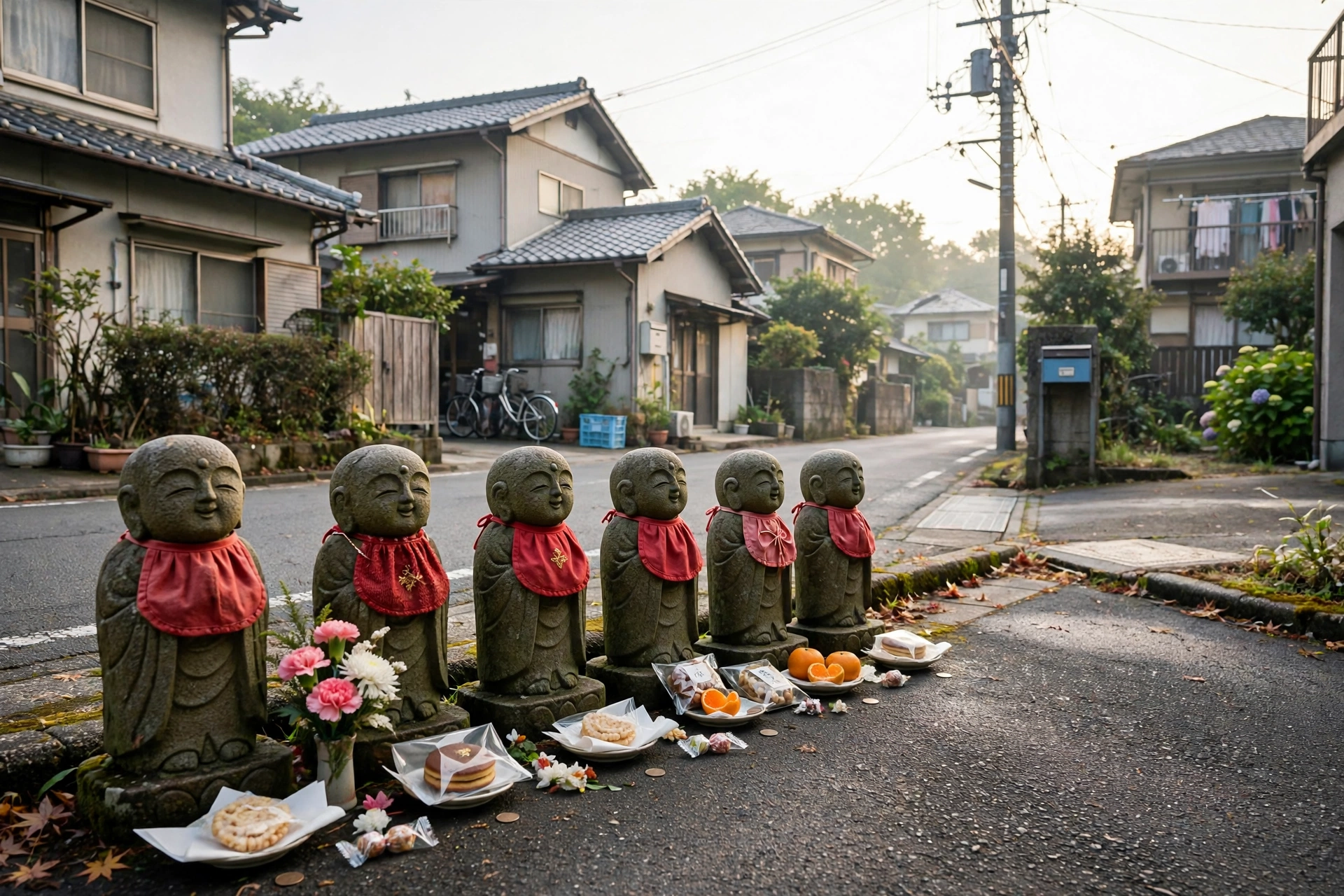
The result first: the Buddhist statues you meet in everyday life are not statues in a textbook. They are statues that are still receiving people’s prayers today, and each one carries a different answer to the question “What happens when we die?”
- The statues you actually meet are the six Jizo by the roadside, the Mizuko Jizo in a cemetery, Amida in the main hall of a temple, Kannon on a pilgrimage, and the guardians who stand at a gate or in the temple grounds
- Each statue’s answer is different — Amida comes to meet you, Jizo keeps going around to save people even after death, Yakushi takes on illness and pain while you are alive, and so on
- If you know who the main statue of a temple is, you can roughly see how that temple answers the question “What happens when we die?”
I am Kurashiki Bouzu (kurashiki-bouzu), born in 1971, a former funeral director. I now live in an old folk house in Kurashiki, Okayama, and work together with Moka, my AI butler.
This article is the third and last in the series “Basics of Buddhist Statues,” which organizes knowledge about religion. In the first article, Buddhist Statues: The Basics — The Four Ranks of Nyorai, Bosatsu, Myoo and Tenbu, How to Tell Them Apart, and the Faces of the Nyorai, I looked at how the ranks work, how to tell statues apart, and the Nyorai. In the second article, Bosatsu, Myoo and Tenbu — Those Who Reach Out a Hand, Those Who Stop You Even by Scolding, Those Who Guard the Gate, I looked at the Bosatsu, the Myoo and the Tenbu. In this article, I set aside memorizing names for a while and line up again the statues you actually meet in everyday life. And at the end, I gather in one place the answers to “What happens when we die?” — the measure that runs through this series — statue by statue. The material is the record of “Knowledge of Religions” that I had Moka (my AI butler) assemble from published sources and organize.
Buddhist statues you meet in everyday life — at funerals, cemeteries and by the roadside
Let me set aside memorizing names for a while and line up again the statues you actually meet in everyday life.
- The six Jizo by the roadside: Six Jizo statues standing in a row where a road leads to, or at the edge of a village. They are Jizo himself going around the Six Realms, and they often wear a red bib. They are a form of prayer in everyday life, wishing for safety on a journey and for salvation for those who have died
- The Mizuko Jizo in a cemetery: A place that receives prayers for mizuko — children who could not be born. The sight of flowers, sweets and toys offered in front of a small statue can still be seen at temples in many places today
- Amida in the main hall of a temple: In temples of the Pure Land schools, Amida Nyorai as the principal image stands at the center of funerals and memorial services. The teaching of raigo — that Amida comes to meet you — becomes the very atmosphere of the farewell
- Kannon pilgrimages and visits: Kannon pilgrimages such as the Saigoku Thirty-Three Temples are a form of folk faith that goes beyond schools. The prayer “Please hear my suffering now” is directed to Kannon
- The guardians at gates and in temple grounds: The Shitenno (Four Heavenly Kings), Fudo Myoo, Fujin (the wind god) and Raijin (the thunder god) are met at the gate, before you enter the hall. As figures who “firm up the outside” of the story of salvation, they protect the place
It seems to me that in the past, there were Jizo statues everywhere along the roads. Ever since I was small, I too would bow once as I passed in front of a Jizo statue. From childhood, when I knew neither the names nor the ranks, Jizo was a presence close to everyday life — someone you bowed your head to as you passed by.
From the eyes of a former funeral director, if you gain one more way of seeing statues at a temple or a cemetery, the way the place looks changes. That is because, from who the principal image is, you can roughly see how that temple answers the question “What happens when we die?”
The thread of views on life and death — each statue’s different answer to “What happens when we die?”
At the end, building on the rearrangement in the canonical record, I gather each statue’s answer in one place.
- Shaka Nyorai (Shakyamuni): Shows the way out of the cycle of wandering (samsara)
- Amida Nyorai: Death is a departure for the Pure Land (ojo — birth in the Pure Land). He comes to meet you
- Dainichi Nyorai (Mahavairocana): Without waiting for death, you become a Buddha in this very body (sokushin jobutsu)
- Yakushi Nyorai (Bhaisajyaguru): Takes on illness and pain during your life
- Kannon Bosatsu (Avalokiteshvara) and Senju Kannon (Thousand-Armed Kannon): Saves present suffering, without leaving out a single person
- Jizo Bosatsu (Ksitigarbha): Keeps going around to save people even after death. Children above all
- Miroku Bosatsu (Maitreya): In the far future, the time of salvation will surely come
- Fudo Myoo (Acala): Stops a wavering heart with an angry face
- Ashura (Asura): Prayers for the dead (tsuizen — memorial offerings for the repose of the dead) remain in the form of a statue
The reason the articles on Buddhism said that “the names for the afterlife and the ideas about memorial services differ from school to school” is that this answer to “What happens when we die?” differs from Buddha to Buddha. The lineup of statues is, just as it is, the lineup of views on life and death.
Summary
- If you look at Buddhist statues by the four ranks — Nyorai, Bosatsu, Myoo and Tenbu — you can grasp the whole picture. The lower the rank, the closer the statue comes to everyday life
- There are four points for telling statues apart: clothing and ornament, facial expression, what the statue holds, and the shape of the hands (mudra). The only two exceptions you need to remember are Dainichi Nyorai, who wears ornaments, and Jizo Bosatsu, who has the form of a monk
- The representative statues are: among the Nyorai, Shaka, Amida, Dainichi and Yakushi; among the Bosatsu, Kannon, Senju Kannon, Jizo, Miroku, Monju (Manjushri), Fugen (Samantabhadra) and Seishi (Mahasthamaprapta); among the Myoo, Fudo Myoo and the Godai Myoo (Five Great Myoo); and among the Tenbu, the Shitenno, Bishamonten (Vaishravana), Benzaiten (Sarasvati), Ashura, the Junishinsho (Twelve Heavenly Generals) and the Nijuhachibushu (Twenty-Eight Legions)
- The statues you meet in everyday life (the six Jizo by the roadside, the Mizuko Jizo in a cemetery, Amida in a main hall) are not statues in a textbook. They are statues that are still receiving prayers now
- Each statue has a different answer to “What happens when we die?” To look at a statue is to look at the view of life and death of that temple and that family
The next time you go to a temple, please try guessing just one thing first: “Which of the four ranks is this statue?” More than whether you get it right, the small effort of looking closely at the clothing and the shape of the hands brings you much closer to the statue.
A note on this article
- 2026-11-18: English draft created (ledger No. 919). A results-first rewrite of the Japanese article (ledger No. 213, final version of 2,001 characters, including the memory added after publication — that ever since childhood the author bowed once as he passed in front of a Jizo statue), not a literal translation. Headings, internal links (the /blog/ slugs are kept as in the original) and the gathering of the thread of “What happens when we die?” are kept. The material is Chapter 9, “Basics of Buddhist Statues,” of the canonical “Knowledge of Religions” record, and was not remade twice.
- Publication note for this English version: this article is not in the three central groups for simultaneous Japanese–English publication (Moka-related, internet-related, picture books). Under the house rule, publication of this English version is to be after the AdSense review. This file is a draft only (draft: true) and has not been published or sent to git.
- November 18, 2026 ― English draft created (ledger No. 919; results-first rewrite of the Japanese article, ledger No. 213, final version including the author's childhood memory of bowing before Jizo statues). Not published. This article is not in the three central groups for simultaneous English publication (Moka-related, internet-related, picture books), so publication of this English version is to be after the AdSense review, in line with the house rule.(6,544 characters)