
Kiyomizudera — The Stage of Kiyomizu, Kannon, and About 1,250 Years of Prayer
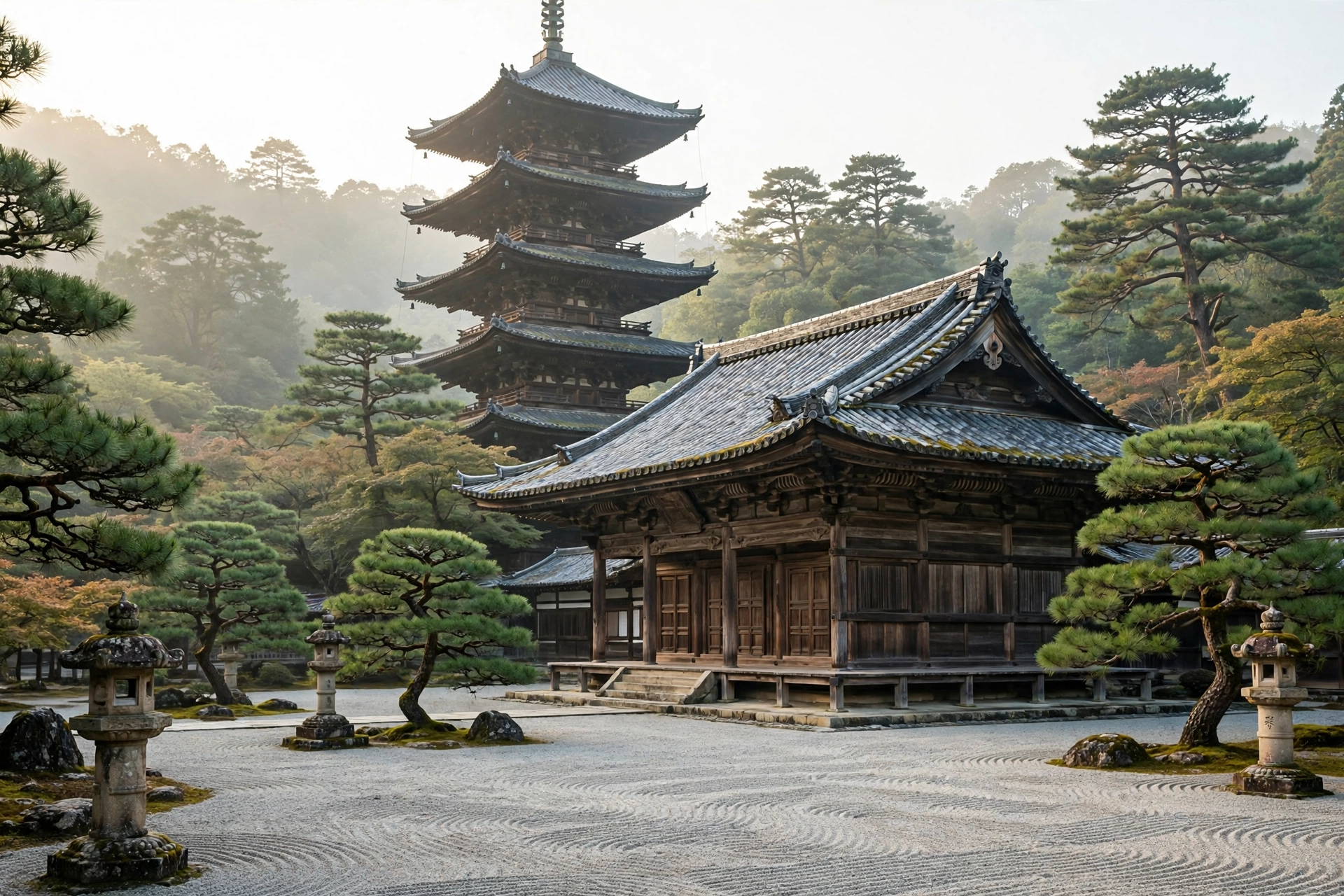
The point first: Kiyomizudera, founded in 778 — about 1,250 years ago — is the head temple of the Kita-Hosso School, enshrining the Eleven-Headed Thousand-Armed Kanzeon Bosatsu as a hidden Buddha, and is the 16th temple on the Saigoku Thirty-Three Kannon pilgrimage. Its main hall’s Stage of Kiyomizu, about 13 m high and built without a single nail, is its best-known feature. In 1994 it was registered as a World Cultural Heritage site as part of the “Historic Monuments of Ancient Kyoto.” For memorials, the officially held Higan-e ancestral services can be confirmed; the order of a Kita-Hosso funeral could not be confirmed in official sources, so this article does not describe it.
I am Kurashiki Bouzu (kurashiki-bouzu), born in 1971, a former funeral professional now living in an old house in Kurashiki, Okayama, working with Moka, my AI butler.
This is one article in a series introducing temples across Japan, one temple at a time. This time it is Kiyomizudera in Higashiyama Ward, Kyoto City. This is not a record of a visit I made myself; it is an article organizing only confirmed facts from Kiyomizudera’s official site and published sources of Kyoto City and Kyoto Prefecture. Please read it as preparation before a visit.
Basic information
- Temple name: Otowa-san Kiyomizudera
- School: head temple (Daihonzan) of the Kita-Hosso School
- Address: 1-294 Kiyomizu, Higashiyama Ward, Kyoto City, Kyoto Prefecture
- Principal image: Juichimen Senju Kanzeon Bosatsu (Eleven-Headed Thousand-Armed Kanzeon Bosatsu), a hidden Buddha. The official explanation describes it as a Kannon expressing great compassion with eleven expressions and forty-two arms, long called with affection “the Kannon of Kiyomizu”
Kiyomizudera is also the 16th temple on the Saigoku Thirty-Three Kannon pilgrimage. In 1994 it was registered as one of the World Cultural Heritage “Historic Monuments of Ancient Kyoto.” Its precinct covers 130,000 square meters, with more than 30 halls and pagodas standing in it.
History
Kiyomizudera’s founding is recorded in its official history as Hoki 9 (778) — about 1,250 years ago.
According to the official origin story, the monk Kenshin (later renamed Enchin), who had trained in Nara, walked north following a revelation in a spiritual dream and found, on Mount Otowa in Kyoto, a waterfall where pure water sprang forth. By the waterfall he met the old hermit Gyoei Koji, who was training there, received a sacred tree suited to carving a Kannon image, carved the statue, and guarded the sacred place. This pure spring is the later Otowa Falls. Two years later, the warrior Sakanoue no Tamuramaro, who had come to Mount Otowa to hunt deer, met Kenshin and, together with his wife Miyoshi Takako, built a temple enshrining the Eleven-Headed Thousand-Armed Kanzeon Bosatsu as its principal image, naming it “Kiyomizudera” after the purity of the waterfall.
Since its founding, its halls have been lost in more than 10 great fires, but each time they were rebuilt. Most of the present halls were rebuilt in 1633, and Kyoto Prefecture’s official guide attributes them to a donation by Tokugawa Iemitsu. As for its school, from the Hosso School of its founding, the Kita-Hosso School was established in 1965 by the then chief priest, Ohnishi Ryokei Osho, and the temple became independent as its head temple. Ohnishi Ryokei Osho is regarded as its restorer.
Highlights
The main hall (National Treasure) is a wooden building standing on the cliff of Mount Otowa, rebuilt in 1633. Its front stage, known as the “Stage of Kiyomizu,” is built in the kake-zukuri overhanging style, without a single nail, supported by 18 keyaki (zelkova) pillars more than 400 years old. The stage is about 13 m high, with a floor area of about 200 square meters. The official explanation says the stage was originally a place to offer performing arts to the principal image, Kannon.
The main gate, Niomon (Important Cultural Property), was rebuilt around 1500, and the three-story pagoda (Important Cultural Property) is about 30 m high, described as among the largest in Japan. Otowa Falls is the origin of the temple’s founding and the source of its name, a purifying water long called “Golden Water” and “Life-Prolonging Water.” There is a custom of scooping the clear water, falling in three streams, into a ladle and praying.
Other sights in the rich precinct include Zuigu-do, where you can experience the “womb pilgrimage”; Amida-do, said to be the place where constant nembutsu chanting was first performed in Japan; Okuno-in, built directly above Otowa Falls; the garden of Jojuin, known as the “Garden of the Moon”; and Koyasu-to, which has gathered faith for safe childbirth. Cherry blossoms are at their best from late March to early April, and autumn leaves from mid-November to early December (varying by year).
Events
From the official events guide, the main ones. Dates may change by year.
- Shunie: February 1 to 3. In the inner sanctuary of the main hall, sins are confessed before the principal image and their pardon is prayed for
- Seiryu-e: an event connected with the dragon, an incarnation of Kannon
- Gotan-e: April 8. The flower festival celebrating the Buddha’s birth, with memorial offerings of sweet tea
- Sennichi Mairi: August 9 to 16. A merit day of Kannon faith, where one day’s worship is said to carry the benefit of a thousand days. During this period, special viewing of the main hall’s inner sanctuary is also held
- Butsumyo-e: December 1 to 3
- Joya no Kane: December 31. The bell is struck 108 times, praying for the removal of worldly desires
Monthly events include Kannon ennichi (the 17th and 18th of each month) and Buddhist culture lectures continuing since 1966 (the second and fourth Sundays of each month). Special night viewing is also held in spring and autumn.
Funerals and memorial services
As a former funeral professional, what draws my attention is the memorial services. Among those officially held as events at Kiyomizudera, first is Higan-e. The official events guide states clearly that at the spring and autumn Higan, “a memorial service for the repose of all spirits of the three worlds and of ancestors is held.” It is an important, confirmable example of ancestral memorial services being officially held at Kiyomizudera.
In the Obon season, there are Urabon sermons (August 1 to 5), begun by Ohnishi Ryokei Osho in Taisho 4 (1915), which anyone may join. The Jizo Bon-e on August 23 is a memorial event holding a service at the Hyakutai Jizo-do.
There are also anniversary services for important figures, such as Kaisan-ki (May 23), the anniversary service for the founder Enchin Shonin and for Sakanoue no Tamuramaro, and Jion-e (November 13), the memorial service on the anniversary of Jion Daishi, the first patriarch of the Kita-Hosso School.
The order of a Kita-Hosso School funeral could not be confirmed in official sources, so this article does not describe it. Not writing what is not known is the rule of this series.
Practical information for a visit
Contents confirmed from the official site and public tourism guides:
- Visiting hours: gates open at 6:00. Closing is normally 18:00, and 18:30 in July and August. During spring and autumn special night viewing, closing is 21:30 (reception ends at 21:00). Granting at the amulet office and sutra office (goshuin) begins at about 8:00
- Admission: ¥500 for adults, ¥200 for elementary and junior high school students. This amount could not be confirmed in the text of Kiyomizudera’s official site, so I note here that it is the figure in public tourism guides such as Kyoto City’s official tourism Navi. Please check the latest amount in official guides before you go
- Access: from the city bus stops “Kiyomizu-michi” or “Gojo-zaka,” about a 10-minute walk
- Note on entry routes: the official access page warns that entry to the precinct is by only two routes — up Kiyomizu-zaka to Niomon, and up Chawan-zaka to the disaster-prevention road — and that map apps may show routes by which entry is not possible
- Closing days: none (basic information in Kyoto City’s official tourism Navi)
Sources
- Kiyomizudera official site
- Kiyomizudera official, “Prayer”
- Kiyomizudera official, “History”
- Kiyomizudera official, “Visiting / precinct guide”
- Kiyomizudera official, “Events”
- Kiyomizudera official, “Access / visiting hours”
- Kiyomizudera official, “Visiting hours guide”
- Kyoto City official tourism Navi, “Kiyomizudera”
- Kyoto City official tourism Navi, “Kiyomizudera (illumination and special night viewing)”
- Kyoto City official, World Heritage “Kiyomizudera”
- Kyoto Prefecture official, “World Heritage Kiyomizudera”
- Kyoto Prefecture Tourism Federation official, “Kiyomizudera Sennichi Mairi, special night viewing”
- November 22, 2026 ― Published in English (translation of the Japanese article, ledger No. 2699)(7,275 characters)