
Tenryuji — The Sogenchi Garden Borrowing Arashiyama as Scenery, Ranked First Among Kyoto's Five Great Zen Temples
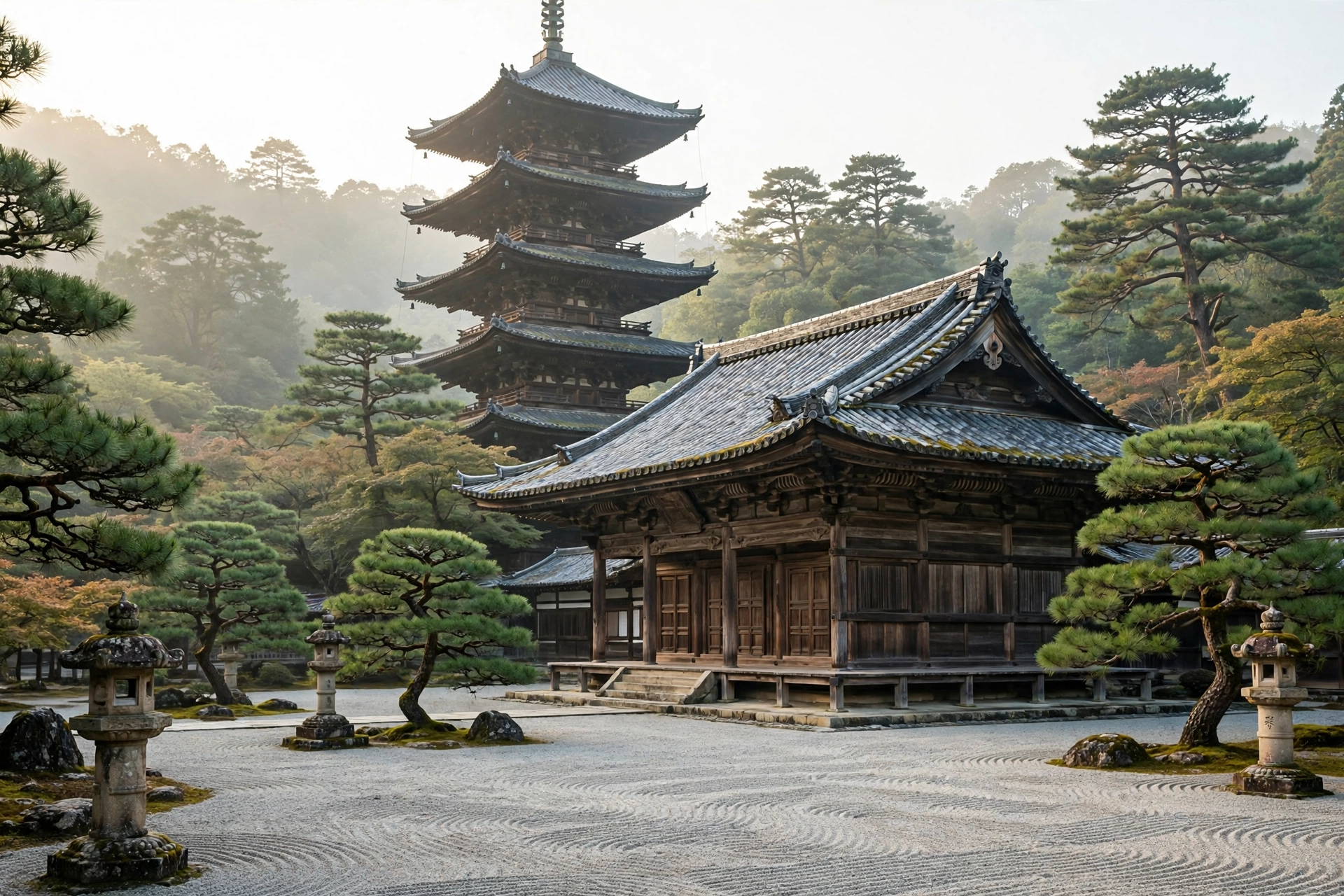
The point first: Tenryuji in Ukyo Ward, Kyoto, is the head temple (Daihonzan) of the Rinzai Tenryuji School and ranks first among Kyoto’s Five Great Zen Temples (Kyoto Gozan). It was founded in 1339 by Ashikaga Takauji, with Muso Soseki as founding priest, to hold memorial services for Emperor Go-Daigo, and was registered in 1994 as a UNESCO World Heritage site as part of the “Historic Monuments of Ancient Kyoto.” Its Sogenchi Garden, created by Muso Soseki and borrowing Arashiyama and Kameyama as scenery, survives from the founding, while most present main buildings are reconstructions from the Meiji period onward — the Great Hojo (Daihojo) was completed in 1899. The seated Shaka Nyorai in the Daihojo (Important Cultural Property) is described by the official site as the temple’s oldest Buddhist statue, having escaped eight fires. No general guide to funerals or memorial services for Tenryuji itself was found on its official site, and this article says so plainly.
I am Kurashiki Bouzu (kurashiki-bouzu), born in 1971, a former funeral professional now living in an old house in Kurashiki, Okayama, working with Moka, my AI butler.
This is one article in a series introducing temples across Japan, one temple at a time. This time it is Tenryuji in Ukyo Ward, Kyoto City. This is not a record of a visit I made myself; it is an article organizing only confirmed facts from Tenryuji’s official site and published sources of Kyoto Prefecture and Kyoto City. Please read it as preparation before a visit.
Basic information
- Temple name: Tenryuji. Its formal name is Reigizan Tenryu Shisei Zenji, and its mountain name (sango) is Reigizan (Mount Reiki)
- School: head temple (Daihonzan) of the Rinzai School, Tenryuji-ha. It ranks first among Kyoto’s Five Great Zen Temples
- Address: 68 Saga Tenryuji Susukinobaba-cho, Ukyo Ward, Kyoto City, Kyoto Prefecture
- Principal image: Shaka Nyorai (Shakyamuni). The seated statue of Shaka Nyorai enshrined on the altar of the Great Hojo (Daihojo) is an Important Cultural Property, regarded as a work of the late Heian period, and the official site explains it as the temple’s oldest Buddhist statue, having escaped eight fires. The Hatto (Dharma Hall) enshrines a Shaka Triad
In 1994, Tenryuji was registered as a UNESCO World Heritage site as one of the “Historic Monuments of Ancient Kyoto.”
History
On the site where Emperor Go-Saga’s Kameyama Villa once stood, Ashikaga Takauji founded this Zen temple in 1339 (Ryakuo 2) to hold memorial services for the repose (bodhi) of Emperor Go-Daigo, with National Teacher Muso (Muso Soseki) as founding priest. The founder (kaiki) is Ashikaga Takauji and the founding priest (kaisan) is Muso Soseki.
The well-known story that a trade ship with Yuan China (the Tenryuji Ship) was fitted out to supplement the construction costs could not be directly confirmed in the public materials checked this time, so this article does not describe it in detail.
Through repeated fires the main halls were lost; the present Great Hojo was completed in 1899, and the Kuri (priests’ quarters) also dates to 1899 (renovated in 2013) — most of the surviving main buildings are reconstructions from the Meiji period onward. While the garden survives from the founding, the buildings carry a history of repeated loss and rebuilding.
Highlights
The Sogenchi Garden is a pond-strolling garden created by Muso Soseki. It borrows Arashiyama and Kameyama as scenery, and the official site explains it as the first place in Japan designated a Historic Site and Special Place of Scenic Beauty.
The Cloud-and-Dragon painting (Unryu-zu) of the Hatto is a ceiling painting drawn in 1997 by Kayama Matazo, depicting a dragon within a circle about 9 m in diameter. The Great Hojo is the temple’s largest building (completed in 1899) and enshrines the principal image, the seated Shaka Nyorai (Important Cultural Property).
The Tahoden hall enshrines a statue of Emperor Go-Daigo; the present building is a reconstruction of 1934. There are also the Hyakka-en garden and Shounkaku / Kan’u-tei (teahouses, 1934). This is a temple to view slowly, both garden and buildings.
To add a little more: the Sogenchi Garden is a special place within Tenryuji — where most buildings are reconstructions from the Meiji period onward — because Muso Soseki’s garden design from the founding is conveyed to the present. The view taking in Arashiyama and Kameyama as borrowed scenery does not complete itself inside the garden alone; the surrounding mountains are included in a single landscape. That it is regarded as the first place in Japan designated a Historic Site and Special Place of Scenic Beauty also shows the height of its value.
It is also striking that the seated Shaka Nyorai enshrined in the Great Hojo is regarded as the temple’s oldest Buddhist statue, having escaped eight fires. Even when buildings burned, the statue remained, and around that statue the temple was built again. I think that repetition itself is the history of Tenryuji. The Hatto’s Cloud-and-Dragon painting is a new ceiling painting, a work of 1997, but at about 9 m in diameter it is large, and that an old garden and a new painting coexist in the same grounds is also part of this temple’s interest.
Events
- Zazen meetings: on the second Sunday of every month from 9:00, at Yuun-an. The official site guides that participation is free and no reservation is needed
- Special opening of the Hatto “Cloud-and-Dragon painting”: centered on Saturdays, Sundays and holidays, with periods of daily opening in spring and autumn. For 2026, materials guided March 1 to May 31 and September 19 to December 6 as daily opening periods
The dates of other annual events could not be confirmed on the official pages checked this time. When you go, please check that year’s official guide.
Funerals and memorial services
As a former funeral professional, what draws my attention is guidance on funerals and memorials. In the range of Tenryuji’s official site checked this time, no general guide to funerals, memorial services, perpetual memorials, interment or tree burials was found. To be honest, no such guide appeared on the official site. Note that sub-temples (tatchu) may handle these differently, so what is written here concerns the guide of Tenryuji itself.
Tenryuji itself is a temple founded to hold memorial services for the repose of Emperor Go-Daigo. That praying for the repose of a departed person stands at the temple’s beginning remains strongly with me as a former funeral professional. But this article does not connect that to modern funeral guidance. Not writing what is not known is the rule of this series.
Practical information for a visit
From the visiting guide on the official site, the confirmed contents:
- Garden visiting hours: 8:30–17:00 (reception until 16:50). For the halls, reception ends a little earlier, at 16:30, according to the guide
- Admission: the garden (Sogenchi and Hyakka-en) is ¥500 for high school students and above, ¥300 for elementary and junior high school students, and free for preschool children. The halls (Great Hojo, Shoin and Tahoden) are an additional ¥300 on top of the garden fee. The Hatto “Cloud-and-Dragon painting” is a separate ¥500 per person
- The halls have days when visiting is suspended for events and the like, so please check the official site before visiting
Fees and hours may change. Please check the latest guide on the official site before going.
Finally, I will leave what this article could not cover. The circumstances of the Tenryuji Ship could not be directly confirmed in the official and municipal materials checked this time, so I did not describe them in detail. An official annual list of events has also not been obtained, so events are limited to the zazen meetings and the opening of the Cloud-and-Dragon painting. The naming of the principal image also differs by source, so I wrote it together with its place — the Great Hojo and the Hatto respectively. I hope you will visit feeling the flow by which a temple born to mourn Emperor Go-Daigo still welcomes many people today together with the scenery of Arashiyama. You can choose garden-only visiting or visiting with the halls added, so please plan using the official guide according to your time. Whether placed at the center of a day walking Arashiyama, or visited as time to quietly face the garden, it is a temple that can receive you in either form.
Sources
- Tenryuji official site, visiting guide (English version)
- Tenryuji official site, precinct guide (English version)
- Kyoto Prefecture, “World Heritage Tenryuji”
- Kyoto City, “Tenryuji”
- November 22, 2026 ― Published in English (translation of the Japanese article, ledger No. 2852)(7,170 characters)