
The Photographs Move, and at the End There Is Only One Bow — Another Kind of Web Funeral I Was Thinking About at 25
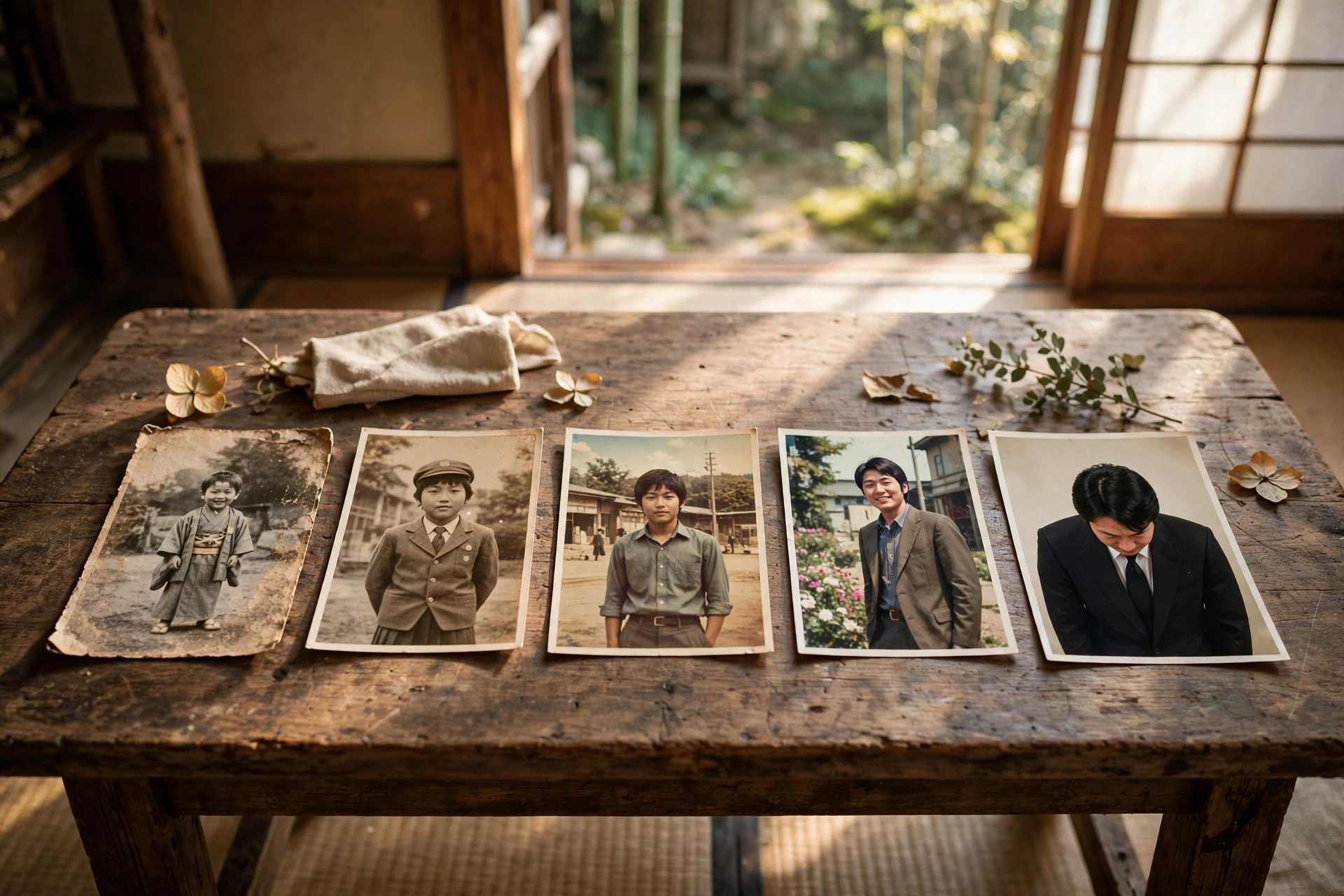
The result first: the Web funeral I was thinking about at 25 does not make the deceased speak. Photographs from childhood to the final days move quietly in chronological order, and in the last scene the person themselves bows slowly once. There are no words and no voice; only one word, such as “Thank you,” appears as a caption. Even now that services that reproduce a deceased person with AI to move, speak and smile have appeared, my line remains before that: movement is only the one bow, and words the person did not say in life are not made to be spoken in that person’s voice and mouth. The purpose is only to leave the deceased in the hearts of the people who sent them off.
I am Kurashiki Bouzu.
I am a former funeral home owner.
This time, I will write about a Web funeral I was thinking about when I was 25 years old. I was born in 1971, so this is a story from around 1996 to 1997. At that time, I was doing something like work making homepages. In an era when the internet was still rare, it was fun to think about what could be done inside a screen, and as an extension of that, I was also thinking about funerals.
I wrote about making a virtual funeral hall in another article. This one is the other one, the story of the video. Let me write honestly first: this is not a story of “I made it.” Technical matters aside, it is a recollection that I had an image. It is not a story of invention, nor of a world first. I would like you to read it only as a story that, about 30 years ago, when I was young, I was thinking that it would be nice if there were such a form.
Not Live — A Video in Which Photographs Move
What I was thinking about at the time was not broadcasting a ceremony live. The form of filming a real funeral hall with a camera and showing it to people far away was not in my head.
What I imagined was photographs of the deceased. Starting with photographs from childhood, then boyhood, youth, the working years, and up to the appearance before death. The photographs line up in chronological order and move quietly, like a video. If I say a video like those shown at a wedding, it may be close. The memorial video that plays during a ceremony — that is it.
However, in my image, that video was not an accompaniment to the ceremony. The video itself came to the center. The people who gathered quietly see that person’s life from the beginning to the end. That is in the middle of the funeral. It was neither a broadcast for people who cannot come to the funeral hall, nor a video to keep as a record; it was a form in which seeing itself becomes the farewell.
In today’s words, I think it would be called a Web funeral. For me, who was making homepages at the time, if a ceremony were to be held inside a screen, this video came to mind first.
At the End, One Bow. That Is the Message
How that video ends was decided in my mind.
In the final scene, the deceased person themselves bows slowly. And there are no words. There is no voice either. Only one word, such as “Thank you,” appears in letters as a caption. And it ends there.
A bow is an ordinary gesture that everyone has done many times in life. Thank you, I am sorry, please take care of me. Japanese people have conveyed more than words by bowing their heads. The deceased bows their head just once at the end. That figure itself becomes a message to the people who gathered. That was the form I was thinking about.
I thought there was no need to add words. If they are words the person said in life, a recording or video may remain. However, making new words the person did not say and making the deceased speak them from their mouth is a different story. The one word in a caption is letters. It is different from making the deceased’s voice. That difference, in the present era, seems to have become clearer instead.
The Line of Not Making Them Speak
The technology to move photographs appeared in the world about 25 years after I was thinking about it. In 2021, MyHeritage’s system called “Deep Nostalgia” spread. It became possible to make videos in which the face in an old photograph blinks, moves its head, and smiles.
Furthermore, in December 2024, a service called “Revibot” came out from Alpha Club Musashino. Based on photographs, home videos and voice data of the deceased, it reproduces the deceased with AI and makes a video in which they move, speak and smile toward you. The initial fee is 99,800 yen, and in as short as three days, a video of about a minute and a half can be made, it is said. A use in which the deceased speaks to the mourners at their own funeral is also put forward. Now, on TikTok and elsewhere, I often see videos in which old photographs have become color and are speaking words. Technology has overtaken my image and gone far ahead.
I do not say this service is bad. If there is a family who asks for it and mourners who are glad, that is one form in its own way. On the providing side as well, it seems that a “dialogue type,” in which the deceased returns words when spoken to, is technically possible, but they deliberately do not offer it. I hear it is out of consideration for the fear that, in grief, people may come to rely entirely on an AI deceased, and that “forgetting” is also an important process. Having done funeral work, I understand that feeling well.
However, my line is much before that. I do not make them speak, in any case. The movement is only the one bow. I do not make words the deceased did not say in life be spoken in that person’s voice and mouth. If you cross there, it catches on the side of ethics. Between a photograph moving a little and speaking words, there is a large step. My form is in the opposite direction from today’s technology. It is a story of deciding what not to do, rather than doing everything because more has become possible.
And a service that moves photographs from childhood to the end in chronological order, closes with the final bow, and places that video at the center of a funeral is, as far as I have looked, not found even now in 2026. My view is that probably no one is doing it.
Only to Leave Them in the Hearts of Those Who Sent Them Off
Why is one bow enough? Why are words unnecessary? The reason is that the purpose is small.
What I was thinking about was only to leave the deceased in the hearts of the people who sent them off. Nothing more than that.
There is one more thing: this form also has no condolence money. You watch the video, receive the final bow, and it ends there. There was no scene of wrapping money from the beginning. The virtual funeral hall I thought about was the same. I think both of the farewells I was thinking about were forms in which money did not move. What was there was the sharing of time to remember the deceased.
It is not about continuing to keep data. It is neither making a splendid page and storing it, nor making it possible to call up the deceased’s figure at any time. Inside the hearts of the people who watched the video, that person’s figure from childhood to the end, and the final bow, remain. After returning home, they remember it at an unexpected moment. With that, its role is finished.
When you do funeral work, you meet many feelings of families who “want to keep” things. Photographs, videos and keepsakes are all precious things. However, the more things there are to keep, the heavier sending off can become in some cases. Conversely, what remains in the heart is light. The figure of one bow needs no capacity and no monthly fee. It is only placed in the hearts of those who saw it.
There is one more thing I have felt on the funeral floor. What truly remains in people’s hearts at a place of farewell is often a small gesture rather than a splendid device. The trembling of a hand placing a single flower on the coffin, the figure of the family quietly bowing their heads at the end. Such a moment remains as a memory even after many years. That the video I was thinking about closed its end not with a showy production but with one bow may also be because, somewhere, there was that feeling that I could not put into words when I was young. Photographs flowing in chronological order is tracing that person’s life. And the final bow is a closing, directed from the side of that life toward those who see them off. The farewell of the watching side and the thanks of the deceased’s side overlap in one scene. I thought that words are not needed there.
The more you do, the further you move from the original purpose. I think my form is small not only because there was no technology, but because that was all the purpose was.
As a Trial, I Made It With My Own Figure
While talking about this story with Moka, my AI butler, we decided to try making it. The role of the deceased is me myself. Using Kurashiki Bouzu’s avatar, we made figures in order from childhood and lined them up.
Starting with the figure from childhood, then the time at 25, the era when I was making homepages. Next, the figure from when I was doing funeral work. And the present me. At the end, in my present figure, I bow slowly, and only one word, “Thank you,” appears as a caption. It is a 30-second video with no sound.
When I saw the finished result, I felt a strange feeling. A picture that was in my head about 30 years ago is, in form only, before my eyes. Of course, this is a trial work. It is not something to use at a real funeral, and I am still alive. Still, I felt that the quietness between a photograph moving and bowing at the end was close to what I had been thinking about. Because there are no words, there remains room for those who watch to layer their own memories. That room itself may be the place that remains in the heart.
Technology will continue to advance. Making the deceased speak will also become more natural, I think. Even so, the form of not making them speak, of only one bow, will not become old. I have now written down and left here the small image I thought of at 25.
Thank you for reading.
Sources
- ITmedia (article on funeral DX including Revibot) https://www.itmedia.co.jp/business/articles/2609/30/news026_2.html
- Toyo Keizai, “The Reality of Online Funerals You Can Also Attend From Home” (@ Funeral) https://toyokeizai.net/articles/-/380780
- November 18, 2026 ― English draft created (results-first rewrite of the Japanese article, ledger No. 113). Not published; publication is a separate step.(8,306 characters)