
A Former Funeral Home Owner Explains: 5 Points to Judge a Funeral Staff Member's Skill
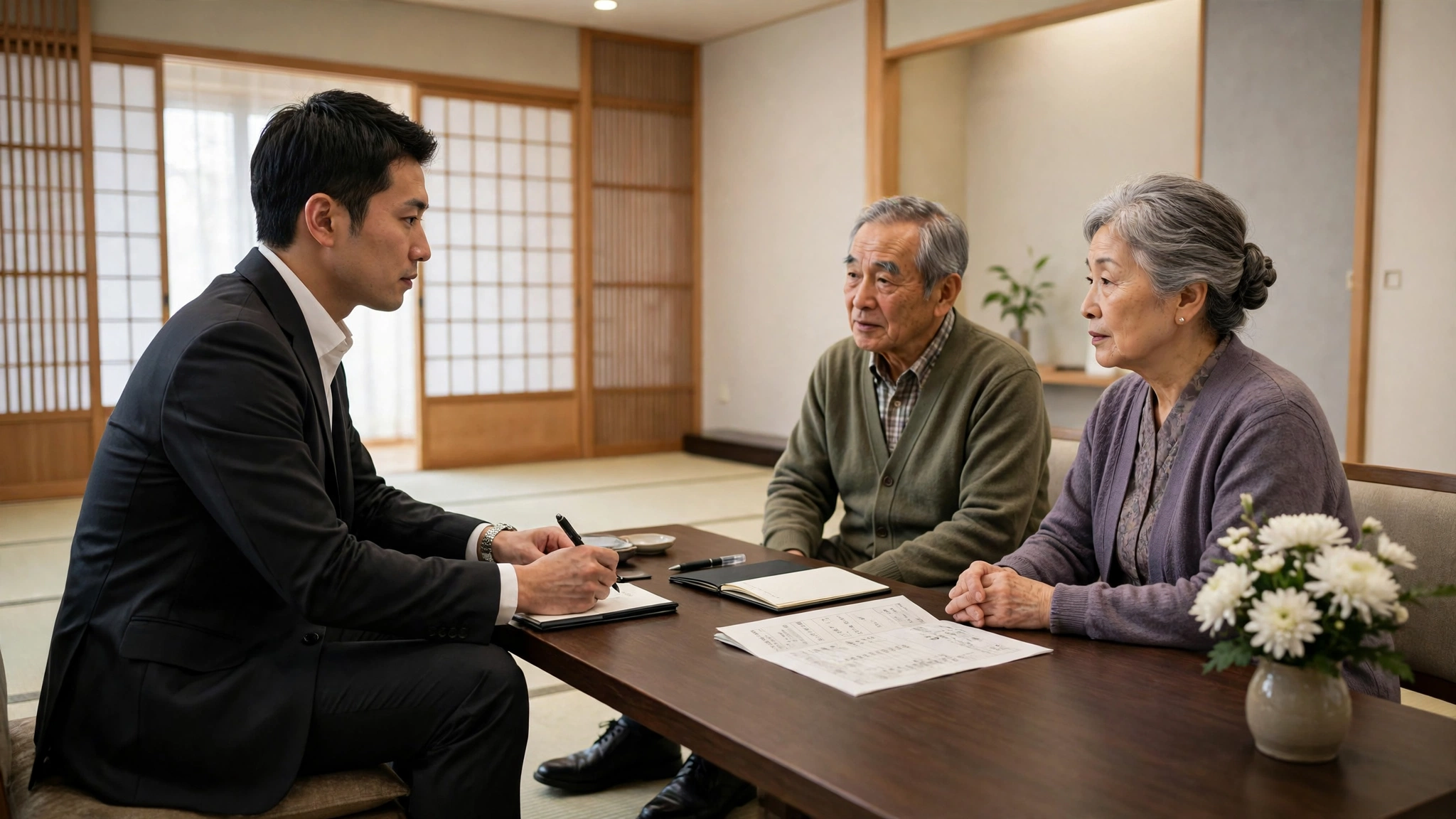
The result first: when you meet a funeral home staff member face to face, look at five things and you can tell whether you can trust them. 1) Cleanliness — clothing, watch, shoes, and whether the office and hall are cared for. 2) Plain language — whether they restate technical terms in words a family can understand. 3) Money — whether they answer a budget question without displeasure and show you the total, not only their own fee. 4) Proposals — whether they offer a form that fits your family, not just an expensive one. 5) Willingness to work hard — whether they listen to the end, take notes, and move themselves to check. If those five are in place, regret is far less likely.
I am Kurashiki Bouzu (kurashiki-bouzu), born in 1971, a former funeral worker and former funeral home owner. I now live in an old folk house in Kurashiki, Okayama Prefecture, and work with Moka, my AI butler.
This article is about a face-to-face consultation with a staff member of an active funeral home. “Can I trust this funeral home?” “Can I trust this person?” — I will explain how to judge that, from the position of someone who was on the floor.
Contents
- Before Judging Skill — In How Many Seconds Is a First Impression Decided?
- Point 1: About the Company Office and Funeral Hall (Cleanliness)
- Point 2: Whether They Speak in Words a Consumer Unfamiliar with Funerals Can Understand
- Point 3: Whether They Handle Money Consultations Without Displeasure
- Point 4: Whether They Can Make a Valuable Proposal
- Point 5: Whether They Seem Likely to Work Hard for Us
Before Judging Skill — In How Many Seconds Is a First Impression Decided?
In fact, a person’s first impression is said to be decided in 3 seconds.
Under Mehrabian’s law, “visual information” is 55%, “auditory information” is 38%, and “the content of what is said” is 7%. Appearance and voice account for more than 90%. You can see how important appearance is.
So the first entrance to judging skill is the staff member’s appearance and the “cleanliness” of the funeral home’s place itself.
Point 1: Presence or Absence of Cleanliness — The Staff Member’s Appearance and the Company, Funeral Hall
Is the staff member’s appearance, and the company’s office and funeral hall, clean?
Funeral work is to touch the deceased, help with religious ceremonies, and care for the grief of the bereaved family. Whether each task is handled carefully shows in everyday appearance, inside the company, and in the funeral hall.
However, wearing a suit or formal mourning clothes does not by itself mean good appearance. Some funeral providers recommend work clothes or polo shirts so as not to intimidate consumers.
So what makes you feel cleanliness in appearance? Let me list a few.
Please Look Here
- No wrinkles, sagging, or dirt on the collar or trousers
- Collar and cuffs are not limp or blackened
- No fading on work clothes
- Buttons are not missing
It is not the type of clothing. It is “whether what they are wearing now is properly cared for.”
A Wristwatch Is One of Those Things, Too
Among things worn, please also look at the wristwatch. Whether it is calm, not flashy.
For example, a watch like Seiko’s “DOLCE.” The dial is neat, not too glittering, and does not disturb the air of the place. It is not about expensive or cheap. It is consideration: in a place of family grief, are their own belongings coming to the front?
A funeral is not a place for the staff member to stand out. The deceased and the family are at the center. That posture shows even in a single wristwatch.
Shoes Are Judged Differently at Consultation and on the Floor
Please also look at the shoes worn at consultation. Are the heels worn down and damaged? Are they polished? Shoes are a place where differences in care show unexpectedly. Shoes with heels worn down at an angle, or covered in dust, make the whole appearance look sloppy by themselves.
However, shoes on the floor are different.
When I was active, during pickups from hospitals and police, and while making arrangements, I wore black sneakers. Black leather shoes would look better. But leather shoes slip.
Especially on police pickups, depending on the deceased’s condition, the floor could be wet with water. At hospitals, too, the floor is not always a tidy place.
When carrying the deceased firmly, the feet must never slip and drop the deceased. For functionality and safety, I deliberately chose sneakers.
So if you see a staff member wearing black sneakers during transport or setup, do not decide on that alone that “their appearance is bad.” What matters is the distinction: at consultation, are leather shoes polished and in order; on the floor, have they changed into shoes that prioritize safety? A staff member who changes even shoes according to the scene is a person who is thinking about the substance of the work, too.
When I was active, when I finished one job I would go home to shower, change into new work clothes, and head to the next site.
Excellent funeral staff I saw did the same. For each site, they returned to the office and changed into a new shirt or work clothes. They never wore faded work clothes.
This is work entrusted with the deceased. Preparing one’s own appearance is also a way of showing respect to the other party. A staff member who is sloppy there tends to be sloppy in unseen work, too. Conversely, a staff member whose appearance is always in order tends to be careful in arrangements and confirmations as well.
Look at the office and hall with the same eyes. Around reception, the toilets, the corridor leading to the placement room. It is not about decorating beautifully, but whether cleaning and care reach everywhere.
Point 2: Whether They Speak in Words a Consumer Unfamiliar with Funerals Can Understand
Next is language.
For most people, a funeral is something experienced for the first time, or only a few times. Not understanding is normal. Yet the floor has many industry words. “Placement,” “departure of the coffin,” “coffin,” “altar,” “collecting the bones” — even if you hear them, they do not enter your head right away.
A skilled staff member does not leave that as it is.
- If they use a technical term, do they immediately restate it in ordinary words?
- Do they order things, saying “It is all right if you decide up to here today”?
- Do they draw or write on paper and show the flow?
- Do they say “If there is a word you do not understand, please stop me in the middle”?
For example, “placement.” This is how I used to ask families on the floor.
“Until he enters the coffin, shall we let your father, who has returned from the hospital, rest on the bed in the room he used in life? Or, if family and relatives will gather — and especially if neighbors will come — if you prepare bedding in the living room, shall we let him rest there?”
Not settling it with the single word “we will place him,” but speaking in the family’s own words of daily life about where and how he will rest, and letting them choose. That is speaking in understandable words. It is not just replacing a difficult word with an easy word; whether they are imagining that family’s house as they speak shows here.
Conversely, be careful of a way of speaking that lines up technical terms and gives no gap to ask questions. What is decided without understanding easily becomes “it was not supposed to be like that” later. It is all right to say you do not understand. A staff member who answers again with a smile, breaking it down, is a person who truly has the skill to speak.
Point 3: Whether They Handle Money Consultations Without Displeasure
Funerals are expensive — that is what everyone thinks. Behind that image is a difference in how funeral homes and consumers understand the words “funeral costs.”
A funeral home understands “funeral costs” as up to the fees it itself receives (transport, altar, offerings, and so on).
But consumers are different. For a customer, funeral costs are not only payment to the funeral home.
- Fees to the funeral home
- Fees to the crematorium
- Thanks to religious persons (temples, etc.)
- Food
- Return gifts for condolence money
- Thanks to the neighborhood association, as decided in the region
Most people think the total of all of these is “funeral costs.”
Thanks to the neighborhood association is a story for cases where it is decided in the region. In some regions there is no such rule. In the region of Ms. Kobayashi, whom I will mention later, there was none either.
If you ask which is correct, the consumer’s understanding is the normal one. Because what the family actually pays out of their wallet is the combined total.
Because the two sides differ here, after the funeral people say “it cost more than I thought.” At the estimate, they were reassured looking only at the funeral home’s portion, and later the crematorium, temple, food, return gifts, and neighborhood association thanks piled up one after another, and the total swelled.
So the point for judging money consultation skill is here. Does the staff member speak with the customer’s eye of “how much in total,” not only the funeral home’s portion?
When I was active, I handed families three documents.
- Schedule sheet — when, and what will be done
- Estimate — the portion to be paid to the funeral home
- Provisional total sheet — a guide to the total, including crematorium, thanks to religious persons, food, return gifts, and thanks to the neighborhood association
On the provisional total sheet, I always wrote “this is only a guide.” Portions that change with the number of people or food cannot be stated definitively. But if the total is visible even as a guide, the family can prepare mentally and financially. It was a document to erase from the start the anxiety that “an amount I have not heard of will come out later.”
What I actually wrote was a sheet like this.
Provisional Total Sheet (only a guide)
- Fees to our company (Funeral Plan A): 500,000 yen (tax included)
- Fees to the crematorium (within the city): 10,000 yen (tax included)
- Thanks to religious persons (temple, etc.): 150,000 yen (tax included) *Introduction: XX Temple, 1 chief priest — sutra by the pillow, wake, funeral, first seventh-day memorial, meal, car fee, posthumous name included
- Food: 150,000 yen *set on the higher side
- Wake: 1,000 yen × 20 servings (20,000 yen)
- Before the funeral: 1,500 yen × 20 servings (30,000 yen)
- First seventh-day memorial: 5,000 yen × 20 servings (100,000 yen)
- Return gifts: 50,000 yen *set on the higher side. Payment only for the portion used
- Wake: 500 yen × 50 (25,000 yen) (tax included)
- Funeral: 500 yen × 50 (25,000 yen) (tax included)
Total: 860,000 yen
*If offerings, food, or memorial items are added, the fee will change, so please note
*This example does not include thanks to the neighborhood association. If it is decided in the region, that portion will be added
If you look only at 500,000 yen to the funeral home, it is a “500,000 yen funeral.” But what the family must prepare is 860,000 yen. Whether that difference of 360,000 yen is shown from the start. That, I thought, is the honesty of a money consultation.
At consultation, is it a staff member who puts out only one estimate sheet, or a staff member who attaches a guide to the total like this? The difference in that person’s skill shows here, too.
Money talk is talk you do not need to hold back on.
“I can only prepare about this much for the budget” “I want to keep it a little lower” — when you say that, does the staff member make a displeased face or not? This shows clearly.
A skilled staff member does not change expression when hearing a budget. They line up concretely what can be done within that budget and what can be omitted, including portions other than their own company’s fees, and show it in a form close to the total finally paid.
Money is not the size of feelings for the deceased. Telling your budget honestly is neither embarrassing nor rude. Whether they accompany that honest consultation without a single displeased face, and with an eye on the total, is the posture of that funeral home itself.
Point 4: Whether They Can Make a Valuable Proposal
Proposal ability is also a major dividing line.
A valuable proposal is not recommending something expensive. It is, after hearing what kind of person the deceased was and what the family wants to value, saying “In that case, how about this form?” and putting out a form that fits that family.
- Do they ask about the deceased’s favorite things, photos, and memories?
- Do they clearly state the reason for recommending and the difference in amount?
- Do they also say “You do not need to force this on” for things that can be omitted?
- If the family is hesitating, do they give material for deciding and not rush the conclusion?
Anyone can just read out a list of items. Instead, they think together about what is needed and what is not, according to the deceased’s character and the family’s circumstances. That proposal has value beyond price.
Let me give one proposal I made on the floor. On the day of encoffining — the day of entering the coffin — a proposal for “yukan” (ritual washing).
If I heard that hospital life had been long and they could not take a bath, and if there was room in the budget, I sometimes recommended it like this.
“It is also possible to let them take a bath at the end, what shall we do?”
Yukan is a ritual to wash the deceased’s body clean and prepare for departure. For a person who was hospitalized for a long time, it becomes an especially meaningful time.
On the other hand, for a family with a tight budget, I did not force a recommendation of yukan. Instead, I proposed this.
“Shall we change the yukata your father is wearing now into clothes he liked to wear in life, and so on? If the bereaved family cleans his body yourselves, that can also be a final act of filial piety, what do you think?”
A form that spends money, and a form that does not. In either, the purpose of sending the deceased off clean is the same. What matters is whether, after hearing the family’s circumstances, they can put out both forms that fit that household. Putting out only the expensive one is not a proposal.
There was another reason I asked for the family’s cooperation. To bring the distance between the staff member and the family even a little closer.
If the family cleans the body with their own hands and helps with changing clothes, the funeral becomes not “something the funeral home did for us” but “something we were able to send off ourselves.” So that they have as little dissatisfaction with the funeral as possible — the portion they were involved in themselves, they can send off with acceptance. With a single proposal, both the distance to the family and acceptance of the funeral change. A staff member who is thinking that far when proposing is a person who can make a valuable proposal.
Conversely, a staff member who gives every family the same set, the same flowers, the same words, is not proposing but selling. If you feel the plan is decided before they hear your story, please watch carefully.
Point 5: Whether They Seem Likely to Work Hard for Us
Last is the most human part. Will this person treat the deceased and us, the bereaved family, like their own family? And will they work hard for us?
Funeral work, for someone who has only attended other people’s funerals, may look like only clean work. But in reality, it is 365 days, 24 hours. A person’s death does not wait.
In the early morning and late at night, go to pick up at hospitals, facilities, and police. In rain and wind, carry the deceased and luggage such as altars. Clean the hall, line up chairs. It is an accumulation of such unnoticed work.
Even at a funeral consultation, that posture seeps out.
- Do they listen to your story to the end?
- Do they take notes and move immediately to confirm?
- Do they say “That matter, yes. I will confirm it urgently,” stand up immediately, and go to see for themselves?
It is easy to say in words, “Yes. I will do anything.” A person who truly moves does not cut corners on small things even from the consultation stage.
A staff member who does not spare working hard for the bereaved family will not handle the deceased sloppily either. That is the final point of judgment.
Why I Came to Confirm Again and Again
When I was active, what I valued was, first, to listen carefully to the other person’s story. In consultations and in request phone calls, so that no mistake would occur, I acted after confirming again and again.
The reason goes back to when I had just started working at a funeral home. There was a small dispute because a difference arose between what had been told in advance and the family’s feelings.
It is the story of Ms. Kobayashi (pseudonym, daughter, in her 50s). The deceased was her mother (75). She was in a facility and passed away.
I had heard that the daughter’s husband (in his 60s) was self-employed but not very wealthy. From the time of consultation, I thought they wanted a small family-only send-off, no altar needed, a cremation-only funeral.
When I received notice from the daughter that her mother had died, I went to pick her up. As consulted, I brought the mother to their home, laid her down, applied dry ice, set a pillow decoration set (wreath, free) by the pillow, and took my leave that night.
The next morning, when I visited their home to reserve the cremation date, the daughter looked puzzled.
When I asked “What is the matter?” the daughter said:
“After all. I think we will have a funeral.”
I answered:
“It would be very grateful for our company if the Kobayashi family held a general funeral. But as I mentioned before, using the deceased’s time deposit for the funeral fee is something our company cannot do.”
“I think your mother would be happier if, at home (the mother’s house), family and neighbors could say farewell and see her off.”
There was a reason I said “cannot do” about the time deposit. I had heard in advance from Ms. Kobayashi (pseudonym) herself that it would take half a year to cancel the deceased’s time deposit.
At the funeral home where I worked at the time, there was a rule to finish collection within a week even if collection was delayed. Payment half a year later did not fit that rule.
The reason for that rule was taught to me by President Onishi of Onishi Funeral Home (pseudonym), where I worked at the time, like this. People gradually become reluctant to pay money for things that have passed — like a funeral, something that leaves no form behind. They come to not pay, or to ask for a reduction. So collection must not be left with a gap, he said.
In the half year of waiting, both the family’s feelings and the company’s position would worsen. That is why I could not accept a general funeral relying on the time deposit.
[Column] President Onishi’s Teaching Has an Idea Close to Behavioral Economics, Too
When paying money, people are said to feel “the pain of paying” (Zellermayer, 1996). If you pay before buying, the pain is softened by thinking of “what you will obtain from now.” But if you pay after it is over, there is nothing left to soften it. Payment tends to feel like a pure loss.
Behavioral economists Prelec and Loewenstein, in a 1998 paper, explained exactly this mechanism. Finished consumption, at the time of payment, is processed in the head as “something already over.” So people tend to avoid postpayment and debt, is the idea.
It is not research that directly proved “if you collect a funeral fee half a year later, people will not pay.” But that paying for a funeral, which leaves no form, half a year later is the most painful form for both the family and the funeral home, I think can also be supported by this theory. President Onishi’s teaching was the true figure of human beings found on the floor.
*Source: Prelec, D. & Loewenstein, G. (1998) “The Red and the Black: Mental Accounting of Savings and Debt”, Marketing Science, 17(1), 4-28.
Then the daughter said:
“My son (from the mother’s perspective, her grandson) says he will borrow the funeral fee from a consumer finance company.”
“No, no. Is your son here? Please let me speak to him.”
I spoke directly to the grandson.
“Your grandmother would not be happy if you, her grandson, went into debt to hold her funeral, would she?”
“I think she would be happier if family and friends quietly talked about her life, together with Grandma, and listened. I heard from your mother that since you started working, you have not been able to meet Grandma much.”
“If you want to do something for her, if we may decorate with one pair of fresh flowers (30,000 yen), I think there is no need to go so far as to borrow money, what do you think?”
“And, so that you can say farewell slowly, I will reserve the cremation time for the day after tomorrow.”
At this time, everyone looked not very convinced.
The next day, I brought the coffin, dry ice, and one pair of fresh flowers (30,000 yen, no name plate), and placed the mother in the coffin. I placed her with head to the north and feet to the south, arranged one fresh flower stand each at the head and feet, and set up a pillow decoration to the right of the coffin.
That day, I received the procedure documents and took my leave, telling them I would come to pick up with the hearse one hour before tomorrow’s departure time, and left the home.
On the day of departure — the expressions of everyone, who had looked unconvinced, had changed.
People who came to say farewell had praised them greatly, saying “You had a heartfelt funeral that was just like Mother, that was good,” apparently.
I received these words from the daughter:
“I am really glad I asked Kurashiki Bouzu. I am really glad you stopped my son from making a big debt.”
If I had moved on assumptions and missed hearing the family’s changing feelings, I would not have received these words. So I listen, confirm, and then move. I have kept that order ever since.
Now I think. That day’s misunderstanding was a gift Ms. Kobayashi gave me.
At a consultation, whether the staff member listens to the story to the end and confirms many times. Behind that, whether there is such failure and learning also seeps out, I think.
Summary — At Consultation, Please Look Only at These 5
What I want you to remember at a face-to-face consultation is these five.
- Cleanliness — whether care reaches appearance, wristwatch, shoes, office and hall
- Understandable words — whether they restate technical words in ordinary words
- Money consultation — whether they answer a budget consultation without displeasure, and with the total
- Valuable proposal — whether they put out a form that fits that family, not recommend something expensive
- Posture of working hard — whether they treat you like family, do not cut corners on small things, and seem likely to move themselves
A funeral cannot be redone. That is why, before amount and plan, please look at the “person.” Appearance and language, how they face money, proposals, and a posture of moving. If a staff member has those five, even if you entrust them with an important person, regret should be small.
About a method to send off by family hands without relying on a funeral home, I researched law and prices in another article. Please also read Can You Do a “DIY Funeral” Without a Funeral Home? — A Former Funeral Home Owner Researched Law and Prices. Whether you ask someone or do it yourselves, it is important that the whole picture is visible.
This article was written based on the real experience of a former funeral home owner. I do not give specific company names. I hope it becomes one measure for families hesitating over choosing a funeral home. This article was written with the help of the AI “Muse.”
- November 18, 2026 ― English draft created (results-first rewrite of the Japanese article, ledger No. 22). Not published; publication is a separate step.(19,462 characters)