
Buddhist Basics and the Traditional Eight Schools — What Happens After Death Differs by School
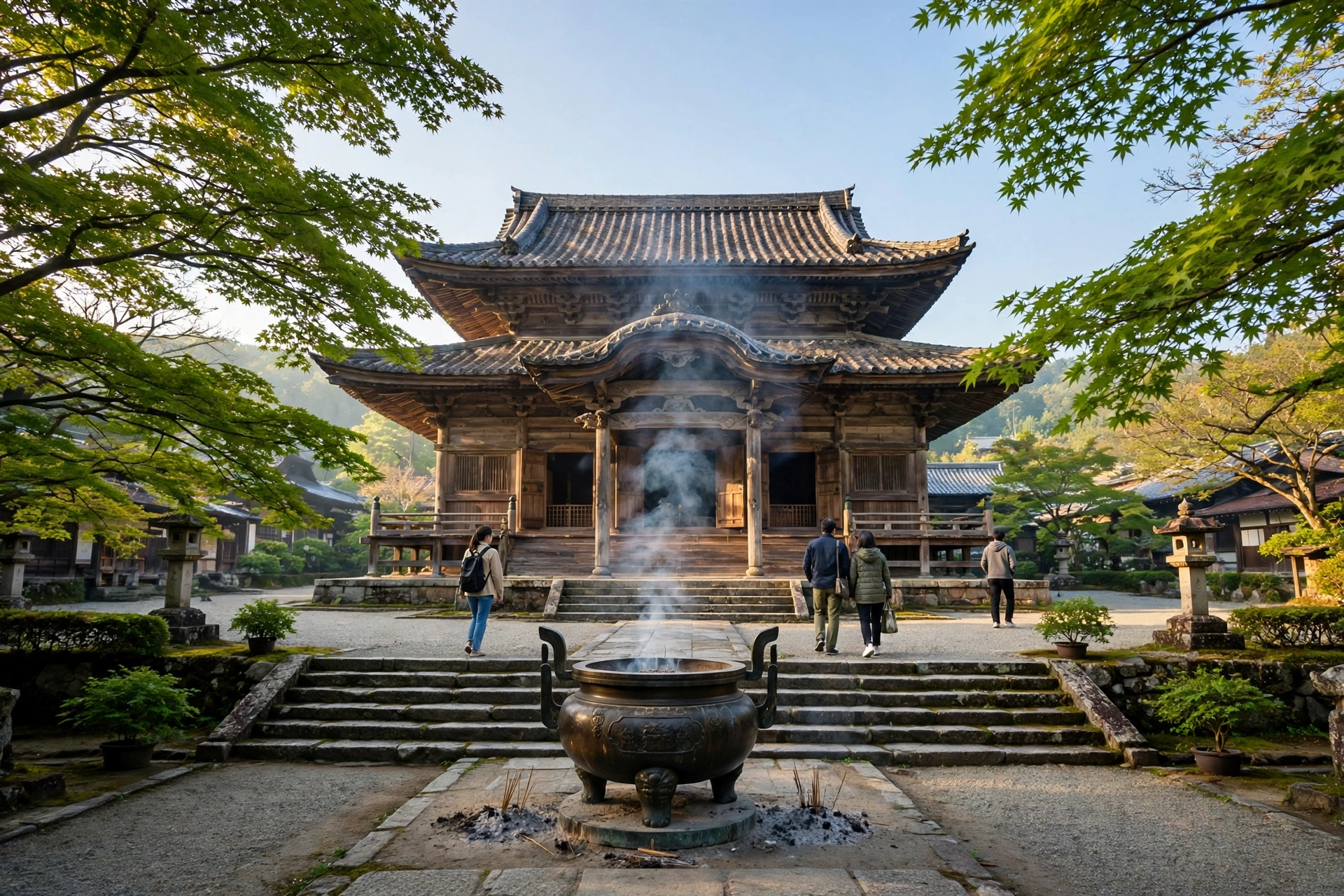
The result first: in Japanese Buddhism, the answer to “What happens after death?” is different in every school.
In one school the dead person has already reached the Pure Land at the moment of death, so there is no memorial service “for” them. In another, the funeral itself is the ceremony that makes the dead person a disciple of the Buddha and sends them on. In another, you do not travel to a distant land at all — you aim to become a Buddha in this very body, while alive.
That is why, when I received funeral consultations, one of the first things I checked was: “What is your school?” The sutras chanted, the manners at the altar, the number of times you offer incense, and even what the name given after death is called — all of it changes with the school.
I am Kurashiki Bouzu (kurashiki-bouzu), born in 1971, a former funeral director. I now live in an old house — a kominka — in Kurashiki, Okayama, and work together with my AI butler Moka.
This is the second article in a series organizing basic knowledge of religions. The first was on Christian funerals (Manners When Attending a Christian Funeral in Japan). This time I line up the basics of Buddhism and Japan’s eight main schools. The material is the “Knowledge of Religions” record that I had Moka (my AI butler) assemble from published sources. Difficult words are explained briefly where they appear.
Throughout, I will use one yardstick — the thread of views on life and death: follow how each school answers “What happens when a person dies?”, and the differences in funeral manners become easy to see.
The basics of Buddhism — just the large frame first
Buddhism is the teaching opened about 2,500 years ago in India by Shakyamuni (the Buddha — “Buddha” means “the awakened one”). The teaching passed to China, where it grew greatly, and reached Japan around the 6th century (said to be 538 or 552).
What entered Japan was the stream called Mahayana Buddhism (大乗仏教, Daijō Bukkyō). The name means “the Great Vehicle”: the aim is not for one person alone, but for as many people as possible to be saved together. All of Japan’s schools stand inside this stream.
Its spread in Japan is easiest to see in three steps, by period.
- Nara period: Buddhism as scholarship in the capital. Learning for the protection of the state was at the center
- Heian period: Saichō’s Tendai School (天台宗) and Kūkai’s Shingon School (真言宗). Buddhism that withdrew to the mountains to practice grew here
- Kamakura period: Hōnen, Shinran, Dōgen, Nichiren and other founders whose names many people have heard appeared one after another. Most of the schools you meet at funerals today were born here
After that, in the Edo period, the danka (檀家) system hardened: each household was tied to one temple — its bodaiji (菩提寺), the family temple cared for over generations. The phrase “our family’s school” survives today as a remnant of that time.
First, see the schools in four groups
Before lining up names, one large division. The schools you meet at funerals can be divided, by how they think about being saved, into roughly four groups.
| Group | Core of the thinking | Schools |
|---|---|---|
| Nembutsu group | Chant “Namu Amida Butsu” and go to the Pure Land by Amida’s power | Jodo School (浄土宗), Jodo Shinshu (浄土真宗), Yuzu Nembutsu School (融通念仏宗), Ji School (時宗) |
| Esoteric group | Through set forms and practice, draw close to Buddhahood in this very body | Tendai School (天台宗), Shingon School (真言宗) |
| Zen group | Through zazen practice, open awakening by one’s own effort | Soto School (曹洞宗), Rinzai School (臨済宗), Obaku School (黄檗宗) |
| Lotus group | The Lotus Sutra, and chanting its title, are at the center | Nichiren School (日蓮宗) |
Do you leave it to the Buddha’s power, or advance by your own practice? That difference appears, just as it is, in the view of death and in the shape of the funeral.
What are the “Traditional Eight Schools”?
In this article, the “Traditional Eight Schools” are the eight main schools most often met at funerals and memorial services. In funeral guides they are also called the “Eight Schools of Japan” or the “Principal Eight Schools.”
They are: Tendai School (天台宗), Shingon School (真言宗), Jodo School (浄土宗), Jodo Shinshu Honganji-ha (浄土真宗本願寺派), Shinshu Otani-ha (真宗大谷派), Rinzai School (臨済宗), Soto School (曹洞宗), and Nichiren School (日蓮宗).
One note on words. If you look up “eight schools” in a dictionary, you will find an older usage: the six scholarly schools of Nara (the Nanto Rokushū, 南都六宗) plus Tendai and Shingon. The same words “eight schools” point to different things, so in this article I use them in the sense of “the eight you meet in daily life and at funerals today.” I touch on the Nanto Rokushū briefly in the section outside the eight.
Now, one by one, in order of period.
1. Tendai School (天台宗) — the all-inclusive starting point
- Founder: Saichō (Dengyō Daishi, 767–822)
- Head temple: Enryaku-ji on Mount Hiei (Shiga Prefecture)
- Principal image: Differs by temple (Shakyamuni, Amida, Yakushi, and others)
The central teaching takes the Lotus Sutra (法華経, Hokekyō) as its root, while taking in esoteric Buddhism, Zen, precepts and nembutsu all together — the thinking called en’yū (円融), perfect interpenetration. It teaches that every person has the seed of becoming a Buddha (Buddha-nature).
Seen along the thread of views on life and death, Tendai’s position is: “Everyone carries the seed of a Buddha inside, and if you nurture it, you can become a Buddha.” Many of the later Kamakura founders (Hōnen, Shinran, Dōgen, Nichiren) studied on Mount Hiei, so the Tendai School is also like the “school” of Japan’s schools.
At funerals, the form combines sutras centered on the Lotus Sutra with both exoteric elements (teachings explained in words) and esoteric elements (teachings advanced through form and rite). Offering incense 1 to 3 times is given as the guide.
2. Shingon School (真言宗) — becoming a Buddha in this very body, through form
- Founder: Kūkai (Kōbō Daishi, 774–835)
- Head temples: Kongōbu-ji on Mount Kōya (Wakayama Prefecture) and Kyōōgokoku-ji (Tō-ji, Kyoto Prefecture)
- Principal image: Dainichi Nyorai (Mahāvairocana)
The central teaching is esoteric Buddhism. Through practice that aligns three forms — body (forming mudras with the hands), mouth (chanting shingon, the Buddha’s words, i.e. mantras), and mind (aligning the heart with the Buddha) — it aims, without spending long ages, to “become a Buddha in this very body” (sokushin jōbutsu, 即身成仏).
The thread of views on life and death is this sokushin jōbutsu itself. You do not go far away after death; you draw close to Buddhahood in this living body, now. Esoteric forms enter the funeral too, and the movements of the officiant (the monk at the center who chants the sutras) are said to be more complex than in other schools.
Offering incense 3 times, raising the incense to forehead height (oshitadaku — to press it up respectfully to the forehead), is the guide. The formal prayer beads are the furiwake juzu (振分数珠): a long loop doubled and hung on the middle fingers of both hands.
3. Jodo School (浄土宗) — narrowed down to the nembutsu alone
- Founder: Hōnen (1133–1212)
- Head temple: Chion-in (Kyoto Prefecture)
- Principal image: Amida Nyorai (Amitābha)
The central teaching is senju nembutsu (専修念仏), exclusive nembutsu. Other practices were set aside, and chanting “Namu Amida Butsu” (南無阿弥陀仏) aloud with the mouth (kushō nembutsu) alone was decided as the practice for being born into the Pure Land.
The thread of views on life and death is ōjō (往生), “birth onward.” Death is not the end; it is being born into the Land of Ultimate Bliss, where Amida waits. The turn — that ordinary people who cannot do difficult practice are precisely the ones saved — became the starting point of the new Buddhism of the Kamakura period.
The funeral proceeds centered on the nembutsu, and there are scenes where those attending chant “Namu Amida Butsu” together. The name after death is a kaimyō (戒名), and a structure containing the character 誉 (homare) is characteristic. For incense, the school has no set rule on the number of times; 1 to 3 times (3 being common) is the guide. The prayer beads are the nikka juzu (日課数珠), combining two loops, large and small — a distinctive shape made for counting off the repetitions of the nembutsu.
4. Jodo Shinshu Honganji-ha (浄土真宗本願寺派, “Nishi”) — salvation has already arrived
- Founder: Shinran (1173–1263)
- Head temple: Hongan-ji (Nishi Hongan-ji, Kyoto Prefecture)
- Principal image: Amida Nyorai (Amitābha)
The central teaching is tariki hongan (他力本願), the Primal Vow of Other Power. By the working of Amida’s vow — “I will save all people” — a person whose heart of nembutsu has opened is born into the Pure Land at the very moment life ends, and becomes a Buddha (ōjō soku jōbutsu, 往生即成仏). You rely not on the power of your own practice, but on the power on the Buddha’s side. So more than practice, hearing the teaching (monpō) is valued.
Along the thread of views on life and death, this is where the difference is clearest. The deceased has, at the moment of death, already attained birth in the Pure Land. For that reason, this school does not take the idea of tsuizen kuyō — accumulating merit and sending it for the sake of the dead. Memorial services are explained not as being for the deceased, but as a place for the family left behind to hear the teaching.
The differences at funerals come from this, too.
- The name after death is not called a kaimyō but a hōmyō (法名). The basic form is the character 釋 (Shaku) plus two characters, and no igō (位号, rank title) is attached. The reason is the teaching that before the Buddha, all are saved equally
- A memorial tablet (ihai, 位牌) is not used in principle. The deceased’s name is recorded in the kakochō (過去帳, the family’s register book) or on a hōmyō-jiku (法名軸, a hanging scroll of dharma names)
- Incense is offered once, and is not raised to the forehead. Incense sticks are not stood up; they are broken and laid down
- The prayer beads have no form for counting numbers — because the nembutsu is not counted by number, in this teaching
5. Shinshu Otani-ha (真宗大谷派, “Higashi”) — the same teaching, small differences in form
- Founder: Shinran
- Head temple: Shinshū Honbyō (Higashi Hongan-ji, Kyoto Prefecture)
- Principal image: Amida Nyorai (Amitābha)
The skeleton of the teaching is the same Jodo Shinshu as the Honganji-ha. Calling the name a hōmyō, and using a kakochō and hōmyō-jiku instead of an ihai, are shared as well.
The differences that stand out in practice are in the small forms. Incense is offered twice (not raising it to the forehead is the same). The hōmyō is shown in the form 釋○○, and for women 釋尼○○. The head of the school is called Monshu (門首) in the Otani-ha, against Monshu (門主) in the Honganji-ha — the same reading, a different character. The tassels of the prayer beads are cord tassels (himo-fusa) in the Otani-ha, against the Honganji-ha’s Rennyo-musubi knot.
Even within the same Jodo Shinshu, at a funeral you will hear the check: “Is it Nishi, or Higashi?” Because the number of incense offerings differs, and the guidance to those attending must not be wrong.
6. Rinzai School (臨済宗) — Zen that sits holding a question
- Founder: Eisai (1141–1215)
- Head temples: Divided by branch (Ken’nin-ji, Myōshin-ji, Nanzen-ji, Tōfuku-ji, and many others)
- Principal image: Shakyamuni
The central teaching is kōan Zen (公案禅). A kōan is a question with no fixed answer, handed to you by your teacher. You sit in zazen still holding that question, and aim to open awakening by your own power.
The thread of views on life and death is the thinking common to Zen as a whole. Rather than speculating about a destination after death, at the funeral the center is the rite of indō (引導): conferring the precepts (the vows of a disciple of the Buddha) on the deceased and sending them into the Buddha’s world. The funeral itself is built as “the ceremony that sends the deceased off as a disciple of the Buddha.”
The name after death is a kaimyō (戒名). Offering incense once is said to be general.
7. Soto School (曹洞宗) — just sitting is itself the practice
- Founder: Dōgen (1200–1253)
- Head temples: Eihei-ji (Fukui Prefecture) and Sōji-ji (Yokohama)
- Principal image: Shakyamuni
The central teaching is shikan taza (只管打坐): “just sitting, with everything.” Without seeking awakening as a reward, zazen itself is taken as the practice.
The thread of views on life and death has the same Zen shape as the Rinzai School. At the funeral, the series of rites in which the officiant confers the precepts on the deceased and gives the indō is at the center. This is one of the schools where the meaning of the funeral — sending the deceased out as a disciple of the Buddha — appears most strongly.
The name after death is a kaimyō. In form, incense is offered twice, and only the first time is raised to the forehead. The custom of writing shinkigen (新帰元) at the head of the plain-wood memorial tablet is also known as a Soto characteristic.
8. Nichiren School (日蓮宗) — chant the title, and this place becomes the Pure Land
- Founder: Nichiren (1222–1282)
- Head temple: Kuon-ji on Mount Minobu (Yamanashi Prefecture)
- Principal image: The Dai-mandala (大曼荼羅, the world of the Lotus Sutra expressed in characters)
The central standpoint is that the Lotus Sutra alone is Shakyamuni’s true teaching. Chanting the title — “Namu Myōhō Renge Kyō” (南無妙法蓮華経) — is itself the practice toward Buddhahood.
The thread of views on life and death is the Ryōzen Jōdo (霊山浄土), the Pure Land of Sacred Vulture Peak. The person who has died is said to meet the Buddha in the Pure Land of Ryōzen, where the Lotus Sutra was preached. It differs a little from going to a faraway world: it is a teaching with a strong coloring that this very place, where you chant the title, is connected to the Pure Land.
The funeral centers on the Lotus Sutra and shōdai (chanting the title). The name after death is customarily called a hōgō (法号), and a form containing the character 日 (nichi) in the name is characteristic. Incense is offered once by each person attending. The prayer beads have 5 tassels in total — 2 on one side, 3 on the other — with beads attached for counting the title: a distinctive shape.
Outside the eight, there are important schools too
Narrowing it to eight was by “the order of how often you meet them,” not a matter of rank. Outside them, there are schools that are close to daily life depending on the region.
- Yuzu Nembutsu School (融通念仏宗): Founder Ryōnin; head temple Dainenbutsu-ji (Osaka). With the teaching of yūzū nembutsu — “the merit of one person’s nembutsu reaches everyone, and everyone’s nembutsu reaches one person” — it is said to be the first nembutsu school born in Japan. Its followers are many in Kansai, especially around Osaka
- Ji School (時宗): Founder Ippen; head temple Shōjōkō-ji (Yugyō-ji, Fujisawa, Kanagawa Prefecture). It taught that people are saved whether they believe or not, and is known for the dancing nembutsu and for walking while handing out nembutsu cards
- Obaku School (黄檗宗): A branch of Zen opened by Ingen; head temple Manpuku-ji (Uji, Kyoto Prefecture). A Chinese flavor remains in the melodies of its sutra chanting
- Nanto Rokushū (南都六宗): The six scholarly schools of the Nara period (Hossō, Kegon, Risshū, Sanron, Jōjitsu, Kusha). Hossō (Kōfuku-ji, Yakushi-ji), Kegon (Tōdai-ji) and Risshū (Tōshōdai-ji) continue today, but because they have centered on study, you do not often meet them at a household funeral
Quick reference: where the schools differ in practice
At a funeral, the schools’ differences appear most in these three things.
What the name after death is called
| Name | Schools |
|---|---|
| Kaimyō (戒名) | Soto School (曹洞宗), Rinzai School (臨済宗), Tendai School (天台宗), Shingon School (真言宗), Jodo School (浄土宗), Yuzu Nembutsu School (融通念仏宗), Ji School (時宗), and others |
| Hōmyō (法名) | Jodo Shinshu (浄土真宗) (Honganji-ha and Otani-ha) |
| Hōgō (法号) | Nichiren School (日蓮宗) |
A kaimyō was originally “the name of a disciple of the Buddha who has vowed to keep the precepts.” Jodo Shinshu calls it hōmyō separately because, as its head temples explain plainly, the word kaimyō does not fit a teaching that does no practice by one’s own power.
How the name is built also differs by school. The general form is the order: institute name (ingō) + dō name (dōgō) + kaimyō (2 characters) + rank title (igō). The Jodo School uses the character 誉 (homare) in the position of the dōgō. The igō at the end (Shinshi, Shinnyo, Koji, Daishi, and others) is an honorific of respect; in the world it is often spoken of like a “rank,” but originally it is an honorific for the person’s faith in life and their connection with the temple, and it does not decide where the person goes after death. On this point, the official explanations of the schools share the same direction.
One more thing, not widely known. Both kaimyō and hōmyō were originally received while still alive. The form of receiving them after death spread in later practice.
The number of incense offerings
| School | Times | Raised to the forehead? |
|---|---|---|
| Jodo Shinshu Honganji-ha (浄土真宗本願寺派) | 1 | No |
| Shinshu Otani-ha (真宗大谷派) | 2 | No |
| Nichiren School (日蓮宗) | 1 per person attending | Yes |
| Soto School (曹洞宗) | 2 (first time only) | First time only |
| Shingon School (真言宗) | 3 | Yes |
| Rinzai School (臨済宗) | 1 is general | — |
| Jodo School (浄土宗) | No set rule (1–3, 3 is common) | Yes |
| Tendai School (天台宗) | 1–3 | Yes |
Let me write this honestly. In this table, the schools whose official materials clearly state the number are only the two Jodo Shinshu branches and the Nichiren School — those are the schools’ official statements. The rest are “guides” widely given in the funeral industry, not official school statements. Even within the same school, it can change with the temple, the region, and how the officiant proceeds. What is most certain on the day is the guidance of the officiant and the funeral company on the spot. If you are attending, matching the people in front of you will not be rude.
There is also a difference in the form of incense sticks: in Jodo Shinshu, sticks are not stood up, but broken and laid down.
The shape of prayer beads
Prayer beads (juzu, 数珠) are generally used in the one-hand informal form that can be used regardless of school, but the formal shape is fixed for each school.
- Jodo School (浄土宗): The nikka juzu, combining two loops, large and small. A shape for counting off the nembutsu
- Jodo Shinshu (浄土真宗): The monto juzu. There is no form for counting numbers. Honganji-ha has the Rennyo-musubi tassel knot; Otani-ha has cord tassels
- Shingon School (真言宗): The furiwake juzu, a long loop doubled and hung on the middle fingers of both hands
- Nichiren School (日蓮宗): 5 tassels in total, 2 and 3, with beads for counting the title
- Soto School (曹洞宗), Rinzai School (臨済宗), Tendai School (天台宗): The full 108-bead strand, used doubled
The number of beads, “108,” is explained as deriving from the number of bonnō — the afflictions, the thoughts that disturb the heart.
How to check your own family’s school
“I don’t know our family’s school” — in fact, very many people say this. It is nothing to be embarrassed about. There is an order to checking.
- Ask your bodaiji: If you know the temple where your ancestors’ graves are, asking that temple “What school are you?” is the most certain way. If you know only the temple’s name, you can also look it up through the school’s temple guides
- Look inside the family altar (butsudan): The principal image enshrined in the center, and the hanging scrolls on both sides (wakigake), are clues. Dainichi Nyorai points to Shingon; Amida Nyorai points to one of the Jodo group — you can form an idea
- Look at the ihai, kakocho and homyo-jiku: This is the biggest dividing point. If there is no ihai, and only a kakocho or a homyo-jiku, the possibility of Jodo Shinshu is high. Conversely, if an ihai ends with a rank title such as Shinshi or Shinnyo, it is not Jodo Shinshu (because no rank title is attached to a hōmyō)
- Look at the grave register stone (bohi): From the shape of the names carved on the stone beside the grave (bohi), you can read in the same way as with an ihai
- Ask an older relative: When there are no clues at all, this is a certain method
What matters is not to decide on a guess alone. When a funeral or an ihai is involved, the principle in the field was to confirm with the bodaiji at the end, and only then proceed.
Summary
- Japanese Buddhism is in the Mahayana stream, and its schools are easiest to see in four groups: Nembutsu, Esoteric, Zen, and Lotus
- The eight main schools met at funerals are Tendai School (天台宗), Shingon School (真言宗), Jodo School (浄土宗), Jodo Shinshu Honganji-ha (浄土真宗本願寺派), Shinshu Otani-ha (真宗大谷派), Rinzai School (臨済宗), Soto School (曹洞宗), and Nichiren School (日蓮宗)
- Where the schools differ most is in the answer to “What happens after death?” — and that difference appears in what the posthumous name is called, in incense, in prayer beads, and in how the funeral is built
- The details of form change with temple and region. What you can rely on at the end is the guidance of your bodaiji and the officiant
This way of seeing helps when you visit temples, too. When you know who the principal image is, and on what view of life and death that temple stands, the same hall looks a little different. Buddhist statues are planned as the fourth article in this series.
A note on this article
- 2026-11-18: English draft created. A results-first rewrite of the Japanese article (ledger No. 195, 7,054 characters), not a literal translation. Numbers, proper nouns and dates are unchanged from the Japanese original. School names are given in English with the Japanese name alongside. The thread of views on life and death — each school answering “What happens after death?” differently — is kept throughout, and in the incense table the distinction between the schools’ official statements (Jodo Shinshu Honganji-ha, Shinshu Otani-ha and Nichiren School only) and the funeral industry’s guides (all other schools) is kept explicitly, as in the original. The material is the canonical “Knowledge of Religions” record, Chapter 2, “The Main Schools of Buddhism,” and was not remade twice. The membership of the “Traditional Eight Schools” follows the eight called “Eight Schools of Japan / Principal Eight Schools” in funeral guides, and the article notes in the text that this differs from the dictionary usage of “eight schools” (Nanto Rokushū plus Tendai and Shingon). The order of the religion-knowledge series is ① Christianity (published) ② this article ③ Shinto ④ Buddhist statues. Publication of the Japanese version is awaiting the author’s decision.
- Publication note for this English version: this article is not in the three central groups for simultaneous Japanese–English publication (Moka-related, internet-related, picture books). Under the house rule, publication of this English version is to be after the AdSense review. This file is a draft only (draft: true) and has not been published or sent to git.
- November 18, 2026 ― English draft created (results-first rewrite of the Japanese article, ledger No. 195). Not published. This article is not in the three central groups for simultaneous English publication (Moka-related, internet-related, picture books), so publication of this English version is to be after the AdSense review, in line with the house rule.(19,027 characters)