
Christian Basics — Catholic and Protestant, and How Their Answers to 'What Happens After Death?' Differ
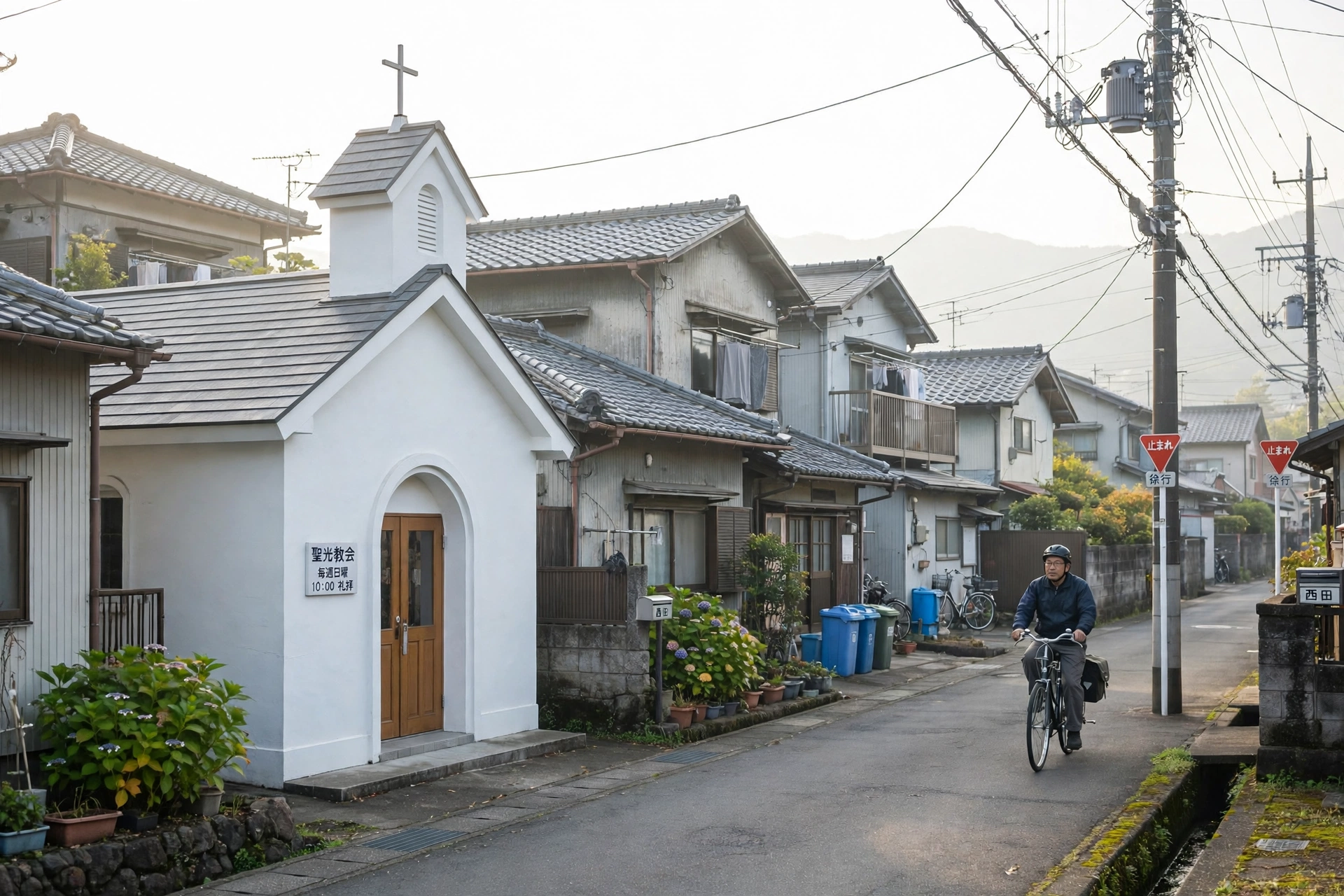
The result first: Catholics and Protestants share one answer — death is not the end, but is held in the hope of resurrection and eternal life — and yet the colour of that answer differs.
On the Catholic side, there is the idea of Purgatory: a stage of being purified before entering heaven. Because of that, it has meaning for those left behind to pray for the person who has died. There are Requiem Masses to remember the dead, and November 2 is All Souls’ Day, a day set aside to commemorate all who have died.
On the Protestant side, there is no Purgatory. The person who has died is received as someone who has been called home to God. Prayer turns more toward thanksgiving to God and comfort for the family left behind, and the gathering to remember the dead is called a memorial service — many churches also hold an annual memorial worship service for all those who have been called home that year.
That is why, when a family said “We would like a Christian funeral,” the first thing I checked was: “Was it Catholic, or Protestant?” It is the same as asking “What is your school?” at a Buddhist funeral. Which church the person belonged to changes how the service is built, and even what the clergy are called.
I am Kurashiki Bouzu (kurashiki-bouzu), born in 1971, a former funeral director. I now live in an old house — a kominka — in Kurashiki, Okayama, and work together with my AI butler Moka.
I have already published an article on the manners for those attending a Christian funeral (Manners When Attending a Christian Funeral in Japan). That one is about “what to do on the day.” This time I organize the basic knowledge underneath it: what Christianity is, how Catholic and Protestant differ, and where you meet Christianity in daily life in Japan. The material is the “Knowledge of Religions” record that I had Moka (my AI butler) assemble from published sources. Difficult words are explained briefly where they appear.
I will use the same yardstick as in the Buddhist article (Buddhist Basics and the Traditional Eight Schools). What shows the differences most clearly is the thread of views on life and death — how each tradition answers “What happens when a person dies?” Follow that thread, and the differences in the shape of the funeral become easy to see, even inside Christianity itself.
The basics of Christianity — just the large frame first
Christianity is the religion that began about 2,000 years ago in the land of present-day Israel and Palestine, from the teaching of Jesus Christ. Jesus was crucified and died, and is believed to have risen again three days later. That “resurrection” stands at the centre of the Christian view of life and death.
Three points are enough for the large frame.
- God is one: Christians believe in one God. Both Catholics and Protestants hold the teaching of the Trinity — that God works in three forms: God the Father, Jesus the Son, and the Holy Spirit
- The Bible is the source of the teaching: The Bible consists of the Old Testament, from before Jesus, and the New Testament, which records the life and teaching of Jesus
- Baptism is the entrance to becoming a believer: Through baptism (洗礼, senrei) — being cleansed with water — a person becomes a member of that church. That baptism is the entrance is also why a funeral is, in principle, a service for a person who was a believer
The gathering of believers is the “church.” Every Sunday they gather, hear the words of the Bible, sing, and pray. Catholics call this Sunday gathering Mass, and Protestants call it a worship service.
Christianity in Japan — around 1% of the population, but many places to meet it
Christianity is said to have come to Japan in 1549, when Francis Xavier landed in Kagoshima. What arrived then was Catholicism. After that, through the Edo period, there was a long time of prohibition, which was lifted in the Meiji period. Protestantism spread in the Meiji period, after missionaries came to Japan in the second half of the 19th century and worked through schools and hospitals.
The number of believers itself is not large. In the Agency for Cultural Affairs’ Religious Almanac (Shūkyō Nenkan), the number of Christians is given as around 1% of the population. This figure, however, is a total of the numbers reported by each organization, and the way of counting differs from group to group. It is best read not as a precise “proportion,” but as a confirmation of the structure: “in Japan, Christians are a minority.”
And still, there are surprisingly many places where you meet Christianity in daily life in Japan.
- Weddings: Many people who are not believers hold their wedding in a church or chapel. That, however, is about weddings. A funeral, in principle, is a service for a person who was a believer — and here it differs greatly from a wedding
- Schools, kindergartens and hospitals: Schools built on Christian ideas (so-called mission schools), kindergartens and hospitals can be found in familiar towns as well
- Christmas and Easter: Christmas in December has by now settled in as a seasonal event. Easter in spring — the festival of the resurrection, celebrating that Jesus rose again — is, within Christianity, a feast even more important than Christmas
- Attending a funeral: Even if believers are around 1% of the population, through work and neighbourhood ties, anyone may have the occasion to attend a Christian funeral
The pattern “New Year shrine visit at a Shinto shrine, wedding at a church, funeral at a Buddhist temple” is a major characteristic of religion in Japan. Rather than narrowing life to one religion, different religions take charge at different moments. That overlapping is what shapes the overall picture of religion in Japan.
Originally one — how did it divide?
Catholic and Protestant were originally one Christian church. There were two large steps in the division.
The first was the division between East and West in the 11th century. The church centred on Rome in the West and the church in the East separated, and the eastern side is called the Orthodox Church. There are Orthodox churches in Japan as well, but in this article I narrow the focus to the two you meet most often at funerals in Japan: Catholic and Protestant.
The second is the dividing point of this article. In the 16th century, the German monk Martin Luther raised questions about the way the Catholic Church of his time was run. The movement that began with the “95 Theses” of 1517 is the Reformation. The claims — let us return not to the authority of the church but to the Bible; salvation is by faith, not by deeds — spread, and the side that separated from Catholicism came to be called “Protestant.” The word “Protestant” originally means “one who protests.”
“Catholic,” on the other hand, comes from a word meaning “universal (open to all people).” Even after the division, it continued as one organization worldwide, with the Pope in Rome at its head.
So the relationship is this.
- Catholic: One large organization continuing from the early church. At its centre is the Pope in Rome
- Protestant: A general name for the side that separated in the Reformation. It is a gathering of many denominations — Lutheran, Reformed, Baptist, Methodist and others — and there is no single central figure for all of them
“Catholic is one church; Protestant is a general name for many denominations.” That difference gives rise to most of the differences that follow.
Catholic — the tradition of the church, and the seven sacraments
- Centre: One organization worldwide, with the Pope in Rome at its head
- Clergy: Priest. In daily address, “Father” (神父, shinpu) is used — shinpu is a respectful form of address, and the title of the office is priest
- Gathering: Mass. A form combining readings from the Bible and a sermon with the Liturgy of the Eucharist (Holy Communion)
A characteristic of Catholicism is that, in addition to the Bible, it values in the same way the tradition the church has handed down (Sacred Tradition). The prayers and forms the church has kept through its long history remain, just as they are, in its present shape.
Another characteristic is the “sacraments.” These are rites for receiving God’s grace, and there are seven of them: baptism, confirmation, the Eucharist, penance (reconciliation), anointing of the sick, holy orders, and matrimony. That the forms of funerals and weddings are firmly set is because this idea of the sacraments lies underneath.
There is also the custom of entrusting prayers to the Virgin Mary and to the saints, who are taken as models of faith. That is why statues of Mary and of saints are placed inside churches.
At a funeral, there is a “prayer at the wake” corresponding to a wake, and the central “Funeral Mass.” Within the Mass, Catholic believers who have received baptism receive Holy Communion. For those attending who are not believers, the manner is to wait quietly in your seat.
Protestant — the Bible alone, faith alone
- Centre: Each denomination and each church. There is no central figure who gathers them all together
- Clergy: Pastor. The usual forms of address are “Pastor” with a respectful title, or the person’s name followed by “Pastor”
- Gathering: Worship service. Hymns, readings from the Bible, prayer, and the pastor’s sermon are at the centre
The Protestant yardstick is gathered in the words of the Reformation: “the Bible alone” (the authority for faith is placed in the Bible alone) and “faith alone” (salvation is not by an accumulation of deeds, but by believing in God’s grace).
From this, several forms follow.
- More than the tradition of the church or the authority of the Pope, it values checking the words of the Bible themselves
- There is the idea of the “priesthood of all believers”: every believer can face God without going through clergy. The pastor stands in a position of helping and guiding that
- Its rites centre on baptism and Holy Communion, whose basis in the Bible is clear. It does not take the form of seven sacraments as in Catholicism
- It does not offer prayers to saints or to Mary, and the inside of the church is, in many places, kept plain, with decoration held back
Because there are many denominations, the differences from church to church are large — that too is a Protestant characteristic. Even among Protestants, how a service proceeds follows the order of service of that church.
A funeral is a “funeral service,” and takes the form of a worship service. What corresponds to a wake is the “eve service (eve prayer meeting).” Unlike Catholic practice, in many cases the funeral and the farewell are not separated; the farewell is held within the funeral service itself.
Quick reference — Catholic and Protestant
| Item | Catholic | Protestant |
|---|---|---|
| Shape | One church headed by the Pope in Rome | A general name for many denominations |
| Clergy | Priest (addressed as Father) | Pastor |
| Sunday gathering | Mass | Worship service |
| Where authority is placed | The Bible and the tradition of the church | The Bible alone |
| Rites (sacraments) | Seven | Baptism and Holy Communion at the centre |
| Song | Sacred songs (seika) | Hymns (sambika) |
| What corresponds to a wake | Prayer at the wake | Eve service |
| Centre of the funeral | Funeral Mass | Funeral service (in the form of a worship service) |
| Incense | There is an offering of incense by the priest | No incense in the liturgy |
For those attending, the movements do not change greatly on either side. At the centre of the farewell is the offering of white flowers, called kenka (献花, flower offering). For the money offering that corresponds to kōden at a Buddhist funeral, the envelope inscription that is safe for both is “go-karyō” (御花料, money offering for flowers). In Catholic use, “go-Misa-ryō” (御ミサ料, Mass offering) is sometimes written instead. The details of manners for attending are gathered in the earlier article on manners.
On “incense,” let me write one thing precisely. It cannot all be gathered under “Christianity does not use incense.” In the Catholic liturgy, the priest offers incense — censing the coffin and the altar. At Catholic funerals in Japan, following the priest’s offering of incense, there are also forms in which those attending offer flowers (and in some cases, incense). In Protestant practice there is no use of incense in the liturgy, and the flower offering is the basis.
The thread of views on life and death — “What happens after death?”
The shared answer is clear. Death is not the end; the person who has died is sent off in the hope of Christ’s resurrection and eternal life. That is the framework shared by both.
For that reason, the words used also change from Buddhist funerals. In Christianity there is no idea of a world where the dead wander (the meido, the dark realm of Buddhist usage). Words such as “May they rest in blessed peace” in the Buddhist sense (go-meifuku o oinori shimasu) or “becoming a Buddha” (jōbutsu) are not used. Instead, people say things like “May they rest in peaceful sleep,” or speak of “the hope of resurrection.”
On top of that shared frame, the colour of the answer divides between Catholic and Protestant.
Catholic — there is meaning in praying for the person who has died
In Catholicism there is the idea of “Purgatory” (煉獄, rengoku). It is the idea that there is a stage in which the person who has died is purified before entering heaven.
From this comes the form: “There is meaning in those left behind praying for the person who has died.” Requiem Masses are held to remember the deceased, and November 2 is All Souls’ Day (死者の日, Shisha no Hi), a day to commemorate all who have died. That a funeral becomes a place of entrusting the deceased to God and praying for them has this idea as its foundation.
Protestant — received as someone called home to God
In Protestantism there is no idea of Purgatory. The person who has died is received as someone who has been called home to God (called to heaven).
So the direction of prayer changes a little as well. Rather than praying for the onward journey of the deceased after death, thanksgiving to God and comfort for the family left behind stand at the centre of the funeral service. The gathering to remember the deceased is called a memorial service (記念会, kinenkai), and many churches hold, once a year, a memorial worship service for all the departed together — a “memorial service for those called home” (召天者記念礼拝, shōtensha kinen reihai).
This difference also appears in the words used for someone’s death. In notices and the like, it is often said that Catholics write kiten (帰天, “returned to heaven”) and Protestants write shōten (召天, “called to heaven”).
The thread we saw in the Buddhist article — “what happens after death differs by school” — runs in the same way inside Christianity. Even within the same Christianity, the place given to the meaning of praying for the dead is different. That difference appears as a difference in the form of remembering: the Requiem Mass on one side, and the memorial service on the other.
What I always confirmed at the end, in the field
As basic knowledge, let me write one more important premise.
Christian funerals are a field in which the differences by denomination and by church are especially large, larger than in other religions. What I have written in this article is the general form in Japan, and how a service proceeds follows the rules of that church. And whether a church will accept the funeral of a person who was not a believer also differs in handling from church to church. In Catholic practice it is the judgment of the priest of the church the person belonged to; in Protestant practice, too, it is the judgment of each church. It is not something that can be stated definitively as a single unified rule.
That is why, in the field, the principle was to confirm which church the deceased had belonged to, and to check directly with that church. The work of confirming went beyond “Catholic or Protestant?” to “which church?” as well.
Summary
- Christianity is a religion that places the resurrection of Jesus at its centre. Baptism is the entrance to becoming a believer, and the Sunday gathering is called Mass by Catholics and a worship service by Protestants
- In Japan, believers are around 1% of the population, but there are many places to meet Christianity in daily life — weddings, schools, kindergartens, Christmas and more
- Catholicism is one church headed by the Pope in Rome; it values the Bible and the tradition of the church, and its sacraments are seven. Protestantism is a general name for the many denominations that separated in the Reformation, and its yardsticks are “the Bible alone” and “faith alone”
- What the view of death shares is this: “Death is not the end, but is held in the hope of resurrection and eternal life.” The difference appears in the form of remembering — on the Catholic side there is the idea of Purgatory, and Requiem Masses praying for the deceased; on the Protestant side there is the memorial service
- This is a field where differences from church to church are large. What you can rely on at the end is confirmation with the church the deceased belonged to
The manners for attending (the order of the flower offering, the envelope for the “go-karyō” offering, and the choice of words) are gathered in Manners When Attending a Christian Funeral in Japan. Next, I plan to organize the basic knowledge of Shinto.
A note on this article
- 2026-11-18: English draft created. A results-first rewrite of the Japanese article (ledger No. 202, 5,892 characters), not a literal translation. Numbers, proper nouns and dates are unchanged from the Japanese original — 1549, 1517, November 2, around 1% of the population, the seven sacraments, and the rest. Denominational terms follow common English usage — priest (addressed as Father), pastor, Mass, worship service, baptism, the Trinity, and “go-karyō” for the money offering — with the Japanese given alongside where it helps. The thread of views on life and death is kept throughout: the shared answer (death is not the end, but is held in the hope of resurrection and eternal life), then the difference — on the Catholic side, the idea of Purgatory, Requiem Masses praying for the deceased, and All Souls’ Day; on the Protestant side, no Purgatory, and the memorial service and memorial worship for those called home. The material is the canonical “Knowledge of Religions” record, Chapter 4, “Christianity (Catholic / Protestant),” and Chapter 1, “The Overall Picture of Religion in Japan,” and was not remade twice. The order of the religion-knowledge series is ① Christianity (this article) ② Buddhism (ledger No. 195; the Japanese version is published) ③ Shinto ④ Buddhist statues. Points where handling differs from church to church — such as whether the funeral of a person who was not a believer is accepted — are written not as definitive statements, but as matters for individual confirmation, as in the original. Publication of the Japanese version is awaiting the author’s decision.
- Publication note for this English version: this article is not in the three central groups for simultaneous Japanese–English publication (Moka-related, internet-related, picture books). Under the house rule, publication of this English version is to be after the AdSense review. This file is a draft only (draft: true) and has not been published or sent to git.
- November 18, 2026 ― English draft created (results-first rewrite of the Japanese article, ledger No. 202). Not published. This article is not in the three central groups for simultaneous English publication (Moka-related, internet-related, picture books), so publication of this English version is to be after the AdSense review, in line with the house rule.(16,016 characters)