
Shinsōsai Basics — The Shinto Funeral: Order of Rites, Tamagushi Hōten, the Fiftieth-Day Festival and Kamidana-fūji
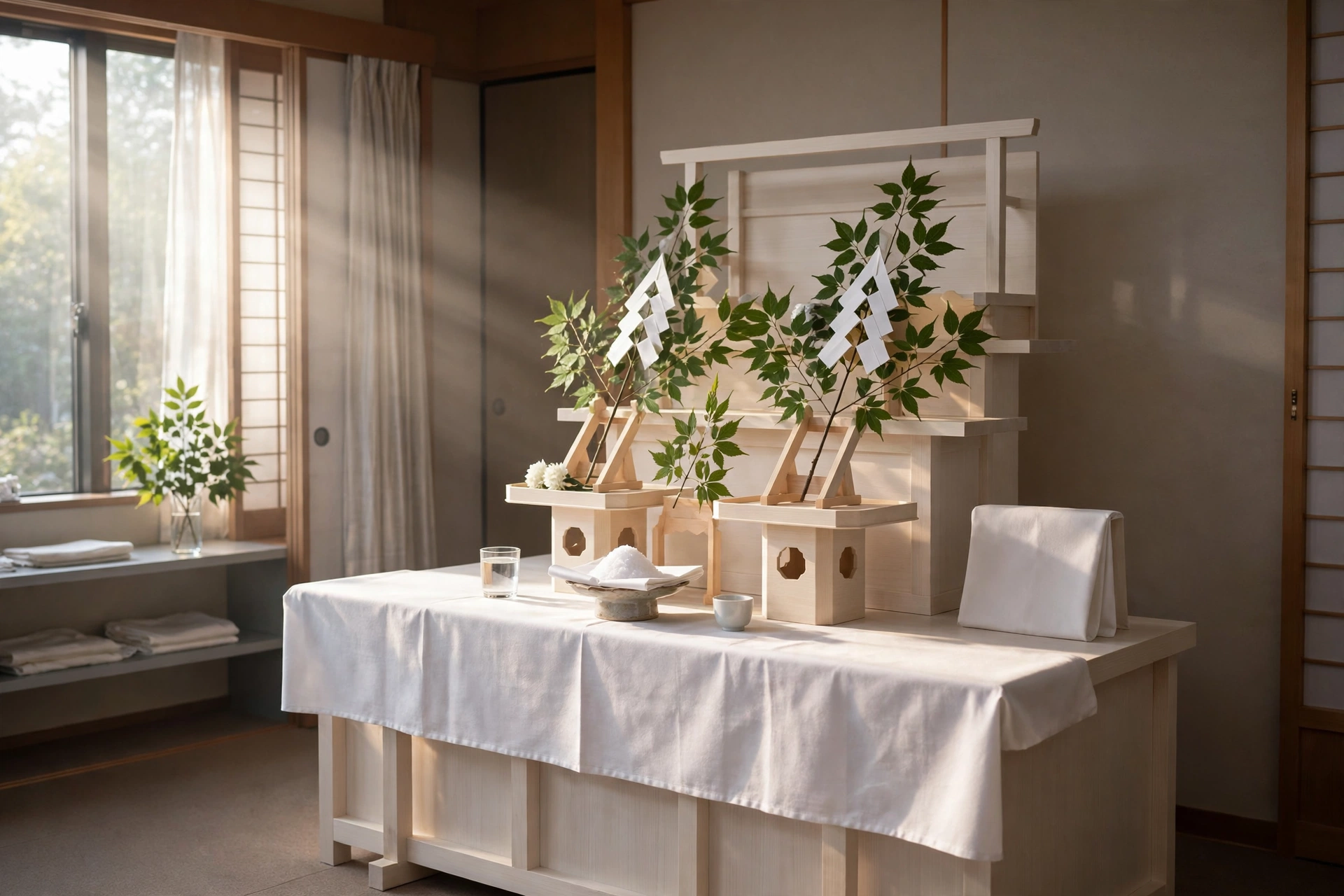
The result first: a Shinsōsai — the Shinto funeral — is not held inside a shrine. A Shinto priest comes out to the home or the funeral hall to lead it. The central farewell rite is not incense but Tamagushi Hōten, the offering of a sakaki branch, and the clapping at that moment is silent. Mourning does not end on the 49th day as in Buddhism, but at the Fiftieth-Day Festival, when the spirit is welcomed in as a guardian of the home.
That is the shape in one breath. Everything else — the names of the rites, the wording on an offering envelope, the day for enshrining — follows from the Shinto view underneath it: death is kegare (a loss of vitality), passing is kiyū (returning to the unseen world), and the spirit (mitama), honoured through rites, becomes a guardian of the home.
I am Kurashiki Bouzu (kurashiki-bouzu), born in 1971, a former funeral director. I now live in an old house — a kominka — in Kurashiki, Okayama, and work together with my AI butler Moka.
When a family said “We are Shinto,” the first thing I confirmed in the field was which shrine to ask, and whether to proceed with a Shinsōsai. The sutras, the incense, and the day mourning ends — everything differs from a Buddhist funeral. This article organises the flow and manners of that Shinto funeral.
The basics of Shinto itself — the eight million kami (yaoyorozu no kami), how a jinja differs from a jingū, the ujigami and ubusunagami — and the core of its view of life and death (death is kegare, passing is kiyū, the mitama becomes a guardian of the home) are in Shinto Basics — Eight Million Kami, the Ujigami, and the Answer to ‘What Happens After Death?’. Please read this article as its continuation. Within the series organising basic knowledge of religions, I keep the same yardstick as the first article, on Christianity (Christian Basics — Catholic and Protestant), and the second, on Buddhism (Buddhist Basics and the Traditional Eight Schools) — following the shape of the funeral from the difference in the answer to “What happens when a person dies?” The material is the “Knowledge of Religions” record that I had Moka (my AI butler) assemble from published sources. Difficult words are explained briefly where they appear.
Shinsōsai — the Shinto funeral
A funeral in the Shinto form is called a Shinsōsai. It is a form arranged on the foundation of Japan’s indigenous funeral customs. The person who leads the rites is not a Buddhist monk but a shinshoku — a Shinto priest who serves at a shrine — and the chief officiant is called the saishu.
There is one important premise. A Shinsōsai is not held inside the shrine building (the shaden). Because death is understood as kegare, the general form is to invite the priest to the home or to a funeral hall (saijō). People tend to imagine “a funeral at a shrine,” but in practice it is the reverse: the priest is the one who comes out to you.
The flow of a Shinsōsai (general form)
This is the flow of the main rites, based on the guidance of Jinja Honcho (the Association of Shinto Shrines). Jinja Honcho itself notes that names and contents may differ slightly by region, so please read this as the general form.
- Kiyū Hōkoku-sai: A rite to report to the ujigami (the local guardian kami) that the person has returned to the unseen world (kiyū)
- Tsuya-sai: A rite held at night to comfort the mitama of the deceased, corresponding to the Buddhist wake. Together with it, in many cases, a Senrei-sai is held — the rite of transferring the mitama into a mitamashiro (also called a reiji, a spirit tablet — the vessel in which the spirit is enshrined)
- Sōjō-sai: The rite of the final farewell to the deceased, corresponding to the Buddhist funeral and farewell service. It is the centre of the Shinsōsai. It includes the offering of saishi (the words addressed to the kami), the reciting of a brief account of the deceased’s life, condolence speeches and telegrams, and Tamagushi Hōten
- Hakkyū-sai: The rite at the departure of the coffin
- Kasō-sai: The rite held at the crematorium when the cremation takes place
- Kika-sai: On returning home, enshrining the reiji and the ashes with care (hōan — to enshrine reverently) and reporting that the funeral has ended
- The Reisai that follow: After the rite of the following day, a rite is held every ten days — the Tenth-Day Festival, Twentieth-Day Festival, Thirtieth-Day Festival and Fortieth-Day Festival — leading to the Fiftieth-Day Festival
Placed side by side with the Buddhist form, the differences become clear.
| Item | Buddhist form | Shinsōsai (Shinto) |
|---|---|---|
| Officiant | Buddhist monk | Shinto priest (saishu) |
| Central farewell rite | Offering incense (shōkō) | Tamagushi Hōten |
| Idea of where the deceased goes | Becoming a Buddha / birth in the Pure Land (jōbutsu / ōjō) | Becoming a guardian of the home (sorei) |
| Where the posthumous name rests | Ihai (memorial tablet) | Reiji (mitamashiro, spirit tablet) |
| Milestone marking the end of mourning | 49th day (shijūkunichi) | Fiftieth-Day Festival (Gojūnichi-sai) |
| Inscription on the offering envelope | Go-kōden and similar | Go-Tamagushi-ryō, Go-Sakaki-ryō, Go-Reizen and similar |
What I checked most carefully in the field was the replacement of words. Not kōden (incense money) but Tamagushi-ryō. Not kuyō (a Buddhist memorial offering) but Reisai (a spirit festival). If even one word on an information leaflet or a reception sign is wrong, it can leave the family with a lingering sense that something is off. At a Shinsōsai, the checking of words was done even more carefully than at a Buddhist funeral — that, as a general observation, was the feeling in the field.
A quick guide to Tamagushi Hōten — the rite that corresponds to offering incense
Tamagushi Hōten is the Shinto rite of worship that corresponds to offering incense. A tamagushi — a branch of sakaki, an evergreen tree held sacred in Shinto — is offered before the kami, and the worshipper bows in reverence.
The general steps are as follows.
- Receive the tamagushi (receive it carefully with both hands)
- Turn it clockwise so that the root end of the branch faces the altar
- Place it on the tamagushi stand
- Perform nirei-nihakushu-ichirei — two bows, two claps, one final bow. At a funeral or a Reisai, however, the custom is to make the claps silent — shinobite, the “silent hand” — without sound
The claps are made without sound because the occasion is not a celebration. That is the only point that differs from the clapping at an ordinary shrine visit. As a guest, if you follow the person in front of you, you will not be impolite.
For the offering of money, the envelope inscriptions used are Go-Tamagushi-ryō (玉串料, tamagushi offering), Go-Sakaki-ryō (御榊料, sakaki offering) and Go-Reizen (御霊前, before the spirit), among others. Go-kōden (御香典, incense money) is the Buddhist wording, so at a Shinsōsai it is safest to avoid it.
The Fiftieth-Day Festival and the annual festivals — the milestone that ends mourning
Even after the Shinsōsai, the rites continue.
The Gojūnichi-sai (Fiftieth-Day Festival), on the 50th day after death, is the milestone that ends mourning, corresponding to the Buddhist 49th day. At this festival, in many cases, a Gōshi-sai is held together with it — the rite of enshrining the mitama together with the ancestral spirits in the soreisha (the shelf/altar for ancestral spirits) — and the interment of the ashes (the burial rite) is also often held at this time.
In other words, the Fiftieth-Day Festival is not an “end.” It is the milestone at which the mitama joins the guardians of the home. The words resemble the Buddhist “end of mourning” (kiake) at the 49th day, but it is easier to understand if you take the content to be this dividing line: “the welcoming in as an ancestral spirit has been completed.”
After that, on the anniversary of the death, a Nensai (annual festival) is held — the First-Year Festival, Third-Year Festival, Fifth-Year Festival, Tenth-Year Festival, and so on, in milestone years. It corresponds to the Buddhist nenki hōyō (anniversary memorial service), but in Shinto it is not called a hōyō. The custom is to call it a Reisai (spirit festival) or Nensai.
If you line up only the milestones of the Reisai, they look like this.
- The day after the funeral: the rite of the following day (Yokujitsu-sai)
- Every ten days: Tenth-Day Festival, Twentieth-Day Festival, Thirtieth-Day Festival, Fortieth-Day Festival
- Day 50: Fiftieth-Day Festival (the end of mourning; often held together with the Gōshi-sai and the interment)
- After that: annual festivals (Nensai) such as the First-Year, Third-Year, Fifth-Year and Tenth-Year Festivals
Kamidana-fūji — one more rite, inside the home
When a family member dies, there is a custom of closing the doors of the household Shinto altar (the kamidana) at home and sealing the front with a sheet of white hanshi paper. This is called Kamidana-fūji — sealing the household altar.
Its meaning is said to be to prevent the kegare of death from reaching the kamidana. It is the idea of separating the pure place where the kami are enshrined from the period in which kegare is present. The guide for when to remove the seal is the Fiftieth-Day Festival, when mourning ends — though this varies by region.
What is interesting is that this Kamidana-fūji is a widely rooted custom that is sometimes also practised in households holding a Buddhist funeral. In a home that has a kamidana, regardless of denomination, the movement “when a family member dies, seal the kamidana” has remained. You could call it the layered faith of Japan, seen inside the home.
Put the other way around, when I was asked at a funeral consultation, “What should we do about the kamidana?”, it was not a question limited to Shinto households. Knowing how to seal it, and the guide for when to remove the seal, was part of the preparation in the field — something you could explain at a funeral of any denomination.
What I always confirmed at the end, in the field
As basic knowledge, let me write one more important premise.
Compared with the Buddhist form, Shinsōsai are few in number, and this is a field in which differences by region and by shrine appear easily. What I have written in this article is the general form in Japan, based on the guidance of Jinja Honcho. The actual content of the saishi (the words offered) and the order of the rites follow the way of the priest of the shrine you ask.
That is why, in the field, the principle was to confirm which shrine’s ujiko (parishioner) the deceased had been, and to check directly with that shrine. The work of confirming extended beyond the single word “in Shinto” to “at which shrine?” It is exactly the same structure as the “which church?” I wrote about in the article on Christianity.
Summary
- The Shinto funeral is the Shinsōsai, led by a Shinto priest (saishu) who comes out to the home or the funeral hall. It is not held inside the shrine building
- The flow of rites runs: Kiyū Hōkoku-sai, Tsuya-sai (with the Senrei-sai), Sōjō-sai, Hakkyū-sai, Kasō-sai, Kika-sai — and after that, through the Reisai held every ten days, to the Fiftieth-Day Festival
- The farewell rite is Tamagushi Hōten, and the custom for the clapping is shinobite — without sound. The envelope inscriptions are Go-Tamagushi-ryō, Go-Sakaki-ryō and Go-Reizen. Go-kōden is not used
- The milestone that ends mourning is the Fiftieth-Day Festival, often held together with the Gōshi-sai and the interment, and after that the annual festivals (Nensai) are held. Kamidana-fūji is a custom that is also practised in some Buddhist households
Next, I plan to organise the basic knowledge of Buddhist statues — who the statues you meet at a temple are, and what they represent.
- November 18, 2026 ― Published. English version — a results-first rewrite of the Japanese article (ledger No. 211).(9,642 characters)