
Shinto Basics — Eight Million Kami, the Ujigami, and the Answer to 'What Happens After Death?': Becoming a Guardian of the Home
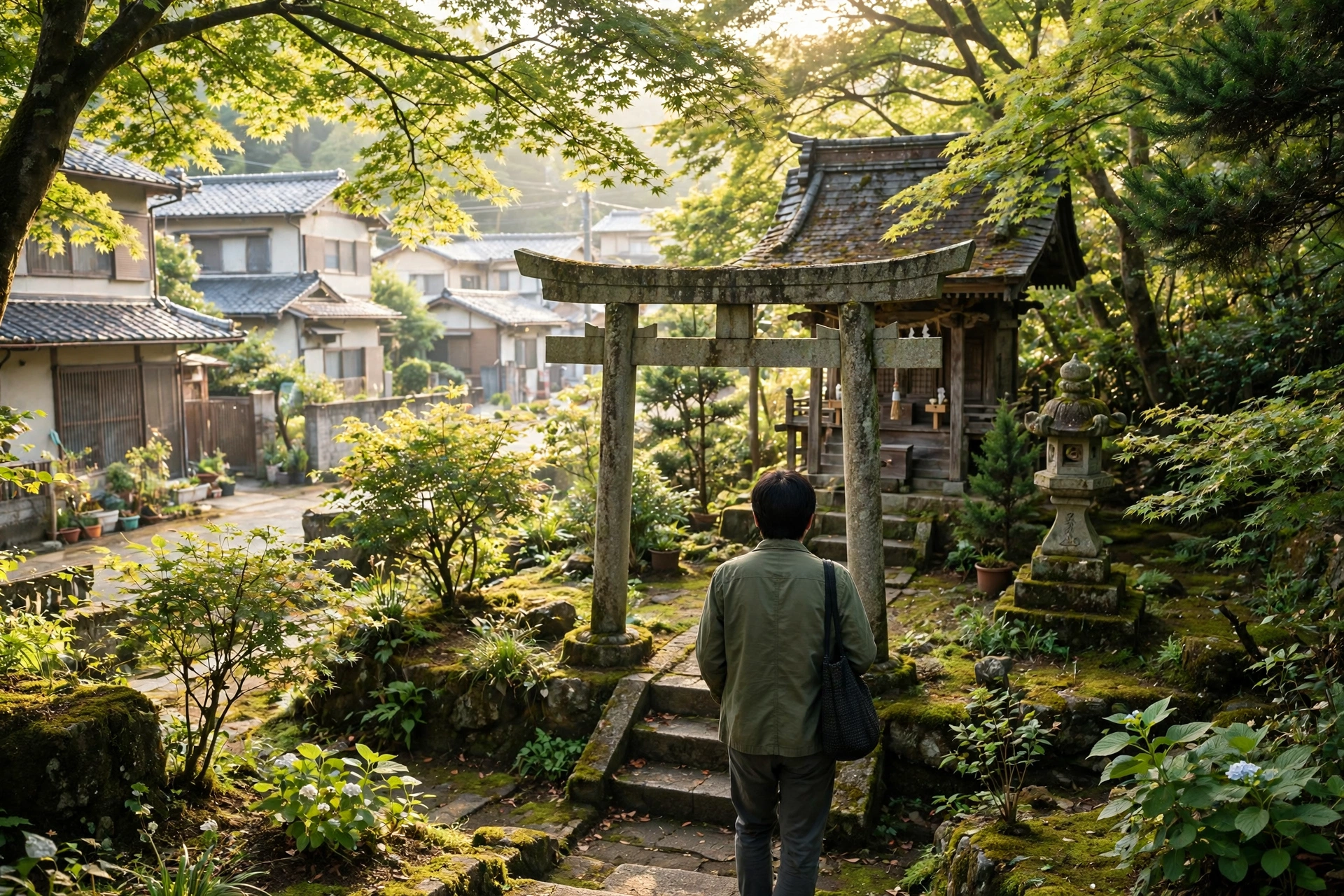
The result first: in Shinto, a person who has died does not travel far away. Through repeated rites of honouring (saishi), their spirit — the mitama — becomes a guardian of the home, an ancestral spirit (sorei) who watches over the family.
That is Shinto’s answer to “What happens when a person dies?” Death is understood as kegare — not “unclean” in a moral sense, but a state in which vitality has been lost, like a withered spirit. Passing away is called kiyū — returning from this visible world (utsushiyo) to the unseen world (kakuriyo). It is completely different in shape from the Buddhist ideas of becoming a Buddha (jōbutsu) or being born into the Pure Land (ōjō). Once you follow that thread, the shape of the Shinto funeral also comes into view.
I am Kurashiki Bouzu (kurashiki-bouzu), born in 1971, a former funeral director. I now live in an old house — a kominka — in Kurashiki, Okayama, and work together with my AI butler Moka.
When a family said “We are Shinto,” the work at a funeral did not begin at a shrine. It began by confirming which shrine to ask, and whether to proceed with a Shinto funeral, a Shinsōsai. The sutras, the incense, and the day mourning ends — everything differs from a Buddhist funeral. And yet Shinto itself is something almost everyone in Japan has touched, at a New Year shrine visit or at Shichi-Go-San. It is precisely when a funeral comes that “what is different?” becomes hardest to see.
This article is the third in a series organising basic knowledge of religions. It follows the first article, on Christianity (Christian Basics — Catholic and Protestant), and the second, on Buddhism (Buddhist Basics and the Traditional Eight Schools). The flow and rites of the Shinto funeral itself are in a separate article: Shinsōsai Basics — The Shinto Funeral, Tamagushi Hōten, the Fiftieth-Day Festival and Kamidana-fūji. This article is the foundation underneath it: what Shinto is. The material is the “Knowledge of Religions” record that I had Moka (my AI butler) assemble from published sources. Difficult words are explained briefly where they appear.
I will use the same yardstick as the first two articles. What shows the differences most clearly is the difference in the answer to “What happens when a person dies?”
What Shinto is — a faith in daily life, with no founder and no single scripture
Shinto is a faith that has grown in Japan since ancient times. It has no founder like Jesus in Christianity or Shakyamuni (the Buddha) in Buddhism, and its teaching is not gathered into a single scripture like the Bible or the sutras. In broad outline, it is this: people sensed the working of the kami (deities) in nature — in mountains and rivers, in great trees and rocks, in the turning of the seasons — revered their ancestors, and handed that reverence down within the life of their community.
If you are meeting this for the first time, you may wonder: “If there is no book of rules, how has it continued?” The answer is that the milestones of daily life themselves were the place of handing down. The beginning of the year, a child’s growth, the building of a house. At those moments people went to a shrine and put their hands together in prayer. That repetition, in place of a scripture, preserved the shape.
Yaoyorozu no kami — there is not just one kami
The deities of Shinto are called the yaoyorozu no kami — the “eight million kami.” “Eight million” (yaoyorozu) is a way of saying “a very great number.” It does not mean that anyone has counted exactly 8,000,000. There is a kami of the mountain, a kami of the rice fields, a kami of the sea, a kami of fire, a kami of learning. Kami are present here and there throughout nature and daily life, and Shinto does not take the form of worshipping only one deity. That is one of its large characteristics.
The way of counting is also distinctive: kami are counted with the counter hashira — hitohashira (one kami), futahashira (two kami), and so on. If you go to a shrine and ask, “Who is the enshrined deity here?” — the saijin, the kami enshrined at that shrine — this world of hashira comes a little into view.
How does a jinja differ from a jingū?
The place where a kami is enshrined is a jinja, a Shinto shrine. According to Jinja Honcho (the Association of Shinto Shrines, the organisation that brings together many of Japan’s shrines), there are about 80,000 shrines across Japan. When people say there are more shrines than convenience stores, that may convey how close to daily life they are. The small shrine in a residential neighbourhood is one of them.
The ending of a shrine’s name falls into several kinds.
| Name | What kind of shrine it is |
|---|---|
| Jingū | A name that can be used only by shrines with a deep connection to the Imperial family. When people say simply “the Jingū,” they mean the Grand Shrine of Ise (Ise Jingū). Meiji Jingū and Atsuta Jingū are also in this group |
| Taisha | Originally a name that referred to Izumo Taisha. It is now also used for large shrines with a deep history |
| Jinja | The most general name. Most shrines fall into this form — the Hachiman shrines, Inari shrines and Tenmangū shrines found in each region |
| Miya | A name sometimes used for shrines that enshrine an emperor, a member of the Imperial family, or a historical figure |
In other words, this is not a simple ranking in which “a jingū is greater.” It is enough to hold it this way: the name is decided by the kami enshrined and by how that shrine came to be. A small neighbourhood shrine is not lower in rank for being small.
Ujigami and ubusunagami — the kami who protect you
Two words come up often in connection with shrines.
- Ujigami: Originally, the ancestral kami of a clan (uji) — a family line bound by blood. Today it is widely used to mean “the kami who protects the area where you live, and that shrine.” The people who live in that area are called its ujiko (parishioners of the local shrine)
- Ubusunagami: The kami who protects the land where you were born. Even if you move away, the kami of your birthplace is said to remain your ubusunagami
In present-day life, these two overlap, and in most cases “the kami of the local shrine” is simply called the ujigami. As a rough guide, this is enough: if there is a shrine that carries a portable shrine (mikoshi) through the streets at a festival, that shrine is very often the ujigami of that area.
Meeting Shinto at the milestones of life
Because there are few occasions on which you are asked whether you are a believer or not, you meet Shinto naturally at the milestones of life.
- Hatsumōde: The first shrine visit of the year, to give thanks for the year that has passed and to pray for safety in the new year
- Omiyamairi: Taking a newborn baby to the ujigami shrine, to report the birth and pray for the child’s growth
- Shichi-Go-San: At the milestones of ages three, five and seven, giving thanks for a child’s growth and praying for their health ahead
- Jichinsai: A rite held before building a house, to greet the kami of that land and pray for the safety of the construction and the prosperity of the home. If you see a tent and bamboo standing on an empty plot of land, it is almost always this
- Shinzen-shiki: A form of wedding in which the vows are made before the kami at a shrine
- Yakubarai / oharai: At a yakudoshi (a traditionally unlucky age) or another milestone year, having kegare ritually cleared away (harai — purification) and praying for safety
Here a large characteristic of religion in Japan appears. In the Agency for Cultural Affairs’ Religious Almanac (Shūkyō Nenkan), the number of Shinto adherents is given as about 83 million (as of December 31, 2023 — Reiwa 5). This figure, however, is a total of the numbers reported by each organisation, and when it is added to the figure for Buddhist adherents, the sum far exceeds Japan’s total population. The reason is that one person can be counted twice, just as they are: an ujiko of a shrine and at the same time a danka (a parishioner household) of a temple. The correct way to read this statistic is not as a proportion — “what percentage of the population is Shinto?” — but as a confirmation of the structure: the Shinto and Buddhist figures stand close to each other, and in daily life they overlap.
“Hatsumōde at a shrine, a funeral in Buddhism, a wedding in the Shinto or Christian form” is an easy-to-understand example of that overlap. Life is not narrowed to one religion; different religions take charge at different moments. That layered way of being is what shapes the overall picture of religion in Japan. That is why, even though households that say “We will hold our funeral in Shinto” are in the minority, Shinto itself has entered everyone’s daily life.
The thread of views on life and death — death is kegare, passing is kiyū
From here is the core of this article.
In Shinto, death is understood as kegare. Kegare is not a word meaning “dirty.” One explanation reads it as ke-gare — “the withering of spirit/energy” — a state in which vitality has been lost. If you hear it as pointing to the state itself of having lost someone dear, of feeling as if your spirit has withered, it may fall into place a little.
A person passing away is called kiyū in Shinto — “returning to the unseen.” It is a way of saying that the person returns from this visible world (utsushiyo) to the unseen world (kakuriyo). Buddhist words such as jōbutsu (becoming a Buddha), ōjō (birth in the Pure Land) and go-meifuku (“blessed peace” in the Buddhist sense) do not fit inside this framework. At a Shinto funeral people do not say “May they rest in blessed peace” (go-meifuku o oinori shimasu) not because it would be rude, but because the idea of where the person has gone is different.
So what happens to the mitama — the spirit, something like the soul — of the person who has returned to the unseen world? In the official explanation of Jinja Honcho, a Shinsōsai (Shinto funeral) is a funeral that “settles the mitama of the person who has died, purifies it, and enshrines it for a long time as a guardian of the home.” In other words, by repeating the rites of honouring (saishi), the mitama becomes a guardian of the home (sorei, an ancestral spirit). That is Shinto’s answer to “What happens when a person dies?”
The person does not go away to a distant world. They remain with the home and move to the side that watches over their descendants. This is also a little different from the Buddhist picture of the dead returning at Obon. In Shinto, the rite of sending off is itself the preparation for “welcoming the person as a guardian.”
The story of Shinsōsai is in a separate article
That is as far as the basics of Shinto and its view of life and death go. The Shinto funeral that stands on this view is the Shinsōsai.
The flow of a Shinsōsai (from the Kiyū Hōkoku-sai to the Fiftieth-Day Festival), a quick-reference table of the differences from the Buddhist form, the steps of Tamagushi Hōten — the farewell rite that corresponds to offering incense — the Fiftieth-Day Festival and the annual festivals (nensai), and Kamidana-fūji (sealing the household altar) are in Shinsōsai Basics — The Shinto Funeral, Tamagushi Hōten, the Fiftieth-Day Festival and Kamidana-fūji. If you are thinking, “We would like to hold our funeral in Shinto,” please read it together with this article.
Summary
- Shinto is a faith with no founder and no single scripture, in which reverence for nature and for ancestors has been handed down at the milestones of daily life. Its deities are called the eight million kami (yaoyorozu no kami), and the difference between a jinja and a jingū is a difference of name that follows from the kami enshrined and from how the shrine came to be
- In daily life you meet Shinto at Hatsumōde, Omiyamairi, Shichi-Go-San, Jichinsai, Shinzen-shiki weddings and more. The layered way in which the Shinto and Buddhist worlds overlap is a characteristic of religion in Japan
- Its answer on life and death takes this shape: death is kegare, passing away is kiyū (returning to the unseen world), and the mitama, honoured through repeated rites, becomes a guardian of the home (sorei)
- The flow and manners of the Shinto funeral, the Shinsōsai, are in the separate article (Shinsōsai Basics)
- November 18, 2026 ― Published. English version — a results-first rewrite of the Japanese article (ledger No. 209).(10,050 characters)