
More Faces Among the Buddhist Statues — Nyorai, Bosatsu, Myoo and Tenbu, plus the Honzon and Mizuko Jizo
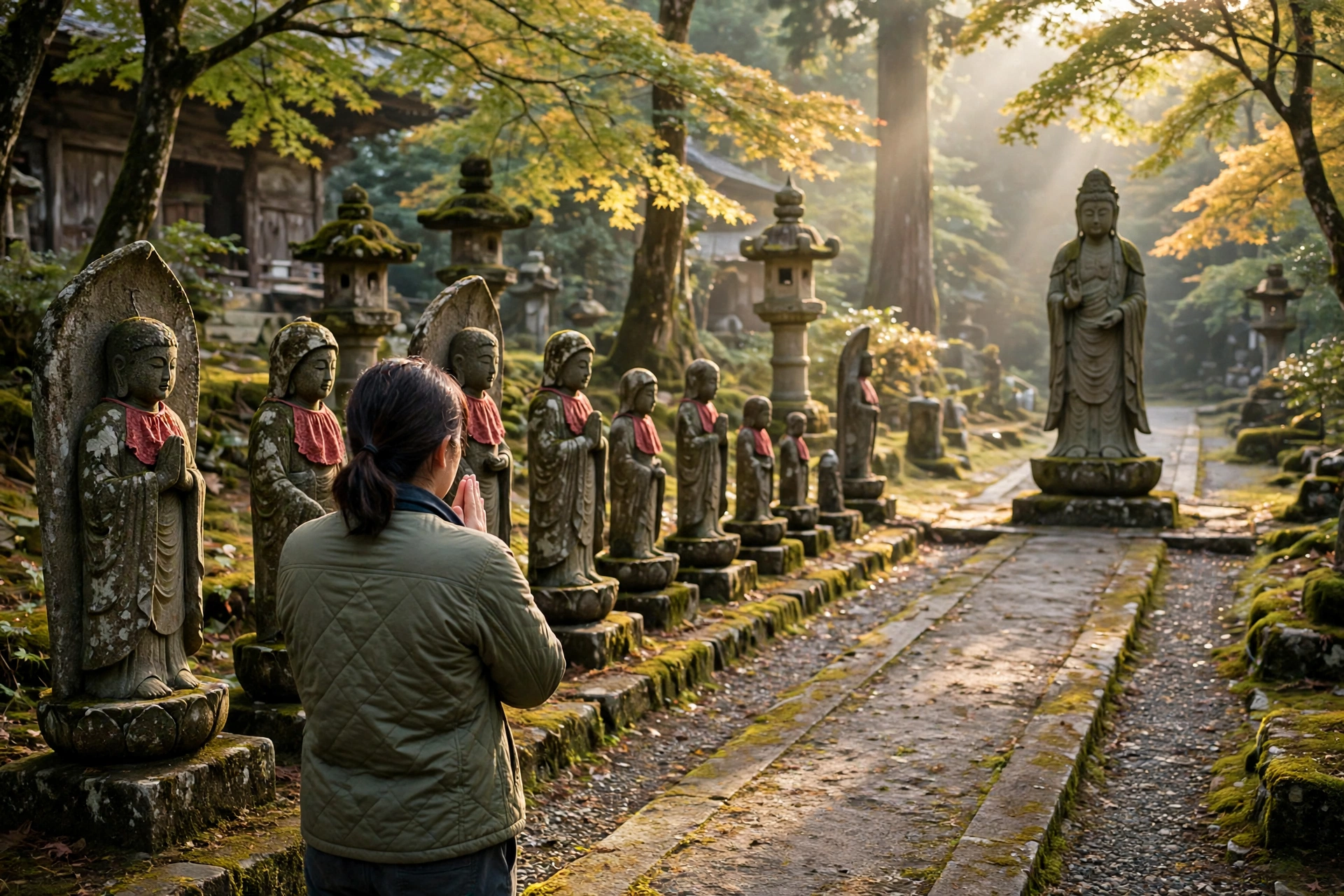
The result first
Beyond the four ranks and the Nyorai introduced in the basics article, a temple holds many more faces. This article adds them: Monju Bosatsu and Fugen Bosatsu flanking Shaka; Seishi Bosatsu, the second attendant in the Amida triad; Fudo Myoo, the Myoo with the angry face; the Four Heavenly Kings and Bishamonten, the Tenbu who guard the grounds; the Twelve Divine Generals and the Twenty-Eight Attendants who serve the Buddhas; and the two figures met most closely at funerals — the Honzon, the principal image of a temple and its school, and the Mizuko Jizo, the Jizo enshrined in cemeteries for children who died.
I am Kurashiki Bouzu (kurashiki-bouzu), born in 1971, a former funeral director now living in an old house in Kurashiki, Okayama, working with my AI butler Moka (Muse).
In Basics of Buddhist Statues, I read the statues by their four ranks — Nyorai, Bosatsu, Myoo and Tenbu — and lined up the Nyorai at the top. This article continues from there, using the same comparisons: a Nyorai is “one who has arrived,” a Bosatsu is “one who reaches out a hand,” a Myoo is “one who stops you even by scolding,” and a Tenbu is “one who guards the gate.”
The Honzon — the Buddha at the centre of a temple and its school
The Honzon is the Buddha enshrined at the centre of a temple and its school. At a funeral, the Honzon of the deceased’s school decides the shape of the service. In funeral work, a visit to a temple began with checking who its Honzon was. The face differs by school:
- Shaka Nyorai: the founder of Buddhism in his awakened form. The source of every school, and the Honzon of Zen
- Amida Nyorai: the Buddha of the Pure Land of Ultimate Bliss, who comes to meet those who recite the nembutsu at the end of life. The Honzon of the Pure Land schools
- Dainichi Nyorai: in esoteric Buddhism, the Buddha who is the universe itself. The Honzon of Shingon
- Yakushi Nyorai: the Buddha who heals illness. The medicine jar in his left hand is the mark, and he is the centre of prayers for recovery
The statue in the middle of the main hall may look the same in role, but the Honzon changes with the school — and that difference leads to differences in how a funeral proceeds and how memorial services are understood.
Monju and Fugen — wisdom and practice
Monju Bosatsu and Fugen Bosatsu flank Shaka Nyorai; together the three are the Shaka triad. Monju carries wisdom and rides a lion. Fugen carries practice and compassion and rides a white elephant.
A famous real statue is the Monju riding a lion at Abe Monju-in in Nara (National Treasure), made by Kaikei in 1203 — the Bosatsu behind the proverb “three people together have the wisdom of Monju.” Monju is also familiar from prayers for examinations and study.
The pair form the two wheels on the road to awakening: without both wisdom (understanding) and practice (doing), one does not reach salvation. They stand on the side that asks “how should we live?” rather than “where do we go after death?”
Seishi Bosatsu — the other attendant of the Amida triad
Seishi Bosatsu attends Amida Nyorai. Amida with Kannon Bosatsu and Seishi Bosatsu makes the Amida triad — also the shape of the welcoming descent, coming to meet a person at the end of life. Kannon carries compassion, Seishi carries the light of wisdom, and together they guide the dying to the Pure Land.
The mark of Seishi is the water jar on the crown. Seishi rarely stands at the centre of devotion alone; the statues are “one as a triad,” like the Amida triad at Chion-in in Kyoto, the head temple of the Jodo school. The Pure Land teaching takes this shape: a journey’s departure needs both feeling and reason.
Fudo Myoo — the rescuer with the angry face
The representative Myoo is Fudo Myoo, said to be Dainichi Nyorai changed into an angry form to save those who will not follow the teaching. He holds a sword in his right hand (cutting delusion and evil), a rope in his left (to pull people up), bears flames on his back, and sits on rock. He is the Honzon of the goma fire ritual, and a presence close to funerals as well.
That angry face is not anger — it is the face of someone stopping you in earnest. Facing the unease at the moment of death and the wavering of those left behind, Fudo shows a place to set the mind that does not move. In popular devotion, the Fudo Myoo of Naritasan Shinsho-ji in Chiba is widely known.
The Four Heavenly Kings and Bishamonten — generals who guard the four directions
The Four Heavenly Kings are Tenbu in the form of generals who guard the four sides of Mount Sumeru, the mountain at the centre of the world: Jikokuten in the east, Zochoten in the south, Komokuten in the west, and Tamonten in the north. They wear armour and tread on demons. The Four Heavenly Kings of Horyu-ji’s Golden Hall are said to be the oldest surviving set in Japan (Asuka period), and the set at Todai-ji’s Kaidan-in (Tenpyo period, National Treasure) is known as a realistic masterpiece.
Tamonten of the north is also worshipped alone as Bishamonten, counted among the Seven Lucky Gods, a god of wealth and of success in contests — Shigisan Chogosonshi-ji in Nara and Kurama-dera in Kyoto are famous. The Four Kings do not save individuals; they guard the teaching and the place itself, standing at the temple gate and hall — and at the outer edge of a funeral ground.
The Twelve Divine Generals and the Twenty-Eight Attendants — those who serve
The Twelve Divine Generals are twelve attendants in the form of generals who guard Yakushi Nyorai. Later they were linked to the twelve zodiac signs, and a devotion grew in which the general of one’s own birth sign serves as one’s guardian Honzon. The standing set at Shin-Yakushi-ji in Nara (Tenpyo period, National Treasure) survives complete.
The Twenty-Eight Attendants are the twenty-eight who serve Senju Kannon, the Thousand-Armed Kannon. Gods of the Tenbu, Ashura, and even the wind god and thunder god are counted among them; the set at Sanjusangen-do is the representative example. Ashura is a god of battle who turned to guarding the Buddha’s teaching, and the Ashura statue at Kofuku-ji in Nara is known as a statue made as a memorial offering for a deceased mother.
Around a Buddha, layers of guardians and attendants are placed. At a funeral, too, many hands gather around the person at the centre — the deceased. The shapes overlap.
Mizuko Jizo — the Bosatsu closest to the cemetery
Jizo Bosatsu travels through the six worlds, from the human world to hell, saving beings through the long age after Shaka’s death until the next Buddha appears. He is shown as a monk, holding a pilgrim’s staff in his right hand and a wish-granting jewel in his left. He is the closest Bosatsu to the cemetery, and the one who receives memorials for children who died.
A Jizo enshrined in a cemetery for the memorial of a child who died is a Mizuko Jizo. In the tale of the Sai no Kawara riverbed, children who died before their parents pile stones on the riverbed, and even when demons knock the piles down, Jizo saves them. In funeral work, I saw many people press their palms together before a Mizuko Jizo. Jizo places, inside the scenery of daily life, the view that “even after death, someone still comes around to save.”
In short
- The Honzon is the Buddha at the centre of a temple and its school; Shaka, Amida, Dainichi and Yakushi differ by school, and that difference decides the shape of a funeral
- The attendants have roles too: Monju (wisdom) and Fugen (practice) beside Shaka; Kannon (compassion) and Seishi (the light of wisdom) beside Amida
- Fudo Myoo, the Four Heavenly Kings and Bishamonten, and the Twelve Divine Generals and Twenty-Eight Attendants are the faces on the guarding and serving side
- The Mizuko Jizo is a Jizo enshrined in cemeteries for children who died — one of the statues closest to funerals and memorials
The basics of the ranks and how to tell the statues apart are in the earlier article:
- November 21, 2026 ― English draft created (ledger No. 1478; results-first rewrite of the Japanese article, ledger No. 1477, built from items that were on the knowledge shelf and not yet published).(6,607 characters)
- November 21, 2026 ― Published (all 7 languages at once, on the user's instruction 'publish the unpublished items in every language', 2026-11-21. The URL ends with the Japanese version's ledger number, No. 1477).(6,607 characters)