
How to Visit a Shinto Shrine — and the Shinto Year: Torii, Temizu, Two Bows Two Claps One Bow, from Hatsumode to Shichi-Go-San and Jichinsai
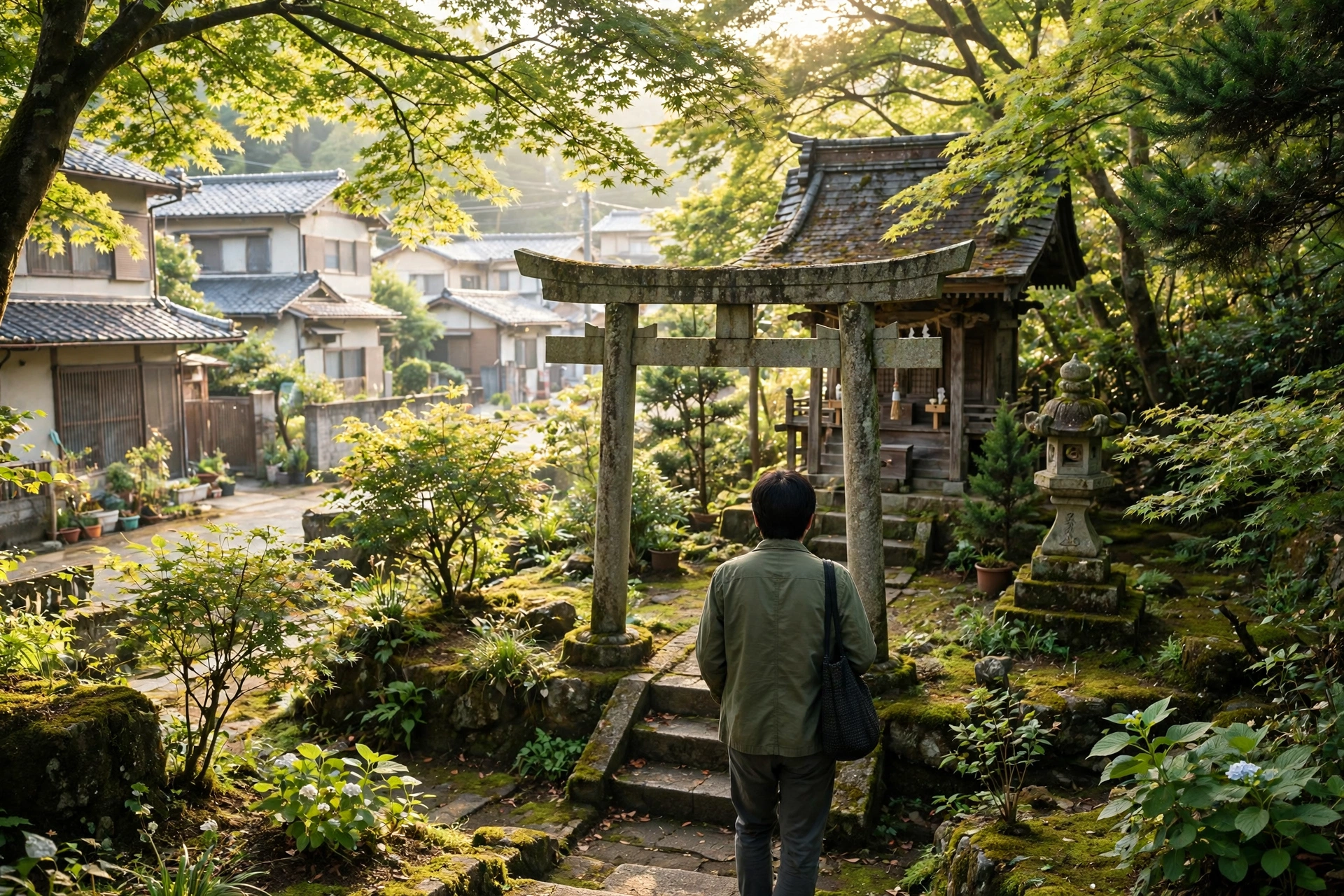
The result first: visiting a Shinto shrine takes five steps, and none of them is difficult.
- At the torii gate: bow once before you pass through. When you leave, turn back toward the shrine and bow once more.
- On the approach (sando): the centre is called seichu, the path of the kami, so walk at either side. (The Jinja Honcho — the Association of Shinto Shrines — also notes there is no strict rule about how to walk the approach.)
- At the water basin (temizuya): purify in this order — left hand, right hand, mouth, left hand again, then rinse the ladle’s handle. Remember: left, right, mouth, left, handle.
- At the hall: offer your coin quietly, ring the bell if there is one, then two deep bows, two claps, one deep bow (nihai nihokusho ippai). When you clap, the right hand is held slightly lower than the left.
- Charms and fortunes: ofuda (talismans) and omamori (amulets) are received, not bought. Renew them about once a year, and return the old ones to the shrine with thanks.
One exception to keep in mind: some shrines have their own form. At Izumo Taisha, the claps are four, not two. Where a shrine has its own way, the shrine’s way is the right way.
I am Kurashiki Bouzu (kurashiki-bouzu), born in 1971, a former funeral director. I now live in an old house — a kominka — in Kurashiki, Okayama, and work together with Moka, my AI butler. My blog has covered Shinto mostly through funerals so far. This article is different: it is about visiting a shrine, and about the festivals and milestones that fill a Shinto year. The material is a sourced knowledge set on shrines and Shinto that I had Moka assemble.
First, the scale: about 80,000 shrines, and kami are counted in “pillars”
A shrine (jinja) is a place where the kami of Shinto are enshrined. The number is usually given as “about 80,000.” The Agency for Cultural Affairs’ Religious Almanac (2025 edition) counts 80,570 organisations registered as “shrines” as of 31 December 2024. That figure counts registered religious organisations only; it does not include the small sub-shrines inside a large shrine’s grounds, or small unregistered wayside shrines. Read the number together with how it was counted.
A piece of trivia for your next visit: kami are counted with the counter hashira — “one pillar, two pillars” (hitohashira, futahashira). Talismans and amulets are counted with tai (“bodies”), and portable shrines (mikoshi) with ki. Ask “how many pillars are enshrined here?” and you will sound like a regular.
The visit, step by step
The torii and the approach
The torii marks the boundary between the sacred world and the everyday world. The shimenawa rope hung on a torii or a hall, with its white paper streamers (shide), shows that what lies inside is sacred and pure.
Temizu: purifying hands and mouth
Before praying, you purify your hands and mouth at the temizuya. Temizu is a simplified form of misogi, purification with river or sea water. The order, as Ise Jingu explains it:
- Take the ladle (hishaku) in your right hand, scoop water, and pour it over your left hand.
- Switch the ladle to your left hand and pour water over your right hand.
- Take the ladle in your right hand again, receive water in your left palm, and rinse your mouth. Never put the ladle directly to your mouth.
- Pour water over your left hand once more.
- Use the remaining water to rinse the ladle’s handle, and put it back.
Some shrines now use running water with no ladles. Follow that shrine’s signs.
At the hall: what you are actually looking at
The innermost building is the honden, which houses the sacred object (goshintai). Visitors do not enter it; you pray at the haiden (worship hall) in front of it. Between the two there is often a heiden, where offerings are presented. Small shrines in the grounds are sessha when they enshrine a kami closely connected to the main shrine’s kami, and massha for the others.
In a formal visit or a rite, you may also see tamagushi hoten: offering a sakaki branch with paper streamers to the kami and bowing. The branch is turned so that its root end faces the altar, and placed on the offering stand.
Ofuda, omamori and omikuji
An ofuda is a talisman received at a shrine, enshrined at home on a kamidana (household altar). Ise Jingu’s ofuda is called Jingu Taima and is placed at the centre of the kamidana as the talisman of the ujigami of all Japan. An omamori is like a small, portable ofuda, carried on your person or in a bag.
Both are best renewed about once a year. Return the old ones, with thanks, to the shrine’s collection point for old talismans, where they are ritually burned. Arrangements differ by shrine, so ask the shrine where you received yours. An omikuji fortune slip may be tied at the shrine’s tying place or taken home — again, follow that shrine’s guidance.
The kamidana at home
A kamidana is the shelf where ofuda are enshrined. The usual advice: a clean place where the family gathers, higher than eye level, with the ofuda facing south or east. In a three-door altar, the Jingu Taima goes in the centre, the ujigami’s ofuda on the right (as you face it), and a revered shrine’s ofuda on the left. The basic offerings are rice, salt and water, with sakaki branches on both sides. The Jinja Honcho adds an important softener: do not get too caught up in the form — what matters is to enshrine them in whatever way you can.
The Shinto year
| When | Event | What it is |
|---|---|---|
| Start of the year | Hatsumode | First shrine visit of the year: thanks for the past year, prayers for the new one |
| Day before spring begins | Setsubun | Bean-throwing — “Fortune in, demons out” — to drive off misfortune |
| 30 June | Nagoshi no Harae | The summer purification: cleansing half a year’s impurities, praying for health |
| Once a year | Reisai | Each shrine’s most important festival, on a day tied to its kami or its history |
| 31 December | Toshikoshi no Harae | The year-end purification, paired with the summer one |
Hatsumode grew from the custom of visiting one’s ujigami — the guardian shrine of one’s area. Today many people visit a shrine they revere, or a famous one. It does not have to be in the first three days: many households go within matsu no uchi, until 7 January (15 January in some regions).
Setsubun is the day before the first day of spring. Roasted soybeans are thrown while chanting “Fortune in, demons out.” The custom descends from tsuina, a court rite for driving off plague spirits.
Nagoshi no Harae (30 June) is one of two great purifications (oharae) each year. You pass through a large ring woven of cogon grass (chinowa) three times in a figure of eight, to ward off illness and disaster — the exact way differs slightly by shrine. Paper figures (katashiro) shaped like a person are rubbed over the body, breathed on to transfer one’s impurities, then floated away or offered at the shrine.
Life’s milestones
Omiyamairi (the baby’s first shrine visit) takes place around 30 days after birth, at the shrine of the ujigami, ubusunagami (the guardian kami of one’s birthplace) or chinju (guardian of the place). The birth is reported with thanks, and the child’s health and long life are prayed for. The guide days are the 31st day for boys and the 33rd for girls; some regions go at around 50 or 100 days.
Shichi-Go-San celebrates children at 3 (boys and girls), 5 (boys) and 7 (girls), around 15 November: thanks for safe growth so far, and prayers for happiness and long life ahead. Each age has an old name — at 3, kamioki (hair is allowed to grow); at 5, hakamagi (first wearing of hakama); at 7, obitoki (the child’s cord is replaced by an adult-style sash). “Until seven, a child of the kami,” the saying goes.
Yakudoshi are ages considered prone to misfortune, counted by the traditional age system (kazoe): for men 25, 42 and 61; for women 19, 33 and 37 — with the years before and after also treated carefully. Age 42 for men and 33 for women are the great yakudoshi. They are also turning points in strength, family and work, and people receive a yakuyoke purification prayer at a shrine. Another reading exists: yakudoshi can be heard as “the year of a role” — a year of service to the kami, and a milestone to mark with thanks rather than only fear.
Building rites come in three: jichinsai, the ground-breaking rite before construction, reporting the use of the land to the kami of the land and praying for safety and peace; jotoshiki / jotōsai, when the ridge beam is raised, giving thanks for progress and praying for safe completion; and shunkōsai / shintakusai, when the building is complete — the close of the sequence that began with jichinsai.
Shinzen-shiki, the Shinto wedding, is held before the kami at a shrine: the couple reports their marriage, exchanges cups in the sankon no gi rite, offers tamagushi, and recites vows; some shrines add a shrine maiden’s dance. Shinto weddings spread from the Meiji era onward and now stand alongside church and civil-style ceremonies.
Associations and festivals: each shrine’s year also holds seasonal rites — Saitansai at the new year, Kinesai praying for a good harvest, Niinamesai giving thanks for it. And ko are associations of people who revere the same kami — the Ise-ko for Ise Jingu, the Konpira-ko for Konpira — which once pooled money so a representative could make the pilgrimage for all (daisan). A shrine holds a community, not only individual wishes.
In short
- The visit: bow at the torii, walk at the side, purify (left, right, mouth, left, handle), then two bows, two claps, one bow. Where a shrine’s own form differs, the shrine’s form wins.
- Ofuda and omamori are received, not bought; renew them about yearly and return the old ones with thanks.
- The year turns on hatsumode, setsubun, the summer and year-end purifications, and each shrine’s reisai. Life turns on omiyamairi, shichi-go-san, yakudoshi, the building rites and the Shinto wedding.
- For the foundations of Shinto itself, and for Shinto funerals, see the companion articles on this blog.
Record of this article
- 2026-11-21: English draft created as a results-first rewrite of the Japanese article (ledger No. 1157). Sources are the sourced knowledge set “Basics of Shrines and Shinto” (Jinja Honcho, Ise Jingu, Meiji Jingu, prefectural shrine associations, the Agency for Cultural Affairs’ Religious Almanac 2025 edition, and Jinja no Iroha supervised by Jinja Honcho). No amounts of money appear in the sources, so none are stated. The cover image is shared with the Japanese article on the basics of Shinto (ledger No. 209). Not published.
- 2026-11-21: Published, together with the Japanese original and the other five language versions, on the user’s instruction.
- November 21, 2026 ― English draft created (ledger No. 1158; results-first rewrite of the Japanese article, ledger No. 1157). Not published.(8,685 characters)
- November 21, 2026 ― Published (all 7 languages at once, on the user's instruction). Japanese original: ledger No. 1157.(8,790 characters)