
Honrenji (Ushimado, Setouchi City, Okayama) — A Seaside Temple That Welcomed the Korean Envoys
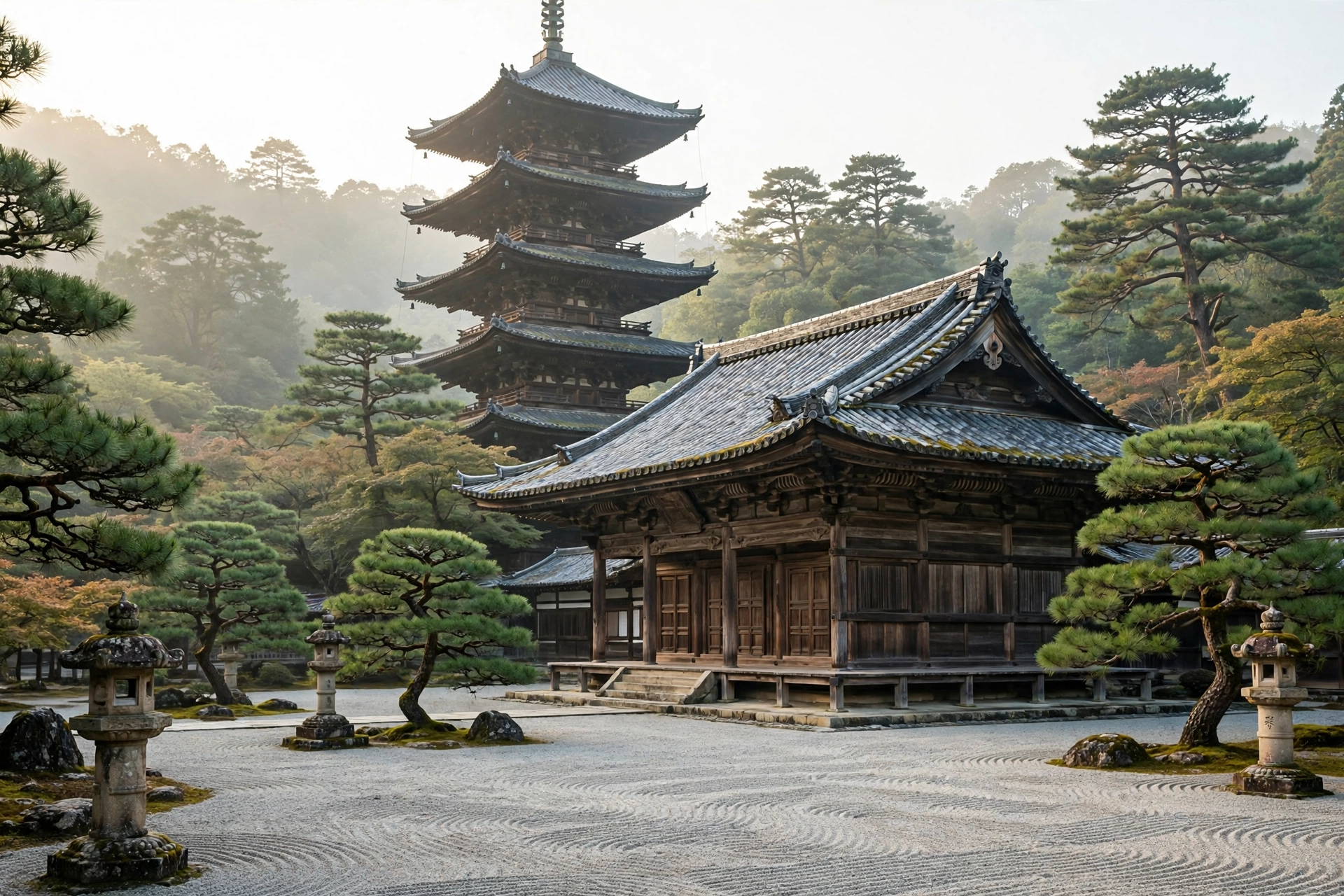
The point first: Honrenji, in the seaside town of Ushimado, preserves a main hall rebuilt in Meio 1 (1492) in the late Muromachi period, together with other national Important Cultural Properties, and in the Edo period it served four times as a lodging for the three envoys of the Korean diplomatic missions. Its precinct is a national Historic Site. Honest limits matter here too: its founding story, its specific principal image, its own annual events, and any reception for perpetual memorials or funerals could not be confirmed in public sources, so this article does not state them.
I am Kurashiki Bouzu (kurashiki-bouzu), born in 1971, a former funeral professional now living in an old house in Kurashiki, Okayama, working with Moka, my AI butler.
This is one article in a series introducing temples across Japan, one temple at a time. This time it is Honrenji in Ushimado, Setouchi City, Okayama Prefecture. This article was organized from official published sources of the temple, public bodies and the Agency for Cultural Affairs; it is not a record of a visit I made myself, and I state that honestly at the outset.
Basic information
- Address: 3194 Ushimado, Ushimado-cho, Setouchi City, Okayama Prefecture 701-4302
- Telephone: 0869-34-2014
- School: a temple of the Nichiren line. Okayama Prefecture’s official tourism information introduces it as “Honrenji of the Hokke School,” while Okayama Prefecture’s cultural property commentary describes it as “a Nichiren School temple” — the wording differs by source, and I note here that both forms exist.
- Principal image: what exactly is enshrined, and how, in Honrenji’s main hall could not be confirmed within public sources, so this article does not describe a principal image specific to Honrenji. For reference, the Hokke School (Honmon-ryu) administration’s official explanation says the school’s principal object of worship is “the Namu Myoho Renge Kyo transmitted by Jogyo in the eight chapters of the Honmon,” shown in the form of the “Great Mandala of the Ten Worlds,” hung at the front of the altar. That is an explanation of the school, and should be read separately from how images are enshrined at Honrenji.
History
The detailed story of Honrenji’s founding could not be confirmed within the public sources checked this time. A tradition exists that it began in Shohei 2 (1347), when Daikaku Daisojo built a Hokke-do hall, but it could not be directly corroborated in public sources, so I leave it here as a story transmitted as temple tradition.
What could be firmly confirmed is the history of its buildings. Setouchi City explains that the present main hall, from an ink inscription on its ridge beam, was rebuilt in Meio 1 (1492) with the help of the Ishihara family, who were patrons of Honrenji. A late Muromachi-period building still stands in Ushimado today.
The other indispensable part is its connection with the Korean envoys. In the Edo period, when the Korean diplomatic missions — envoys of goodwill who came to Japan 12 times — called at Ushimado port, Honrenji was used four times as the lodging for the three envoys. It was later also used as a lodging for Okayama Domain officials who received the missions, and calligraphy scrolls written by envoys and celadon vases are said to have been preserved. The precinct is designated a national Historic Site as the “Korean Envoy Site: Honrenji Precinct, Ushimado,” and in October 2017, “Memories of the Korean Envoys” were registered in UNESCO’s Memory of the World.
Highlights
- Main hall (national Important Cultural Property): designated in Showa 17 (1942). Five bays across the front and five at the side, with a porch, hip roof and formal tile roofing; rebuilt in Meio 1 (1492). Okayama Prefecture’s commentary describes a richly colored inner sanctuary with carving on the altar, and notes viewing is of the exterior only.
- Banshin-do [3 buildings] (national Important Cultural Property): designated in Showa 33 (1958). A shrine hall enshrining the thirty guardian deities of the Lotus Sutra, with the East, Middle and West shrines standing in a row inside a covering structure. The West Shrine is said to have been built in Meio 9 (1500).
- Middle gate (national Important Cultural Property): designated in Showa 45 (1970). A ridge-beam-style gate transmitted as rebuilt around the same Meio 1 period as the main hall.
- Three-story pagoda (Important Cultural Property designated by Okayama Prefecture): built in Genroku 3 (1690), 18.1 m in total height.
- Founder’s hall (Important Cultural Property designated by Okayama Prefecture): built in Genroku 4 (1691), enshrining the founder.
- Mountain gate (designated cultural property of Setouchi City): listed in the city’s designated cultural properties.
- Garden: Setouchi City’s official tourism site introduces the guest hall garden as “a splendid garden by Kobori Enshu.” The details of its creation could not be confirmed in other public sources, so this is presented as a quotation from that guide.
Events
For Honrenji’s own annual events, no guide giving dates could be found within public sources. This article therefore does not give event dates. The head temple of the Hokke School, Honno-ji in Kyoto, publishes memorial events such as Higan-e and Urabon, but those are Honno-ji’s guides and are not treated here as Honrenji’s events.
Funerals and memorial services
For Honrenji’s reception of perpetual memorials, graves, interment of ashes and memorial services, nothing could be confirmed within public sources — in part because no official site of the temple itself could be confirmed. This article therefore does not give specific reception guidance.
As a school reference, the Hokke School (Honmon-ryu) administration’s official explanation places the Lotus Sutra (Myoho Renge Kyo) as its foundational scripture, with the principal object, Namu Myoho Renge Kyo, and the sacred title at its center. For an actual consultation at Honrenji, asking the temple directly is the reliable course.
Practical information for a visit
- By car: about 20 minutes from Okuku Interchange on the Okayama Blue Line
- Public transport: from JR Okuku Station, take a bus toward Ushimado for about 20 minutes and get off right at “Honrenji-shita”
- Viewing guide: the main hall, three-story pagoda and founder’s hall are “exterior only” in Okayama Prefecture’s cultural property commentary, and the precinct as a Historic Site is “exterior free to view”
- Viewing hours and fees: these could not be confirmed in public guides. Checking by telephone before you go is the safe course
In the town of Ushimado, close to the sea, a Muromachi-period main hall and the history of welcoming envoys from a distant country remain quietly present. Even following the sources alone, the weight of this temple comes through.
Sources
- Setouchi City official tourism site, “Honrenji” https://www.okayama-kanko.jp/setouchi/spot/detail_11181.html
- Setouchi City official, “Honrenji main hall” https://www.city.setouchi.lg.jp/soshiki/23/3079.html
- Setouchi City official, “Korean Envoy Site: Honrenji Precinct, Ushimado” https://www.city.setouchi.lg.jp/soshiki/23/3059.html
- Setouchi City official, “Honrenji Banshin-do [three buildings]” https://www.city.setouchi.lg.jp/soshiki/23/3080.html
- Setouchi City official, “Honrenji middle gate” https://www.city.setouchi.lg.jp/soshiki/23/3078.html
- Agency for Cultural Affairs, Cultural Heritage Online, “Honrenji main hall” https://online.bunka.go.jp/heritages/detail/146758
- Okayama Prefecture official, “Honrenji three-story pagoda” https://www.pref.okayama.jp/uploaded/attachment/262180.pdf
- Hokke School (Honmon-ryu) administration official, “About the Hokke School” https://www.hokkeshu.or.jp/about/index.html
- November 22, 2026 ― Published in English (translation of the Japanese article, ledger No. 2672)(6,523 characters)