
A Funeral That Does Not Fail Begins While They Are Still Alive — The Law Decides Only 'Cremation'
The result first: the law does not decide the form of a funeral at all. The Graveyard and Burial Act (enacted in 1948) never even uses the words “funeral ceremony” — it decides only three things: a permit from the mayor is required, cremation and burial must wait 24 hours after death, and cremation must be at a crematorium and burial in a licensed cemetery. A wake, a farewell ceremony, an altar, sutra reading, and the number of attendees carry no legal obligation whatsoever; they are all custom and the family’s free choice. That is why I, a former funeral company owner, think a funeral that does not fail begins while they are still alive: if the goodbye is made while they are alive, there is no need for a funeral for appearances, and no need to force the budget to a total of about 2,000,000 yen against 1,000,000 yen left behind.
I am Kurashiki Bouzu.
I am a former funeral company owner. Today I will write my thoughts on “a funeral that does not fail.”
Let me write something like a conclusion first. This is what I think.
A funeral that does not fail is one where the family prepares the time to say goodbye to the deceased person from while that person is still alive.
If the time of death is near, be beside them as much as time allows. With just that, something is conveyed to each other, I think.
Right After Death, There Is No Time to Think
Why “from while they are still alive”? You can see it by looking at the situation families are placed in right after a death.
The first place a family is made to stand is a hospital. A nurse tells them, “Please have a funeral home come to receive.” In the middle of grief, the first thing that must be decided is the reception (transport).
In the past, near the morgue, phone numbers of nearby funeral homes were posted. In recent years, that is seen less often. What remains to rely on is a homepage found on a smartphone. There, only good things are lined up with beautiful photos. “Funerals from 100,000 yen.”
However, if you say, “Please just do the transport. The funeral will be asked of another place,” a transport fee costing about half of that 100,000 yen may be charged. After the body has already been moved, you cannot refuse.
When the funeral ends and the family sees the bill, they are surprised twice. Once at the sheer gap from the words “from 100,000 yen.” And at the fact that they have already paid. Without knowing whose funeral it was, or for what, only the weekly memorial services pass, and feelings finally settle about three months later. Reviewing receipts while preparing the tax return, they look back for the first time at what had happened in those few days.
Lining up the receipts, the contents are like this. Fees to the funeral home, thanks to religious persons, food costs, cremation costs, hospital costs, and various others. Added together, the total becomes about 2,000,000 yen.
The property their mother left was 1,000,000 yen. The shortfall has to come from daily life. A housing loan, an education loan, a car loan. The monthly household budget was in the red to begin with. The funeral benefit from health insurance is about 50,000 yen. The phrase “a drop in the bucket” is for times like this, I suppose.
Where did the words “from 100,000 yen” go? What remained was a total of 2,000,000 yen, and the life from here on.
Made to decide with no time to think and no room to compare. That is the reality of a family right after a death. That is precisely why preparation for a funeral is too late after death.
If a goodbye can be made in that way while they are alive, a funeral for appearances is not needed. In the past there were things like “use the same altar as the neighbor, Mr./Ms. XX,” a rivalry over the splendor of altars, but that was not for the deceased person — it was a form conscious of the eyes around them.
In fact, this story has legal backing too. This time, I looked into that.
Is There a Legal Rule for a Funeral?
The center of the laws involved when a person dies is the “Act on Graveyards, Burials, etc.” It is a law made in 1948 (Showa 23), abbreviated as the “Graveyard and Burial Act (bochimai-ho).”
Article 1 of this law states its purpose as follows.
The purpose of this Act is to ensure that the management of cemeteries, ossuaries, and crematoriums, and burials and related matters, are carried out without hindrance, in conformity with the religious sentiments of the people and from the standpoint of public health and other public welfare.
And in Article 2, the meanings of “burial” and “cremation” are decided.
In this Act, “burial” means to bury a corpse (including a stillborn fetus of four months or more of pregnancy. The same applies hereinafter) in the ground.
In this Act, “cremation” means to burn a corpse in order to bury it.
What matters here is that, wherever you read in this law, the words “funeral” or “funeral ceremony” themselves never appear.
What the law decides is not about ceremonies. It is only how to handle a deceased body, and its procedures.
Specifically, these three.
- A permit from the mayor is required (Article 5) — A permit is required to perform burial, cremation, or reburial, and a “cremation permit” is issued. It is that document, processed together with the death notification to the municipal office.
- After 24 hours have passed since death (Article 3) — It is decided that neither burial nor cremation may be performed until 24 hours have passed since death.
- The place is decided (Article 4) — Cremation at a crematorium. Burial (earth burial) and burying burned ashes, at a licensed cemetery.
That is all. Turning it over, for the “form of a funeral” — a wake, a farewell ceremony, an altar, sutra reading, the number of attendees — there is no legal obligation at all. Those are all custom, and the family’s free choice.
Incidentally, earth burial is also permitted under the law. However, a licensed cemetery is required, and in reality almost all of Japan is cremation. The core the administrative side asks for is “to receive a permit and cremate (cremate to ashes) at a crematorium.” No more than that, no less — that is the figure of the law.
Who Was the Altar for Appearances For?
If the law does not ask for it, why were there so many splendid funerals in the past?
In my feeling from when I was on the floor, it was appearances. Use the same altar as the neighboring house. For the sake of relatives and neighbors, it cannot be made small. There was an era when the quality of a funeral was measured by the size of the altar and the number of attendees.
But would the deceased person themselves be pleased with a large altar?
I have words I often said to customers who thanked me after a funeral ended.
“I help in the hope that, in the other world, the deceased person will say to me, ‘My funeral was truly good,’ and only then will I feel the funeral has truly ended safely.”
If you say it is a matter of spirit, that is true. But what the deceased person would think is “good” should not be the splendor of the altar. It is that the family did not force themselves. That they did not go into debt to see them off. And above all, that a proper goodbye could be made while they were alive.
A Goodbye Can Be Made While They Are Alive
That is why I think a funeral that does not fail “begins while they are still alive.”
When you know the time of death is near, no grand preparation is needed. Be beside them as much as time allows. Hold their hand. Talk of old times. Just be together. With just that, there is something conveyed to each other.
Families who have spent such time do not waver over the form of the funeral. Even if someone says “It’s small,” they are not shaken. Because the goodbye is already done.
Conversely, families whose goodbye while alive was insufficient tend to try to put their feelings into the form — “at least the funeral should be splendid” — and force both budget and feelings. I feel that often leads to the feeling of “it failed” after the funeral.
The law decides only up to the cremation procedures. Everything else, the family may decide freely. I hope that freedom will be used not for appearances, but for the deceased person and the family.
The Time Until Cremation Is Also Time for Goodbye
And after death, time still remains.
By law, cremation cannot be done for 24 hours after death. Due to crematorium reservation circumstances, it is not rare for cremation to be several days later. That time is not merely “time being made to wait.”
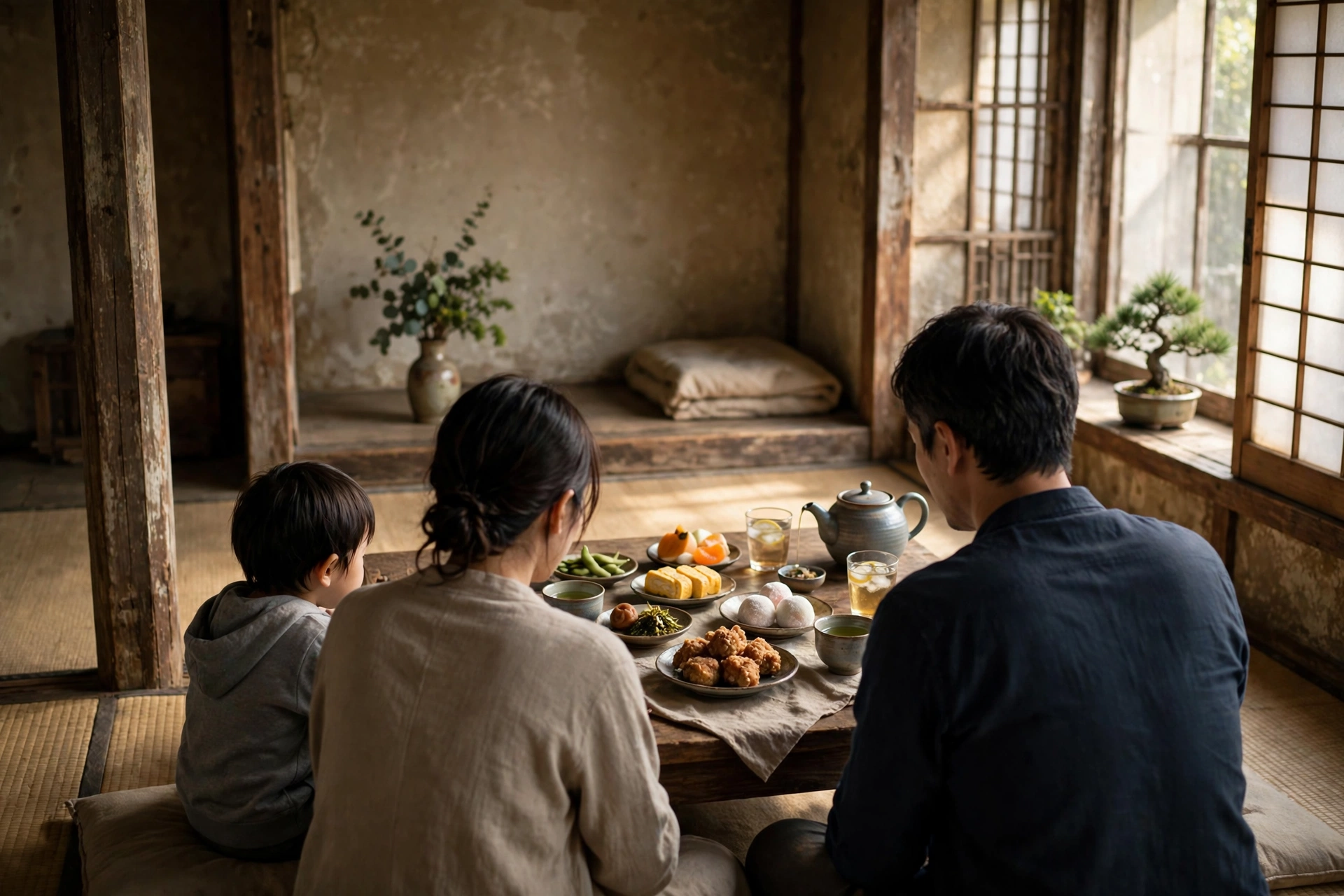
Surround the deceased person and talk of old times. Prepare things the deceased person liked to eat and drink in life, and spend time leisurely while everyone savors them.
I think that itself is a memorial offering. Even without a splendid ceremony, if there is a final time to spend with the deceased person, that becomes the best send-off.
I sometimes hear from families who chose direct cremation or a cremation ceremony, “The time for goodbye was short, and I regretted it.” But if you can spend the days until the cremation day slowly at home, even if the form is small, the goodbye is sufficient. The amount of goodbye is decided not by the size of the ceremony, but by time, I think.
When people speak of funeral preparation, many start from talk of venues and altars, but the real preparation is further before that. The time while they are alive, and the time until cremation comes. That is my conclusion.
This article was written based on the real experience of a former funeral company owner and the current text of the “Act on Graveyards, Burials, etc.” (Act No. 48 of 1948), confirmed on e-Gov Law Search. Quotations of articles are from Articles 1 and 2 of that Act. It does not assert an interpretation of the law. For specific procedures, please check with your municipality or a specialist. This article was written with the help of the AI “Muse.”
- Act on Graveyards, Burials, etc. (e-Gov Law Search) https://laws.e-gov.go.jp/law/323AC0000000048
- Outline of the Act on Graveyards, Burials, etc. (Ministry of Health, Labour and Welfare) https://www.mhlw.go.jp/stf/seisakunitsuite/bunya/0000130181.html
Record of This Article
- Publication date: November 15, 2026
- Character count: About 3,730 characters (Moka counted)
- November 18, 2026 ― English draft created (results-first rewrite of the Japanese article, ledger No. 21). Not published; publication is a separate step.(8,374 characters)