
Can You Do a 'DIY Funeral' Without a Funeral Home? — A Former Funeral Company Owner Checked the Law and the Prices
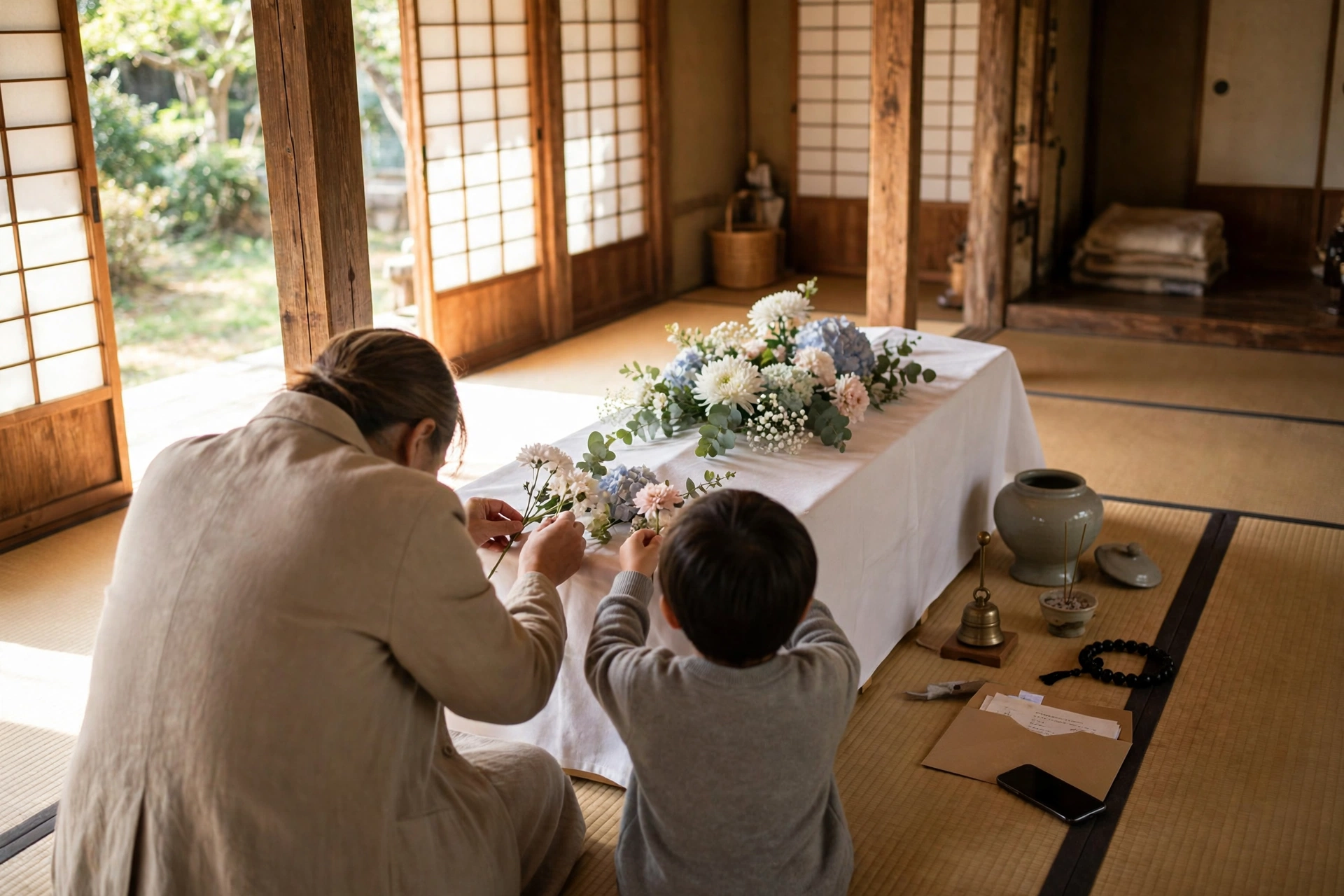
The result first: yes, with conditions. Using a funeral home is not a legal obligation, and there is no national qualification or business license required for funeral work itself, so a family seeing someone off with their own hands is not illegal in any way. What is fixed is only the public procedure to cremation — a death certificate by a doctor only, a cremation permit from the mayor only, no cremation within 24 hours, cremation only at a licensed crematorium, and burial only in a licensed cemetery. In Kurashiki City, the cremation fee for a city resident is 6,500 yen, a mail-order set of coffin and urn starts at 35,000 yen plus 3,000 yen shipping, and the total for a full DIY is roughly in the 40,000 to 50,000 yen range, against 150,000 yen (165,000 yen including tax) and up for a cremation-only funeral at a funeral home. The difference of over 100,000 yen is not the price of things — it is the price of people’s effort and standby. With Kurashiki’s 50,000 yen funeral benefit returned, the real burden can fall close to zero. The biggest wall, however, is transport, and leaving transport and departure to a professional is the realistic line.
I am Kurashiki Bouzu.
I am a former funeral company owner. Today, I did a somewhat bold piece of research.
“Can a family do a funeral by themselves, without using a funeral home?”
Let me write the conclusion first. With conditions, yes.
Using a funeral home is not a legal obligation. For the work of funerals itself, no national qualification or business license is required. A family seeing someone off with their own hands is not illegal in any way.
By the way, the qualification “Funeral Director” is also not a national qualification. It is a title certified by a private association based on a skill examination certified by the Ministry of Health, Labour and Welfare (Grades 1 and 2). Passing is required to call yourself a “Funeral Director,” but it is not a condition for doing funeral work. Occasionally there are funeral homes that write it on their homepage as if it were a “national qualification,” but that is not an accurate way of writing. In a survey by the Ministry of Internal Affairs and Communications, such misleading displays have also been subject to correction.
However, not everything can be done freely. There are parts that even a family cannot replace, clearly decided. I will write from there.
Parts No One Can Replace
What is decided by law (the Act on Graveyards, Burials, etc. = the Graveyard and Burial Act, and others) is this part.
- A death certificate (postmortem examination certificate) can be made only by a doctor
- A death notification is submitted to the municipal office within 7 days (Family Register Act). This is the family’s work
- Only the mayor of the municipality issues a cremation permit. Cremation cannot be done without a permit
- Cremation cannot be done within 24 hours of death
- Cremation can be done only at a licensed crematorium
- Burying ashes (interment) can be done only inside a licensed cemetery. They cannot be buried in a place other than a cemetery, such as a home garden
- Moreover, even inside a cemetery, you cannot bury freely. You must apply to the cemetery manager with the permit and receive confirmation before burial or interment can be done (Article 14 of the Graveyard and Burial Act). Even for a grave where you hold the right of use, the application and confirmation procedures cannot be omitted
In other words, even if the form of the ceremony is free, the “public procedure to cremation” is decided. This is the same for a funeral home and for a family, and cannot be skipped.
The order of practice is also important. Depending on the municipality, the correct order is to first reserve the crematorium, and then go for the death notification and cremation permit procedures. Going in reverse creates double work.
What Happens Locally in Kurashiki
I checked in Kurashiki City, where I live (the city’s official guidance).
- The cremation fee is 6,500 yen for a city resident. For non-residents, however, it jumps to 44,000 yen to 65,000 yen
- In Kurashiki City, an individual cannot directly reserve a crematorium. If you do not use a funeral home, after the death notification and cremation permit procedures at the city hall main office, you apply at the funeral service office (sosai-zumesho) in the main office
- The city’s hearse and funeral supplies can also be requested at that funeral service office
- The crematoriums are currently the Central Crematorium and the Tamashima Crematorium (Kojima and Mabi closed in March 2025)
Interestingly, there are cities like Nagano City that officially guide that “an individual can reserve a crematorium by phone.” How easy a DIY funeral is varies greatly by the municipality where you live. This is the biggest dividing point.
In addition, among crematoriums that do not accept individual reservations, there are some where it is not a judgment at the counter, but the reservation system itself is built on the premise of going through a funeral home, and an individual cannot enter the entrance to reservation. This is Kurashiki Bouzu’s feeling from the floor: rather than “individuals refused,” there are crematoriums that “are not built for individuals to enter.”
Tools Are Now Available by Mail Order
Coffins and urns can now be bought normally by mail order.
- At “Kankon Sosai Kenkyujo,” a mail-order specialist for funeral supplies in Kumamoto, there is a Direct Cremation (Family Funeral) Set Course A, 35,000 yen + 3,000 yen shipping. The contents are an assembly-type coffin, bedding inside the coffin, a 7-sun urn, an urn box, a furoshiki wrapping cloth, and ash-picking chopsticks
- The “DIY Funeral Set” from Tsubasa Koekisha, a funeral home in Nagano, is also sold on Amazon. It is a set with a coffin, bedding, urn, urn box, and furoshiki, plus a handbook on how to proceed (prices change. The display Kurashiki Bouzu confirmed on screen on November 6, 2026, was 43,000 yen)
Here, let me write honestly.
In the past, Kurashiki Bouzu himself was on the side of selling coffins and urns by mail order as a funeral home.
That is precisely why I think the true meaning of coffins and urns being buyable by mail order is not “being able to buy cheaply.” It is that prices came out into the open.
In the past, consumers had no way of knowing how much a coffin was or how much an urn was. Now it is different. If a funeral home’s estimate says “Coffin: XX ten-thousand yen,” you can compare it on the spot with the mail-order price.
Consumers want to know cost and profit. I think that is a natural feeling.
The Cost Story Needs a Preface
In the past, there was a TV program like this. It featured “The cost of a coffin is a few thousand yen. At a funeral home it is sold for tens of thousands of yen,” and got comments from people on the street.
I understand the feeling. But seen from the floor, that way of presenting figures needs a preface.
Even if a funeral supplies wholesaler put a price of a few thousand yen on a coffin, that does not become the purchase price for all funeral homes as it is. Prices change with the number traded. A funeral home that buys only 5 a month and one that buys 50 a month have different conditions. For shipping alone, a company with 5 a month may pay 2,000 yen per coffin, while a company with 50 a month may get free shipping. The purchase price itself is not the same.
Then, is a large company that purchases a lot cheaper? Not necessarily. Large companies have fixed costs such as labor for employees and part-timers, and facility costs for splendid halls. If they do not put that somewhere in the price, the company will collapse. Conversely, a company with 5 a month has fewer people, and hall costs are not as high as a large company’s.
Each company decides the prices of goods and plans and provides them while carrying such circumstances. It is easy to cut out only the cost and feature it amusingly as “a few thousand yen becomes tens of thousands of yen.” But with and without such a preface, the consumer’s reception changes greatly. I would like the side making programs to know that.
There is another change of the times. Old funeral home estimates listed each item: altar so much, coffin so much, dry ice so much, labor so much. At some point that changed to a single lump price called a “funeral plan,” and the contents became invisible. A black box.
One big reason, Kurashiki Bouzu thinks, is how mass media featured it. If you cut out only the unit price of goods and attack “how many times the cost,” showing unit prices becomes a loss. If you make it a plan, you will not be pressed on individual amounts. From the funeral home’s side, that is easier.
It is an ironic story. Wanting to know the breakdown is a natural feeling for consumers. But at the end of the exchanges over how to show it, the industry fled toward not showing the breakdown. The more you want to know, the harder it became to know.
Then What Is the Difference from a Funeral Home’s Price?
Let me try an estimate for a full DIY in Kurashiki (a lower-bound guide, adding only prices with sources).
| Item | Amount |
|---|---|
| Cremation fee (Kurashiki citizen) | 6,500 yen |
| Coffin, urn, and other tools (mail order) | 35,000 yen + 3,000 yen shipping |
| Dry ice (for cooling) | About 5,000 yen to 10,000 yen |
| Total | About 40,000 yen range to 50,000 yen range |
On the other hand, if you ask a funeral home for a cremation ceremony (direct cremation), for example at a published plan of a funeral home in Saga, there is a price of from 150,000 yen (from 165,000 yen including tax).
What is this difference of over 100,000 yen the price of? It is not the price of things.
- The price of standby — answering the phone even at night and rushing over immediately
- The price of two transports — from hospital to home, from home to crematorium
- The price of cooling and management during placement
- The price of agency for municipal procedures and accompaniment at the crematorium
In other words, it is the price of people’s effort and standby. DIY is cheap because it replaces this part with the family’s effort and responsibility. If you do not think of it separately, it becomes crude talk in both directions: “funeral homes are profiteering” or “DIY is almost free.”
When looking at an estimate, look separately at the price of things (the part that can be compared with mail order) and the price of people’s effort. That is how to read it in an age when prices are out in the open.
With the Funeral Benefit, the Real Burden Falls Further
There is one more important sum of money. The funeral benefit.
If the deceased person was enrolled in National Health Insurance or the Late-Stage Elderly Medical Care system, a funeral benefit is paid by the municipality to the person who held the funeral (such as the chief mourner).
- Kurashiki City pays 50,000 yen (city official)
- However, the amount is not uniform by law — it is decided by municipal ordinance. Looking nationwide, there are municipalities with 30,000 yen, and places like Tokyo with 70,000 yen
- In Kurashiki Bouzu’s memory, there was an era in the past when it was more generous. It has gradually fallen to its current form
In Kurashiki’s case, the calculation is that the 50,000 yen funeral benefit returns against the DIY estimate (from the 40,000 yen range). The real outlay may fall close to almost zero.
However, there are two cautions.
- If you do not apply, you do not receive it. The deadline is 2 years from the day after the funeral
- A receipt proving the funeral was held is required. In the case of DIY, be sure to keep mail-order receipts and cremation fee receipts
Transport, the Biggest Wall
In fact, the biggest wall in a DIY funeral is neither law nor tools. It is transport.
Speaking of legal interpretation, a family transporting in their own car, free of charge, is not itself a “business.” When you transport another person’s deceased body as work, for money, you need a license for the freight motor carrier business and a green license plate.
However, the floor is different.
First, it stops on the side of carrying out. Most deceased persons die in a hospital. The car that carries a deceased body out of a hospital is a stretcher vehicle (shintai-sha). What a stretcher vehicle carries is the “body” itself. A stretcher vehicle is loaded with a stretcher whose legs fold. Moving the body onto that stretcher is done not at the exit but in the hospital room or the morgue. The car that carries the body in a coffin is a hearse (reikyusha), the car at the time of departure. Even that stretcher vehicle waits attached to the hospital exit; the car does not come to the hospital room. Moving a deceased body inside a hospital is by stretcher or bed. A trolley is a tool for carrying things, not for carrying a deceased body. From the hospital room to the exit is movement inside the hospital, a section that cannot proceed without the hospital’s arrangements. It is not built so that a family can carry directly from the hospital room to a private car. On top of that, hospitals normally refuse handover to a private car. Conversely, if it is a licensed stretcher vehicle, handover is done without problem. The one who dispatches that car is a funeral home or a stretcher vehicle operator.
A death certificate can be written only by the doctor who was in charge of the deceased person. If death occurs at night and the doctor in charge is not there, a death certificate may not be issued on the spot, and without a certificate the deceased body cannot be moved. Also, if transport by private car becomes known at a checkpoint or such, there is a fear the story will reach the hospital that handed it over, so the hospital side also has no reason to hand over to a private car.
In the past, there was a story like this. A family transported from a hospital in their own car. Carrying out required the help of the doctor and several nurses, and for that, the charge for angel care (postmortem care), normally 20,000 yen, was billed at 50,000 yen, according to one customer. Neither the issuance of a death certificate nor angel care is a fee covered by insurance points. Since there is no official price, the amount is at the hospital’s asking price. There was also a story of 100,000 yen for issuance of a postmortem examination certificate. Borrowing the hospital’s hands also means that cost is incurred.
The receiving side is the same. In Kurashiki Bouzu’s feeling from the floor, 99% of crematoriums nationwide do not accept delivery by private car. If the crematorium does not accept it, you cannot transport even if you want to.
Why do crematoriums not accept private cars? The reason is simple: cremation has fixed times. Furnaces are divided by time, and if one case is delayed, it troubles everything behind it that day.
It was different in the past. Coffins were carried by human hands, and even if carried in by private car, it was an era when human hands could manage somehow. It overlaps with the time when Kurashiki Bouzu was on the floor.
Now is the era of electric trolleys. A trolley semi-automatically receives a coffin placed in a hearse and carries it as-is to the furnace. The equipment itself is built to fit the shape of a hearse. A private car does not ride that system.
In 2017, there was also an exposure called the “White Plate Hearse Incident.” Five funeral operators in Tokyo and Kanagawa were referred to prosecutors on suspicion of violating the Freight Motor Carrier Business Act for using unlicensed private cars as hearses. The trigger was information from Kawasaki City to the police that “white-plate hearses are entering and leaving the municipal crematorium.” How seriously the crematorium side watches which cars come in — this incident tells it well.
Therefore, for transport and departure, asking a professional is realistic. The reason the earlier estimate does not include transport charges is that this part is premised on asking a professional, and charges vary by region and distance. The first step of DIY does not begin with “how to transport it yourself,” but with “how to secure transport.”
Just One Thing, Let Me Say Strongly: Dry Ice Accidents
When placing at home for DIY, dry ice is used to cool the deceased body.
This dry ice — accidents of death by carbon dioxide poisoning have actually occurred. It is a matter for which the National Consumer Affairs Center and the Consumer Affairs Agency have issued official cautions, and there were accidents in home placement as well.
- Always ventilate the room
- Do not bring your face too close to the coffin
- Do not stay alone, attached, for a long time
It is dangerous work if handled with the light feeling of “something that cools.” Please hold this as knowledge even when leaving it to a professional.
It Is Not All or Zero
Reading this far, some may have thought, “Doing it all myself is impossible.” That is normal.
In reality, there is a middle.
- Ask a funeral home only for transport (there are funeral homes that publicly state “transport only”)
- Use the city’s hearse (in Kurashiki, you can consult at the funeral service office)
- Buy tools by mail order and receive professional follow-up only for the troublesome parts (the seller of the DIY funeral set prepares such a way of receiving)
The “range to do yourself” and the “range to leave to others” can be decided separately.
Finally
A DIY funeral suits, I think, people who do not spare effort, who have the hands of siblings and relatives together, and who live in a region where the municipal counter is easy to consult. Conversely, in the middle of sorrow, carrying the municipal office, the crematorium, and driving alone is honestly a harsh story.
Whether money can be saved cheaply is the second story.
Whether you can have the time, over the few days until cremation, to surround the deceased person and say goodbye slowly while talking of old times — Kurashiki Bouzu thinks that is the real dividing point.
A funeral home is, originally, a presence that does troublesome things and things an individual cannot do, in your place. Buying that effort, and bearing it with the family’s hands — neither is a mistake. What matters is to choose for yourselves, knowing the breakdown of the price.
For those who decide to ask a funeral home, I wrote in another article a ruler for discerning the person in charge at a consultation. Taught by a Former Funeral Company Owner! 5 Points to Discern a Funeral Home Employee’s Skills. Neatness, understandable words, how they face money consultations, proposals, and a posture of moving. If the person in charge has these five, you can leave it to them with peace of mind.
The laws and charges in this article were confirmed as of November 6, 2026, from official materials (Kurashiki City, laws, the National Consumer Affairs Center, etc.). Crematorium reservation methods and charges differ greatly by municipality. When actually proceeding, be sure to confirm directly with your municipality and crematorium. Mail-order prices fluctuate.
- November 18, 2026 ― English draft created (results-first rewrite of the Japanese article, ledger No. 19). Not published; publication is a separate step.(15,674 characters)