
Bosatsu, Myoo and Tenbu — Those Who Reach Out a Hand, Those Who Stop You Even by Scolding, and Those Who Guard the Gate
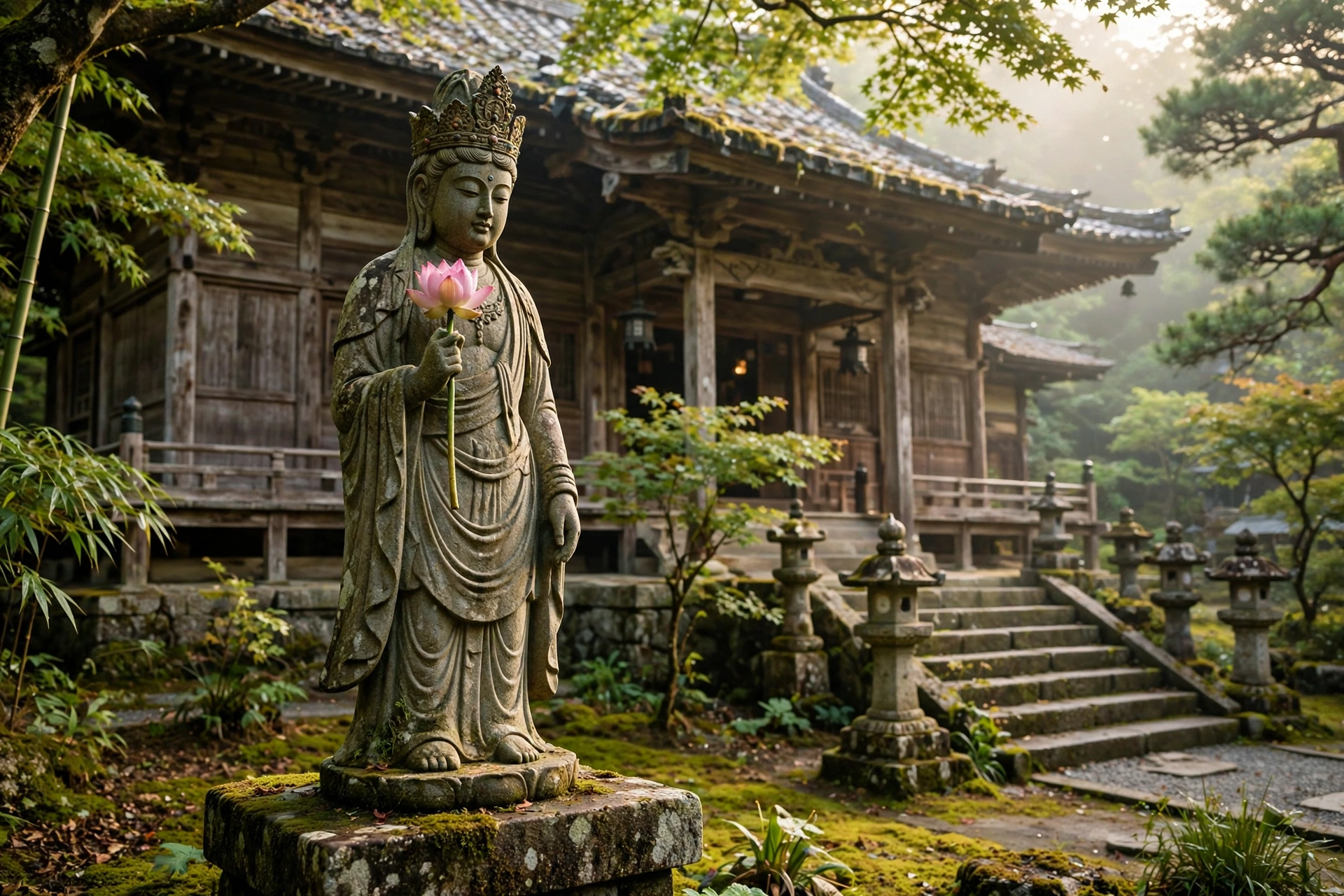
The result first: Buddhist statues are not all doing the same job.
- Bosatsu reach out a hand. Kannon and Thousand-Armed Kannon answer suffering now, Jizo answers those who have died, and Miroku holds a promise for the far future
- Myoo stop you, even by scolding. The angry face of Fudo Myoo is not a face that is simply angry. It is a face that is stopping you in earnest
- Tenbu guard the gate. The Four Heavenly Kings and Bishamonten guard the place itself, Benzaiten and Kisshoten receive the wishes of daily life, and Ashura is a statue that itself became the form of a prayer for a mother who had died
If you keep those three roles in mind, a crowded hall of statues becomes much easier to read.
I am Kurashiki Bouzu (kurashiki-bouzu), born in 1971, a former funeral company owner who now lives in an old folk house in Kurashiki, Okayama, and works with Moka, my AI butler.
This is the second article in the series organizing knowledge about religions, “Basics of Buddhist Statues.” In the first article, Basics of Buddhist Statues — The Ranks of Nyorai, Bosatsu, Myoo and Tenbu, How to Tell Them Apart, and the Faces of the Nyorai, I looked at the system of “ranks” for Buddhist statues, how to tell them apart, and the line-up of the Nyorai, the highest rank. This article looks at the remaining three ranks — Bosatsu, Myoo and Tenbu — through their representative statues.
The measure is the same as in the first article: for each statue I add, briefly, the difference in its answer to “what happens when you die” — the thread of its view of life and death. The quick-reference table of ranks and the steps for telling statues apart are in the first article, so if you get lost, please go back there. The material is the record of “Knowledge of Religions” that I had Moka (my AI butler) assemble from published sources and organize. Difficult words are explained briefly on the spot.
Bosatsu — those who reach out a hand
Kannon Bosatsu
Formally, Kannonzeon Bosatsu. As the name says — “the one who sees the sounds of the world,” the cries of people who are suffering — this is the representative Bosatsu who saves through compassion. Kannon is said to appear by changing form in 33 ways, matching the form of the person who is suffering.
The “Six Kannon,” divided by differences of form, are the basic line-up of the Kannon you will meet at temples.
- Sho Kannon: the basic form
- Thousand-Armed Kannon (Senju Kannon): taken up in the next section
- Bato Kannon: guardian of animals
- Juichimen Kannon: the form with 11 faces on top of the head. The main image of Hasedera (Nara) is famous
- Juntei Kannon
- Nyoirin Kannon: the form resting a cheek on a hand
The thread of the view of life and death is salvation from suffering in this present life. Kannon is a Bosatsu concerned less with “what happens when you die” and more with “what to do about the person who is suffering now.” At the same time, as an attendant to Amida, Kannon also joins the welcoming at the moment of death, so Kannon stands on the boundary between the side that lives and the side that dies.
Thousand-Armed Kannon (Senju Kannon)
One of Kannon’s transformed forms. With a thousand hands, and an eye in the palm of each hand, this is the form of a vow to save people who suffer without overlooking a single one, without letting a single one slip through. One hand is said to save 25 worlds, and by the calculation 25 × 40 = 1000, the hands are often represented as 42 arms in total: 2 main arms and 40 side arms. If you actually started counting them, the day would end, but that very multitude of hands — the “number” itself — is the form of the prayer.
Among real statues, the line-up at Sanjusangendo (Rengeoin, Kyoto) is overwhelming. On the left and right of the central seated Thousand-Armed Kannon (Kamakura period, by Tankei, National Treasure) stand 1,000 standing Thousand-Armed Kannon, and together all 1,001 statues are National Treasures. It is passed down that “there is surely a face that resembles someone dear to you.”
The thread of the view of life and death is “leave no one behind.” The number one thousand is an answer, with a countless number of hands, to a countless amount of suffering. In the words of a funeral, I read it as a vow that leads to “a farewell that drops no one.”
Jizo Bosatsu
This is the Bosatsu who, in the long age without a Buddha — from after Shaka (the historical Buddha) died until Miroku Bosatsu appears — keeps touring the six worlds (the Six Paths, from the human world down to hell) and saving beings there. Jizo is represented in the form of a monk, holding a pilgrim’s staff (shakujo) in the right hand and a wish-granting jewel in the left. The exception to the “Bosatsu without ornaments” I wrote about earlier is this Jizo Bosatsu.
The form in daily life is the six Jizo by the roadside and the Mizuko Jizo in cemeteries, for children who died before birth or in early infancy. In the legend of Sai no Kawara, the riverbed in the afterlife, a child who died before the parents stacks stones on the riverbed, and even when a demon knocks them down, Jizo saves the child — that is how the story is told. Rather than in a single famous statue, the essence of Jizo is in the countless familiar statues close to everyday life.
The thread of the view of life and death is salvation of those who have died, and especially salvation of children. Jizo is a Bosatsu who placed, inside the scenery of daily life, the view that “even after death, there is a being who keeps coming round to save you.” As the receptacle for mizuko kuyo, memorial rites for children who died early, this is a faith that is still active today. In the practical work of funerals and memorials, Jizo can be called the Bosatsu closest to the cemetery.
Miroku Bosatsu
This is the Bosatsu who is promised to become the next Buddha after Shaka. Now Miroku waits in a heavenly world called Tosotsuten, training while time passes, and it is said that 5.67 billion years after Shaka entered nirvana, Miroku will appear in this world and save people as Miroku Nyorai. The staggering number of 5.67 billion years has a length that makes you want to compare it — how many times would the Earth have to turn?
The mark of the form is the Hanka Shii statue: one leg laid across the other knee, a finger rested against the cheek, lost in thought. Among real statues, the representative is the Miroku Bosatsu Hanka Shii statue at Koryuji (Uzumasa, Kyoto), carved from a single piece of red pine, and the statue that became No. 1 among sculptures designated as National Treasures in 1951 (commonly called the “Hokan Miroku”). In the same treasure hall stands, alongside it, a “Crying Miroku,” whose expression looks as if it is weeping.
The thread of the view of life and death is salvation in the future. Different both from Amida’s “if you die, you go to the Pure Land” and from Jizo’s “touring round to save you,” Miroku is a Bosatsu who gave form to the heart that “waits for a salvation that has not yet come.” It is a view of life and death in which the very promise — that a time of salvation will surely come in the distant future — becomes a support for living now.
Monju Bosatsu, Fugen Bosatsu and Seishi Bosatsu
I will introduce together three Bosatsu you meet as attendants (wakiji — statues placed on both sides of the main image).
- Monju Bosatsu: bears wisdom and rides a lion. The Monju Bosatsu Riding a Lion at Abe Monjuin (Nara) (National Treasure, 1203, by Kaikei) is the representative, and it is the source of the proverb “When three people gather, the wisdom of Monju.” Monju is also familiar in prayers for examinations and study
- Fugen Bosatsu: bears action (practice) and compassion, and rides a white elephant. Together with Monju, Fugen secures both sides of the Shaka Triad
- Seishi Bosatsu: attendant in the Amida Triad, paired with Kannon. Kannon bears compassion and Seishi bears the light of wisdom, and the two together guide the person at the moment of death to the Pure Land. The mark is said to be the water bottle (suibyo) attached to the crown on the head
Seen through the thread of the view of life and death, Monju and Fugen are “the two wheels on the road to enlightenment.” The arrangement is that without both wisdom (understanding) and action (doing), you cannot reach salvation — Bosatsu on the side that asks “how should you live,” rather than where you go after death. Seishi’s thread is “the wisdom on the welcoming side”: the form of the Pure Land teaching that a departure needs both feeling (compassion) and reason (wisdom).
Myoo — those who stop you, even by scolding
Fudo Myoo
The representative of the Myoo. It is said to be Dainichi Nyorai changed into an angry form in order to save those who do not follow the teaching. Fudo holds a sword in the right hand (to cut delusion and evil), a rope (kensaku, for pulling people up to save them) in the left, bears flames on the back, and sits on a rock.
Among real statues, one of the group in the three-dimensional mandala in the lecture hall of Toji (Kyoto) is well known, and in popular faith the Fudo Myoo of Naritasan Shinshoji (Chiba) is widely known. Fudo is also the main image of the goma, the prayer in which a fire is burned.
The thread of the view of life and death is the power to cut delusion away. That angry face is not a face that is “angry.” It is a face that is “stopping you in earnest.” Against anxiety at the time of death and the wavering of those who are left behind, Fudo has also been placed near the scene of funerals, as a being who shows where to set an “unmoving” heart — fudo means “immovable.”
The Five Great Myoo, and Aizen and Kujaku
The Five Great Myoo are five figures with Fudo Myoo at the center: Gosanze Myoo (east), Gundari Myoo (south), Daiitoku Myoo (west) and Kongo Yasha Myoo (north), in the form that guards the four directions and the center. They remain together in the three-dimensional mandala in the lecture hall of Toji.
I will add a one-line introduction for just two more. Aizen Myoo is the Myoo who turns desire itself into a power toward enlightenment, and Aizen also became linked with prayers for matchmaking. Kujaku Myoo, the Peacock Myoo, layered over the peacock that eats poisonous creatures, is the Myoo who drives away disaster and poison, and among the Myoo Kujaku has a gentle expression.
The thread of the view of life and death is the arrangement of protection. The form of guarding by direction is a sign of the way of thinking that purifies a place and guards it, and it also leads to the idea of preparing the place of a funeral.
Tenbu — those who guard the gate
The Four Heavenly Kings and Bishamonten
The Four Heavenly Kings are Tenbu in the form of military commanders who guard the four sides of Mount Sumeru, the mountain at the center of the world. Jikokuten (east), Zochoten (south), Komokuten (west) and Tamonten (north). The usual form wears armor and tramples an evil demon (jaki) underfoot.
Among real statues, the Four Heavenly Kings in the Kondo of Horyuji are said to be the oldest Four Heavenly Kings remaining in Japan (Asuka period), and the Four Heavenly Kings of the Kaidanin at Todaiji (Tempyo period, National Treasure) are known as a realistic masterpiece.
Tamonten, on his own, is worshipped under the name “Bishamonten” and is also counted as one of the Seven Lucky Gods. As a god of wealth and of contests, Shigisan Chogosonshiji (Nara) and Kuramadera (Kyoto), among others, are famous.
The thread of the view of life and death is beings who guard the place. The Four Heavenly Kings are not there for the salvation of an individual. Their role is to guard the Buddha’s teaching and the place itself, and they stand in the position of securing the outside of a temple gate, a hall, and also the place of a funeral.
Benzaiten, Kisshoten, Taishakuten and Bonten
I will line up, in one line each, the Tenbu who bear the wishes of daily life.
- Benzaiten: in the form of a goddess who bears water, music, eloquence and wealth, holding a biwa lute, and one of the Seven Lucky Gods. As the three great Benzaiten, Itsukushima Shrine (Hiroshima), Hogenji on Chikubushima (Shiga) and Enoshima Shrine (Kanagawa) are known. Benzaiten was originally an Indian river goddess, and is also a god of words and learning
- Kisshoten: goddess of good fortune and abundance. The Kisshoten statue in the Kondo of Horyuji (Tempyo period, National Treasure) is famous
- Taishakuten: originally an Indian thunder god, and in Buddhism the role of guarding Shaka as lord of the heavenly world. The faith of Shibamata Taishakuten (Tokyo) is widely known among the people
- Bonten: alongside Taishakuten, you meet Bonten in the form of an attendant beside Shaka, or in the form of the Two Heavens (Niten) guarding a gate
The thread of the view of life and death is the receptacle for the wishes of daily life. The Tenbu are the layer that bears not salvation after death but “the wishes of life now” — wealth, words, abundance — and they are a sign that people’s prayers do not fit inside a view of life and death alone.
Ashura
Originally a god who loved battle, and the story is told that Ashura fought with Taishakuten. In Buddhism, Ashura was placed on the guarding side, as one of the “Eight Classes” (Hachibushu), the eight guardians who protect the Buddha’s teaching. The usual form has three faces and six arms.
Among real statues, the Ashura statue at Kofukuji (Nara) (National Treasure) is overwhelmingly famous. In Tenpyo 6 (734), it was one of a group of statues that Empress Komyo had made for the memorial (tsuizen — a memorial service for the deceased) of her mother, Tachibana no Michiyo, who had died. The statue is 153.4 centimeters high and is now displayed in the Kofukuji National Treasure Hall. It is known for a quiet, youthful expression, and for the statue of a god of battle it has an exceptional gentleness.
The thread of the view of life and death is the statue itself, made for a memorial. A daughter’s prayer, thinking of her late mother, became a form. The other thread is that “the god of battle moved to the guarding side.” It overlaps with the Buddhist view that the heart of anger and strife, too, can be changed into a power that protects, rather than being thrown away.
The Twelve Divine Generals and the Twenty-Eight Attendants
Finally, I will place in one line each two groups of attendants (kenzoku — companions who serve a Buddha).
- The Twelve Divine Generals (Juni Shinsho): attendants in the form of 12 military commanders who guard Yakushi Nyorai. Later they became linked with the zodiac (the twelve signs), and a faith was also born in which people made the general of their own zodiac sign their guardian main image. The standing Twelve Divine Generals at Shin-Yakushiji (Nara) (Tempyo period, National Treasure) are a masterpiece that remains as a complete set
- The Twenty-Eight Attendants (Nijuhachi Bushu): 28 attendants who serve Thousand-Armed Kannon. The gods of the Tenbu, Ashura, and the Wind God and Thunder God are also counted among their members. The Twenty-Eight Attendants of Sanjusangendo (National Treasure), and the Wind God and Thunder God statues at both ends (National Treasure), are the representatives
The thread of the view of life and death is the layer of those who serve. The form in which “those who guard and those who serve” are placed in many layers around a Buddha overlaps with the form, at the place where a person who has died is sent off, in which many hands gather around the center — the deceased person.
Summary of the second article
- The Bosatsu are “those who reach out a hand.” Kannon and Thousand-Armed Kannon bear the suffering of now, Jizo bears salvation after death, Miroku bears salvation in the future, and Monju, Fugen and Seishi support from beside the main image
- The Myoo are “those who stop you, even by scolding.” The angry face of Fudo Myoo is not a face that is angry. It is a face that is stopping you in earnest
- The Tenbu are “those who guard the gate.” The Four Heavenly Kings and Bishamonten guard the place, Benzaiten and Kisshoten receive the wishes of daily life, and there are also statues, like Ashura, in which a prayer for a memorial took form
In the third article, I will set aside memorizing names for a while, line up again the statues you actually meet in daily life — such as the six Jizo by the roadside and the Mizuko Jizo in cemeteries — and gather the answer to “what happens when you die” for each statue in one place.
A note on this article
- 2026-11-18: English draft created (ledger No. 913). A results-first rewrite of the Japanese article (ledger No. 212, 5,204 characters), not a literal translation. Numbers, proper nouns and dates are unchanged from the Japanese original. The thread of “what happens when you die” for each statue, the internal links to the first article (/blog/2026-11-18-butsuzo-kiso/) and to the third article (/blog/2026-11-18-butsuzo-kurashi/), and the structure of Bosatsu, Myoo and Tenbu are kept as in the original. The material is the canonical “Knowledge of Religions” record, Chapter 9, “Basics of Buddhist Statues,” and was not remade twice.
- Publication note for this English version: this article is not in the three central groups for simultaneous Japanese–English publication (Moka-related, internet-related, picture books). Under the house rule, publication of this English version is to be after the AdSense review. This file is a draft only (draft: true) and has not been published or sent to git.
- November 18, 2026 ― English draft created (ledger No. 913; results-first rewrite of the Japanese article, ledger No. 212). Not published. This article is not in the three central groups for simultaneous English publication (Moka-related, internet-related, picture books), so publication of this English version is to be after the AdSense review, in line with the house rule.(14,480 characters)