
Tokyo Hakuzen in the East, Koekisha in the West — Who Created the 'Form' of the Funeral?
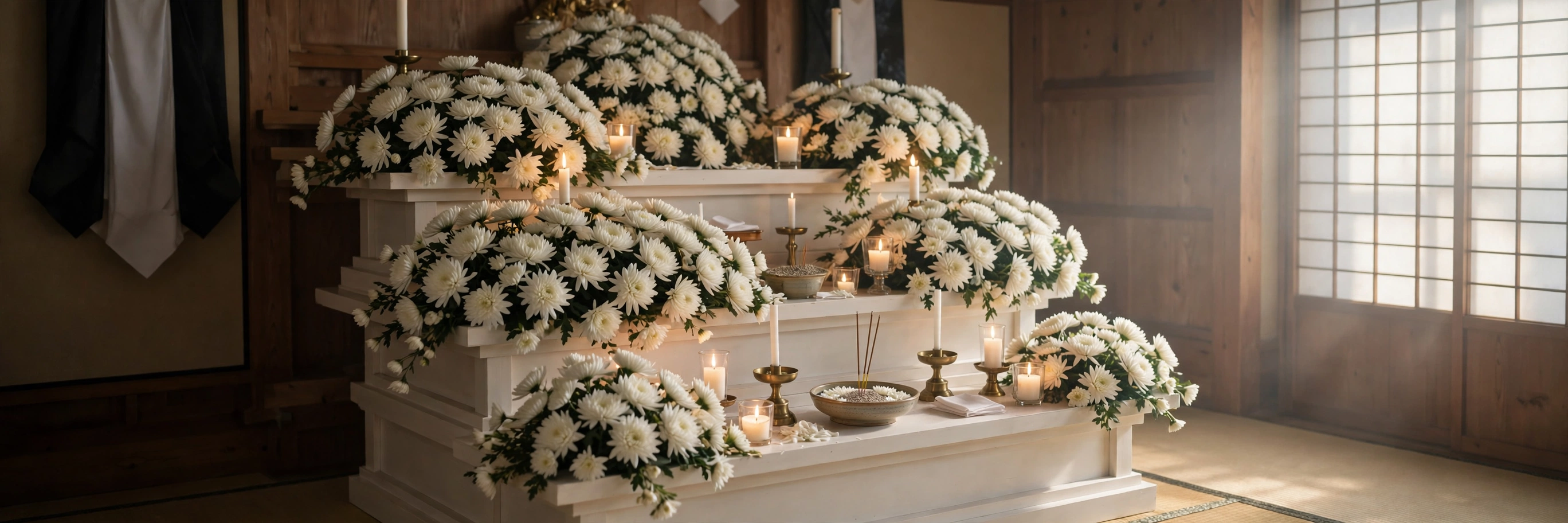
The result first: the law does not tell you to hold a wake or decorate an altar. It decides only that you cannot cremate for 24 hours after death, and that cremation needs a mayor’s permission. The “form” of a funeral — white-wood altar, white flowers, portrait photo in the center, white curtains, palace-style hearse — was not born naturally. It was made, on the side of the funeral industry I was in. Tokyo Hakuzen made cremation into a modern facility’s work; Koekisha made funerals into products, with catalogs, advertising, and explicit prices, and set the measure of “splendidness.” The signs “Koeki (public benefit)” and “Koei (public management)” also borrowed the character for “public” to create trust. Because people made the form, we can choose it again now.
I am Kurashiki Bouzu (kurashiki-bouzu), born in 1971, a former funeral worker and former funeral home owner. I now live in an old folk house in Kurashiki, Okayama Prefecture, and work with Moka, my AI butler.
When you hear “funeral,” I think there is an image you picture. A white-wood altar, white flowers, a portrait photo decorated in the center, a hall covered with pure white curtains, a palace-style hearse.
Then, who decided that “form”?
In fact, what the law decides is only up to cremation and burial procedures. That you cannot cremate for 24 hours after death, that cremation requires permission from a municipal mayor. No law says hold a wake, decorate an altar.
In other words, the “form” of a funeral was not born naturally, but was made by someone. Those who made it were on the side of the funeral industry where I was.
Originally, a funeral was a community’s joint work. Precisely because it was an extraordinary event, the whole neighborhood turned out. Men made funeral implements or stood at reception. Women cooked and served attendees. In some regions, after the funeral sukiyaki and such were served. That meat, too, was not four-legged cow or pig, deer or boar, but two-legged chicken. I heard it was because Buddhist teaching avoided beef, or because for a sudden event there was no time to go get deer or boar, and the bereaved family slaughtered chickens they kept at home and served them to those who helped, and that continued. Sending off the deceased was the work of the whole region. A funeral home was something that took over that work, one by one, from the region’s hands.
Tokyo Hakuzen in the East — Changed Cremation into “a Facility’s Work”
In the industry there is a saying, “Tokyo Hakuzen in the east, Koekisha in the west.”
Tokyo Hakuzen in the east is a crematorium company. According to the company’s official history, it began in 1887 (Meiji 20), when it opened a Western-style crematorium with a red-brick furnace and chimney in Nippori, Tokyo. It developed a furnace for a sleeping coffin (a coffin you enter lying down), but no one wanted to use it, and founder Sohei Kimura himself became the first user — that story remains. In Machiya, it also built Japan’s first gas cremation furnace.
Until then cremation was something done quietly in a corner of a temple. This company changed it into the work of a modern facility run by a company.
About hearses, too, it is spoken of in the industry as a pioneer of introduction. However, about “Japan’s first,” there are various theories, such as a theory that an Osaka provider imported one from America in 1917. Here, I will honestly write “various theories exist.”
Koekisha in the West — Made Funerals into “Products”
Koekisha in the west was born in 1932 (Showa 7) in Kitahama, Osaka. It was a land where large financial and securities companies gathered, and a time when funeral work itself had not yet solidified as a business.
This company’s turning point was assembling funerals as “products.” It advertised in an industry that had no idea of customer attraction or publicity, made funeral catalogs from soon after founding, and showed prices explicitly. By incorporating photography into that catalog set, portrait photos became established as indispensable to funerals, industry records say. The Senri Hall in 1971 is also said to be a pioneer of a modern funeral center.
I have not been able to confirm that this one company invented the altar itself. The altar grew in the Taisho period as funeral processions declined and home funerals spread, and in the 1950s wholesalers spread it nationwide as a set — that is the flow materials describe.
However, putting it in a catalog, attaching a price, and finishing it into a form sold as a set was undoubtedly on the funeral home side. The measure of a funeral’s “splendidness” was thus offered from the product side.
And this “way of selling” itself has become the prototype of the current funeral home sales style. Pre-consultation to gather customers before death, a system to have them become members, guidance to have them see a splendid hall, fixed plans and explicit prices. This progression, which now looks normal, originally came from this company’s idea of making funerals into products with advertising and catalogs. Large companies, small companies, and new companies gathering customers online, even if the form is smaller, inherit this prototype of sales.
The Characters on the Sign — The Invention of “Koeki” and “Koei”
There was another common device among funeral homes of this era. Company names.
Look at the characters “Koeki” (public benefit). Public interest corporations, public works, a government office window. Even if a private company calls itself that, the impression of a “public place” remains for those who hear it. In an era when the only means to investigate were a phone book and word of mouth, that impression became trust as it was.
In fact, tracing Koekisha’s history, there is a record that in 1941 it merged companies called Kita Koekisha and Minami Koekisha. Even within Osaka alone, there were multiple companies calling themselves “Koeki.” In 1943, under wartime national policy, Osaka’s hearse transport providers were integrated, and the name of the company born was, itself, “Koeisha” (public management company) (renamed to Koekisha in 1945). Even now in Shinjuku, Tokyo, there is a funeral home called “Koeisha” of a separate line from Osaka.
In Kansai, I heard there were also many companies where a person who trained at Koeki returned to their hometown, became independent, and called themselves “XX Koeki.” In an era when the phone book was the entrance for orders, there were also near-miss mistakes to similarly named companies — work coming in by a customer’s near miss — that is the talk on the floor. About Koekisha’s origin, too, I heard in the industry a story that it began when a head clerk of Kyoto’s Koekisha was given a noren (a branch with the same trade name). It is a story that does not appear in the official history, so I will place this as “industry talk.”
Names, too, were part of the form. Borrowing the character for “public” to create reassurance and rank. That, too, was one of the funeral images funeral homes made.
People Called “Sorenya” (Funeral Arrangers)
There is one more thing we must not forget. People of the generation before us were called “sorenya.” It means people who purify the deceased and place them in a coffin. Even though there should be no high or low in work, work that touches death was looked down on for a long time. That calling them “funeral shop” was avoided and restated as “funeral company” is also said to be a remnant of that.
There were also people who dared to continue calling themselves by that name “sorenya” as pride. A man born in Osaka named Kosuke Tsujii, who met this work at 53, and in the 25 years until retiring at 78, was involved in more than 3,000 send-offs. He also experienced the Great Hanshin-Awaji Earthquake on the floor, and left that record in a book called Sorenya Shunju. There was a senior who took on a name that had been looked down on himself and made it his sign.
So in splendid halls, company-like names, and the character for “public” in “Koeki” and “Koei,” was there not also a wish, beyond showing to customers, to recover for themselves the dignity of work that had been despised? That is what I think.
From “Sorenya” to “Okuribito” (Sender)
Time progressed, and in 1994 Koekisha listed its stock, the first for the funeral industry. Eventually, when the myth that “banks do not fail” collapsed and failures followed in an era, the stability of this work, where people’s deaths do not decrease even in a recession, was re-evaluated, and young people entering funeral homes as new graduates ceased to be rare. Work once called “sorenya” and looked down on had become work chosen as a “stable company.”
Time progressed further, a book written by an encoffiner came to be featured on television, and in 2008 the film “Okuribito” (Departures) called forth great reputation. After this film, which even received an Academy Award, when preparing encoffining on the floor, it increased that customers would call out “It is just like the film, isn’t it.” Work called “sorenya” became work called “okuribito” and admired. The history of names was, as it was, the history of this work’s dignity.
And now, it is an era where even a large retailer like Aeon handles funerals. “Aeon’s Funeral,” which began in 2009, was not Aeon itself performing it, but a system to guide with fixed-price plans and its own quality standards in partnership with funeral homes nationwide. In other words, it is a form where local funeral homes do work matching a measure made by a company outside the industry. Work of craftsmen called “sorenya” became work of people employed by a company, and eventually became a product lined up on a mass retailer’s shelf as well.
Why Was It Accepted? — The Soil of Vanity and Formality
Of course, just making it does not spread it. There was soil on the receiving side.
In the first place, the form of a funeral is not uniform nationwide. In regions from Kanto to the north, there are lands where cremation is finished first, and then a funeral is held with the bones placed on an altar. It is a form called “pre-cremation” or “bone funeral,” and remains now in Yamagata, Miyagi, Akita, and others in Tohoku. Saying farewell in front of a coffin is not the only normal. That form is made not by law but by land and era can be seen from here, too.
The interest of the funeral business is here. Like real estate, it cannot be fitted into the same type everywhere in the country and “lumped together.” Because what is being sold is the region’s customs themselves. Having made customs that differ by land into business, the form cannot be unified. Even if a large company spread nationwide, in the end it had no choice but to match that land’s customs.
On top of that, in my view, the soil that accepted a large altar is the temperament of Keihan (Kyoto-Osaka). A character that stretches vanity and values formality. From Meiji to Showa, the era that “sending off splendidly is that house’s dignity” continued for a long time. With an altar smaller than the neighboring house, social standing would not hold. In a society with the region’s eyes, the altar’s splendidness was proof of that house’s rank.
The form the selling side made, and the buying side’s vanity. These two meshed, and an era where a “large funeral” was normal was made.
Great Change — The Side That Made It Has Begun to Fold It Up
And now, that normal is collapsing.
In the COVID period, you could not say farewell to an infected deceased, and prompt cremation was required. Deaths of famous people were also reported widely. In Ken Shimura’s case, after hospitalization his family could not visit, and after death, meeting face to face and attending cremation also did not come true. Many people will remember his real older brother’s words, “When he came home, my younger brother had become bones.” Even a person loved by so many people had no choice but to return as bones. That figure spread to society as a whole the real feeling that “a farewell can happen in this form, too.”
Some of you may recall. In that period, you could not go to meet at a hospital, and could not attend a funeral. Not a few people had a farewell with their own family or a close person that was like that.
Ironically, consumers, through that experience, learned that “you can do without formal altars and decorations” and “rather, it is easier.” A mental threshold once lowered does not return to its original.
Let me write this so there is no misunderstanding. It is not a story that the ceremony itself is unnecessary. A wake where a temple priest officiates, as a wake ceremony, is an act meaningful in itself. What people learned in that period was that what was unnecessary was not the ceremony, but the “form” of altars and decorations.
Change on the funeral home side is also progressing. Now I have seen many figures of mid-sized companies bringing in the same consulting company, making similar manuals, and doing similar new-employee education. In an industry that should have made regional customs into business, responses and progression are being aligned into the same form everywhere in the country. Regional customs could not be unified, yet companies are being unified. A slightly ironic story.
There was a period when, in the funeral director examination, responses with customers became examination content. Seeing those responses, honestly, I was dumbfounded by the low level at times. The type of response can be taught by a manual. But the power to receive the feelings behind a bereaved family’s words cannot be raised by a manual.
When I talk with people from other companies, I often heard the words, “A funeral is a one-off job.” I asked back why. If you include pre-consultation, pickup, meeting, setup, ceremony progression, memorial services after that, and collection, I think the association with a customer is rather long. The answer that returned was, “Because each task has its own person in charge, I accompany at the crematorium and do up to collecting the bones.” I could only answer “Ah…” The more finely you divide work, the more, in each person’s eyes, that work looks “one-off.”
If that happens, you end up working without knowing the deceased’s face or the bereaved family’s face. It is recognition only by a name tag and a case name, “For the XX family, Mr./Ms. XX.” The soil where a mistake like mixing up bodies occurs is in such a place, I thought.
Symbolic is the movement of the side that made it. That Tokyo Hakuzen is reported to be partitioning large halls to increase small rooms, and remaking facilities to match family funerals. In an era where regional eyes have thinned, families have become smaller, and lack of burden is chosen over dignity, the soil changed first.
In other words, from Meiji to the latter half of Showa, a funeral was something “extraordinary.” A special act to send off with the whole region. Crossing Heisei to Reiwa now, a funeral has become “part of daily life.” Quietly send off, within the continuation of family life. That is the current form.
The form of a funeral was not made by law. It was made by people. That is why, now, we should be able to choose it again ourselves.
What is truly needed for the deceased and the family? I hope this history becomes material to think about that.
Finally, just one thing. I think funeral work was originally something inherited not by a manual, but by spelling out words and figures. Learn by seeing a senior’s words and the figure of their back. That was the original way this work was transmitted.
About Sources
- Tokyo Hakuzen’s founding and crematorium history: Tokyo Hakuzen Co., Ltd. Official Site “History of Tokyo Hakuzen”
- Koekisha’s founding, catalog, Senri Hall, merger and Koeisha history: Sun Holdings Co., Ltd. Official Site “History,” Koekisha Co., Ltd. Official Site
- Tokyo Hakuzen’s hall downsizing: according to a report by Bunshun Online (2025)
- Circumstances that Ken Shimura’s bereaved family could neither meet face to face nor attend cremation: according to reports at the time (Sports Hochi, Sankei Shimbun, and others)
- Spread of altars (home funerals in the Taisho period, set-ization by wholesalers in the 1950s): according to general organization in academic and industry materials on funeral history
- Regions of pre-cremation and bone funerals (Tohoku, etc.): according to regional funeral explanations by funeral companies
- History that the calling “funeral shop” has been avoided: according to So Hienya “Funeral Basics Lecture: ‘Funeral Service Industry’ or ‘Funeral Industry’?” (Soken)
- Start time and partnership system of “Aeon’s Funeral”: according to published materials of Aeon Life Co., Ltd. and reports at the time
- Japan’s first hearse has various theories (such as a theory that an Osaka provider imported one from the US in 1917). Portions marked in the text as “industry talk” and “my view” are not official records, but the experience and opinion of Kurashiki Bouzu, a former funeral home owner.
- November 18, 2026 ― English draft created (results-first rewrite of the Japanese article, ledger No. 23). Not published; publication is a separate step.(14,060 characters)